
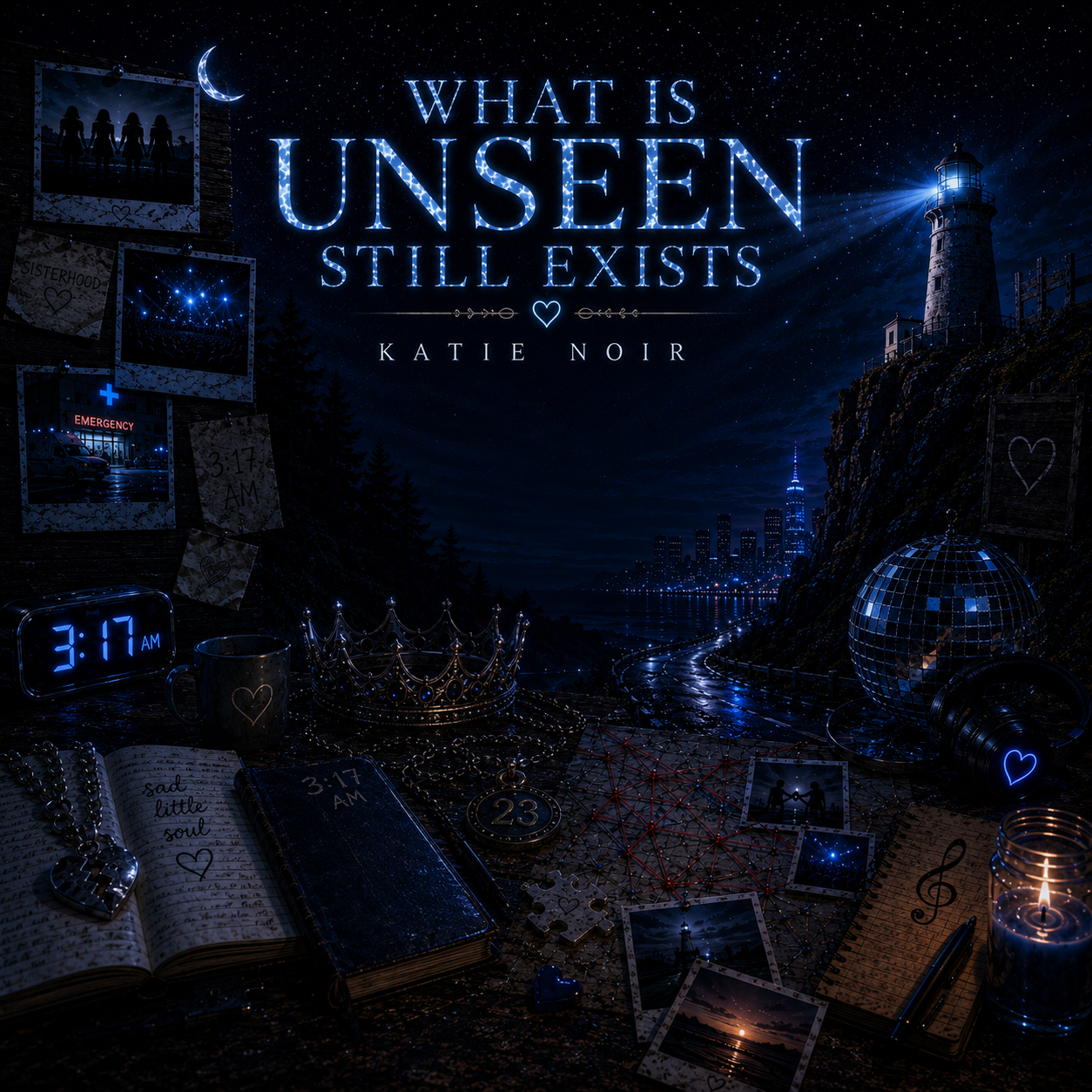
Some debut albums introduce an artist; others introduce a way of thinking. Katie Noir’s What Is Unseen Still Exists is well and truly in the latter camp. It is an ambitious concept album with 23 linked pieces, examining themes of friendship, loneliness, identity, regret, purpose, hope, and the nuanced emotional landscapes often invisible to anyone but the person experiencing them. Instead, Noir has created a sonic universe in which alternative pop, dream pop, electronic music, R&B, hip-hop, dance music, and spoken-word storytelling all coexist in a remarkably fluid state. It’s less a playlist, more an emotional diary, carefully sequenced, with each chapter feeding into a larger narrative of self-discovery. What gives the album an edge is that it was born not as a commercial venture but as a profoundly personal apology to her best friends. The origin adds weight to every lyric, transforming the record from a collection of songs into an act of vulnerability that, over time, becomes deeply universal. By the time the album ends, it’s evident that What Is Unseen Still Exists is not merely documenting emotional experiences but clutching onto them, demonstrating that the unseen is as real as the spoken.
This emotional philosophy is palpable throughout the production of the album with impressive restraint. Katie Noir believes in space, subtlety, and atmosphere rather than chasing the most extreme pop sounds or packing every second of a track with intricate sonic embellishments. Synths float, rhythms burn slow, textures are airy, and electronic layers are sculpted with care, evoking a dreamlike space where every song seems to hang between memory and imagination. The arrangements do not rush to dramatic climaxes but unfold patiently, giving the listener the opportunity to inhabit each emotional moment fully before moving on. The silence is an instrument in itself, the purposeful gaps almost as emotionally charged as the melodies that frame them. Noir’s voice is a perfect match for this stripped-down production style. Fragile but confident, intimate but emotionally articulate, she never oversings or tries for unnecessary vocal acrobatics. Instead, she takes the emotional center of every composition with a quiet sincerity, delivering performances that seem conversational rather than performative. Her delivery feels real, as if she’s reading from her journal at 3 AM rather than performing pop songs, so the listener feels less like an audience member and more like a trusted confidant. That restraint is one of the album’s biggest strengths, though; nothing is overblown or artificially heightened. Each confession is free to breathe in its own terms, in an atmosphere where vulnerability is an act of quiet courage, not dramatic spectacle.
Among the album’s greatest achievements is its remarkable thematic cohesion across such an expansive tracklist. 23 cuts could easily have become repetitive or lost focus in lesser hands, but Noir uses recurring lyrical motifs, emotional callbacks, symbolic imagery, and carefully thought-out sequencing to create an experience that constantly changes course without losing its narrative thread. The album explores familiar themes of invisibility, memory, self-esteem, and personal transformation but in slightly different guises, mirroring the cyclical nature of emotional development itself. The number twenty-three is repeated in significant ways and also reinforces the conceptual identity of the project, acting almost as a secret architectural frame on which is supported the whole record. Songs are never solitary. Instead, they bounce off each other, and new meanings develop as listeners delve deeper into the album. The early moments of uncertainty that are introduced gradually find resolution through the later tracks, while emotional questions often receive answers only after considerable patience. The narrative here is woven together in such a way that attentive listeners will find it rewarding to listen to the record repeatedly as they begin to notice lyrical links that they hadn’t heard before. Katie Noir is accepting of the messiness of it all, not providing neat, simple solutions and leaving contradictions, questions, and unresolved feelings lying around because that’s how real life often is.
“Only Us” is one of the most exciting artistic statements on the album, largely due to the tremendous contrast of sound and subject matter. The song is driven by an infectious dance-pop production, full of kinetic energy, yet contemplating deep existential questions of meaning, connection, and presence. There is no philosophical reflection weighing down Noir’s music. Instead, his music is a fascinating juxtaposition of infectious rhythms and deeply introspective lyricism. A pulsing electronic production strips away the distractions and reaches a simple yet powerful conclusion: the importance of real human connection over abstract pursuits of perfection or purpose. It’s an extraordinary balancing act few contemporary pop artists manage to pull off as well. The album also breezes from dream pop to alternative R&B to electronic minimalism to spoken-word passages to atmospheric pop without feeling at all stylistically disjointed. Every change of genre appears to be motivated by emotional need, rather than arbitrary experimentation. It’s the mark of an artist more interested in honest expression than commercial predictability, and it makes for a listening experience that surprises even as it stays coherent.
Katie Noir’s songwriting maturity is something that sets What Is Unseen Still Exists apart from many emotionally based pop releases. At twenty-one, she writes with a striking emotional intelligence, steering clear of easy answers and offering instead subtle insights into relationships, identity, forgiveness, and the way we view ourselves. Her lyrics are seldom obvious metaphors or predictable heartbreak clichés. No, they are the silent emotional undercurrents that are so often missed—the guilt that lingers when words are misunderstood, the heaviness of loneliness when you’re surrounded by people, the way in which memory warps and twists with time. Even when Noir gets into the most personal of experiences, she’s able to avoid the trap of self-indulgence because her reflections somehow make listeners recognize aspects of their own lives in her stories. She plays with so much emotional complexity that it feels so human. She does not come across as someone who has figured out life’s uncertainties but rather as someone who is learning to live with them. That honesty adds a remarkable emotional credibility to the album. She is not an authority but a fellow traveler, trying to find her way in the midst of the uncertainty with her audience.
Musically, the album is a great display of balance. The production is electronic all the way but never drowns the emotional storytelling, which is the basis of the record. When the mood calls for intimacy, the beats are subtle and restrained, and they grow organically when there is a need for more energy. The synths shimmer without being excessive, and the subtle R&B influences give a warm, human touch to the electronic setting. The spoken-word passages don’t interrupt the flow of music but add narrative texture, moments of reflection between peaks of emotion. There is also something special about the pacing of the album. The length is considerable, but rarely taxing, as Noir is careful to balance introspective moments with songs of brighter rhythmic drive. This dynamic sequencing avoids the monotony of emotion, and still the conceptual narrative plays itself out naturally. It is a production in which all the choices seem to be made in order to promote emotional communication over technical exhibitionism. No unnecessary complexity, no overlayering to show off studio sophistication. Instead, every sound is there because it’s a meaningful part of the album’s emotional architecture, a reflection of a creative vision that prizes sincerity over spectacle.
What Is Unseen Still Exists, notably, refuses to condescend to its audience. Katie Noir believes that people are capable of complex emotions, philosophical concepts, and interconnected storytelling without watering down her artistic vision for mass commercial appeal. The album is, in many ways, more akin to literary introspection than to modern pop songwriting. It’s an album to think about, not listen to; it asks the listener to not only listen to the songs but live in them. That might sound like a bold statement to make in comparison with existential writers like Albert Camus, but there is some truth to it. Noir’s work, like great philosophical literature, is not about grand statements of meaning but intimate human experiences. She understands the most profound questions of life are often posed in the mundane moments of vulnerability, not in great epiphanies. That intellectual curiosity is what keeps the listener emotionally connected because it’s based in honest personal storytelling. The album continues to remind us that unseen struggles are worthy of acknowledgment, that emotional complexity doesn’t need to be masked, and that connection often begins when someone picks honesty over perfection.
Ultimately, Katie Noir’s What Is Unseen Still Exists is one of the most remarkable debut albums to surface in some time because it does what is rarer and rarer in today’s pop music: it prizes emotional truth over commercial convenience. The twenty-three songs of Noir are masterfully woven together, creating a world where vulnerability is strength, silence is expression, and unseen experiences cannot be ignored. Her songwriting is great, her vocal performances nuanced, her production choices judicious, her vision conceptual. Her album is personal and universal. She isn’t merely chasing trends, but instead she is urging her listeners to slow down, contemplate, and rediscover the emotional depth that is often buried beneath the distractions of everyday life. It’s a stunning artistic debut by a young musician whose artistic confidence seems already well in place. If this debut is any indication of what’s to come from Katie Noir, she’s not just another exciting alternative pop artist but an exciting new voice capable of transforming deeply personal experiences into music that transcends her own story. Unseen Still Exists is an album not just to listen to but to live with, to come back to, to slowly understand more deeply each time you return to it.
For more information, follow Katie Noir
WEBSITE – SPOTIFY – SOUNDCLOUD – YOUTUBE – INSTAGRAM