
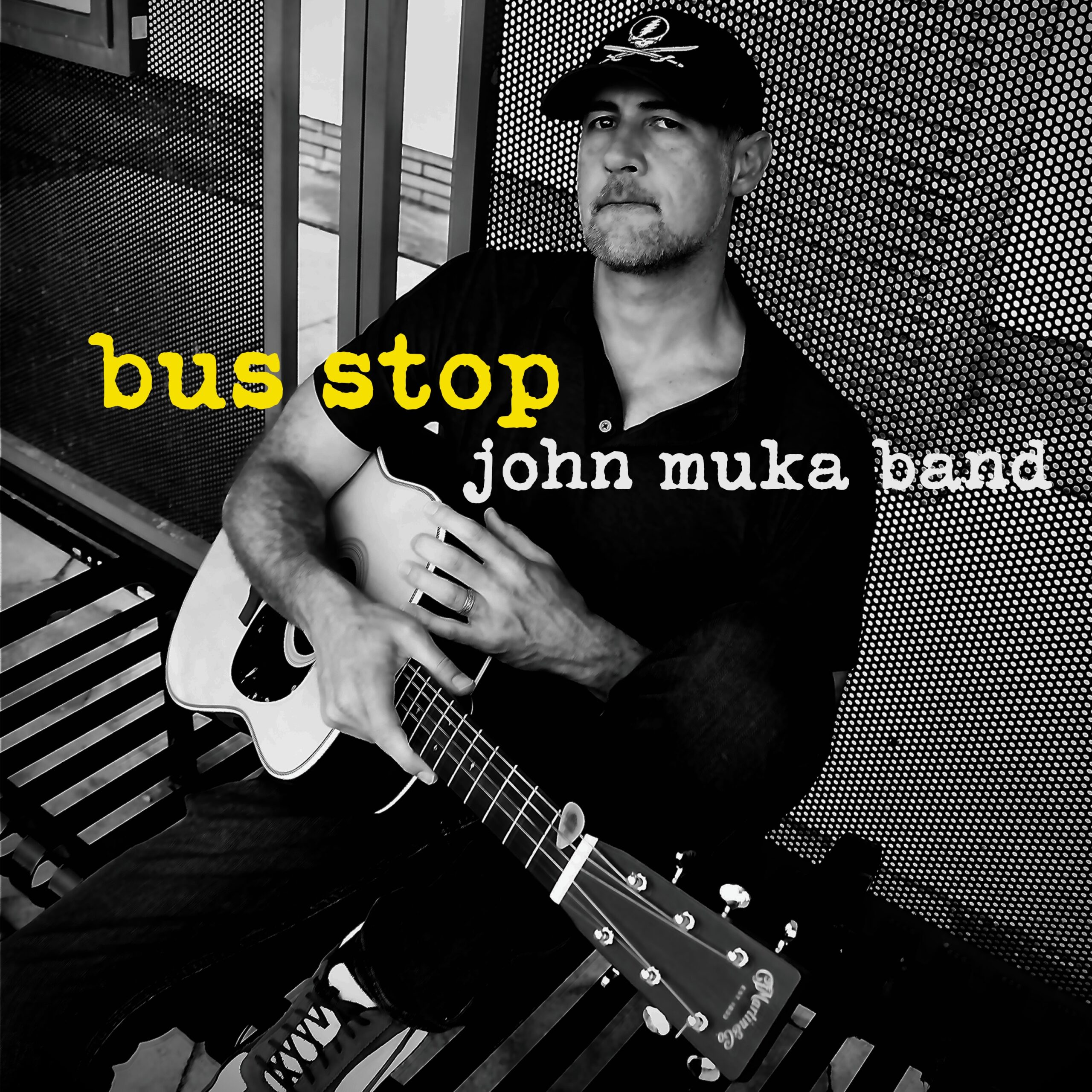
There is something inherently cinematic about waiting for a bus in the rain. It is an ordinary scene, almost invisible in the rush of everyday life, yet it can suddenly become a place where thoughts grow louder, memories surface, and the distance between people becomes impossible to ignore. John Muka Band’s “Bus Stop” understands that strange emotional territory and turns it into a beautifully atmospheric indie-rock experience. The Jacksonville-based collective, led by singer-songwriter John Muka, begins the track with the sound of thunder and rain, immediately placing the listener somewhere between physical landscape and psychological space. Rather than rushing toward a conventional rock opening, the arrangement takes its time, gradually building its world layer by layer. A steady groove eventually provides the track its heartbeat, while melodic lines, percussion, violin, and horn sections occupy the spaces around the vocals with remarkable sensitivity. The result is an unusually textured recording that feels spacious without ever becoming empty. There is a folk-jazz adjacency in the instrumentation, but the emotional center remains firmly within indie rock, creating a sound that is both grounded and dreamlike. From those first atmospheric seconds, “Bus Stop” feels less like a song simply beginning and more like a scene slowly coming into focus. The listener is standing under a dark sky, listening to the rain, waiting for something to arrive, and perhaps realizing that what they are really waiting for is not transportation at all.
The musical arrangement is one of the track’s great strengths because John Muka Band understands the value of restraint. The song does not throw every instrument at the listener immediately. Instead, the gradual build allows each sonic element room to establish its identity before becoming part of the larger picture. That straight, consistent groove provides stability beneath an arrangement that might otherwise feel elusive, and the melodic details add color without overwhelming the central vocal performance. The violin brings an expressive, almost aching quality to the soundscape, while the horns broaden the sonic horizon and impart the track a subtle grandeur. Percussion helps keep everything moving, but the production never feels cluttered. There is a wonderful sense of negative space throughout “Bus Stop,” allowing individual sounds to breathe and giving the vocals a clear position at the center. That clarity becomes particularly important because the lyrics are not merely decorative. Muka writes in images and fragments, using the bus stop, the radio, summer, rain, and the search for information as symbols for a deeper emotional condition. His voice carries the material with an unforced sincerity, while the layered contributions from Amy Hancock introduce another dimension to the performance. When the voices meet, the effect is not simply harmonic sweetness; it feels like two perspectives briefly occupying the same emotional space. That vocal interplay is central to the song’s theme. Connection is not something that exists in isolation, and hearing these voices intertwine lends the concept an almost physical presence.
There are familiar reference points in “Bus Stop,” but John Muka Band uses them as atmosphere rather than imitation. Certain passages may recall the reflective side of Red Hot Chili Peppers, particularly the emotional looseness and road-worn melancholy associated with songs such as “Road Trippin’,” “Scar Tissue,” and “Otherside.” There are also shades of Counting Crows in the way everyday imagery becomes a vehicle for introspection, turning seemingly simple observations into larger questions about life and belonging. Yet the band does not sound like it is chasing either influence. Instead, those echoes exist within a broader musical vocabulary that includes Americana, folk, jam traditions, soulful grooves, and indie rock. The result is a recording that feels organic rather than assembled. Every instrument seems to have a role in the emotional conversation, and the musicianship retains the warmth that comes from people actually interacting with one another in a room rather than simply stacking perfectly isolated sounds. That human quality matters enormously here. “Bus Stop” is ultimately concerned with the difference between being surrounded by communication and genuinely communicating with another person. Its instrumentation reflects that tension beautifully. There are many sounds in the mix, yet the song never loses its intimacy. The rain creates distance, the groove creates movement, the horns and violin expand the horizon, and the voices pull the listener back toward something personal. It is a sonic representation of looking for another human being in the middle of an increasingly noisy world.
What makes “Bus Stop” particularly compelling, however, is the history behind its central idea. Originally written in the early 2000s in the aftermath of 9/11, the song emerged from a period defined by uncertainty, fear, and an intensified awareness of how fragile ordinary life could be. More than two decades later, its questions have not become obsolete; if anything, they have become harder to ignore. We live in an era in which communication is constant, instantaneous, and almost impossible to escape, yet genuine connection can still feel remarkably difficult to find. A person can receive messages, notifications, headlines, social feeds, and endless digital conversation while remaining emotionally isolated. “Bus Stop” captures that contradiction without turning it into a lecture. Its dystopian atmosphere works because the track does not need to describe a specific future. It simply magnifies something already present: the unsettling feeling of being connected to everything except the people immediately around us. The song’s central question—where do we go when we need real connection? —therefore carries a weight that extends far beyond its original historical context. The fact that the composition was written after one of the defining moments of the early twenty-first century only deepens its resonance. Back then, people discovered in frightening circumstances how quickly strangers could reach beyond their normal boundaries. Today, the challenge may be almost the reverse: how do we recover that sense of shared humanity when technology gives us endless opportunities to interact but not necessarily to understand one another? “Bus Stop” does not pretend to solve that problem. Its power comes from asking the question honestly.

By the time “Bus Stop” settles into its full atmosphere, the song feels like the soundtrack to a place that exists somewhere between memory and warning. It is easy to imagine it underscoring a late-night sequence in True Detective, accompanying a lonely drive in The Leftovers, or drifting through the eerie, dreamlike spaces of Twin Peaks. That cinematic quality is not accidental; the arrangement continually suggests images without dictating precisely what those images should be. The rain can be literal or emotional. The road can be a route toward another destination or a metaphor for searching. The bus stop can be a place where people wait for transportation, or it can represent those moments in life when we pause and wonder whether anyone is really coming. John Muka Band allows all of these interpretations room to exist. Most importantly, the group avoids turning the song’s melancholy into despair. There is still movement in the groove, warmth in the guitar and vocals, richness in the harmonies, and a sense of possibility buried beneath the uncertainty. “Bus Stop” ultimately feels like a song about searching rather than surrendering. Its world may be rainy, disconnected, and occasionally dystopian, but the very act of asking where genuine connection can be found implies that the search is still worth making. John Muka Band has taken an old composition born from an anxious historical moment and allowed it to speak naturally to another anxious age, surrounding its message with expressive musicianship and an arrangement that rewards close listening. The final impression is haunting but not hopeless. Like standing beneath a shelter while rain falls across an empty street, “Bus Stop” leaves us listening for footsteps, watching the road, and wondering who might arrive next. In that waiting, the song finds something deeply human: the stubborn desire not merely to be heard, but to find someone willing to listen.
For more information, follow JOHN MUKA BAND
WEBSITE – FACEBOOK – SPOTIFY – YOUTUBE – INSTAGRAM