
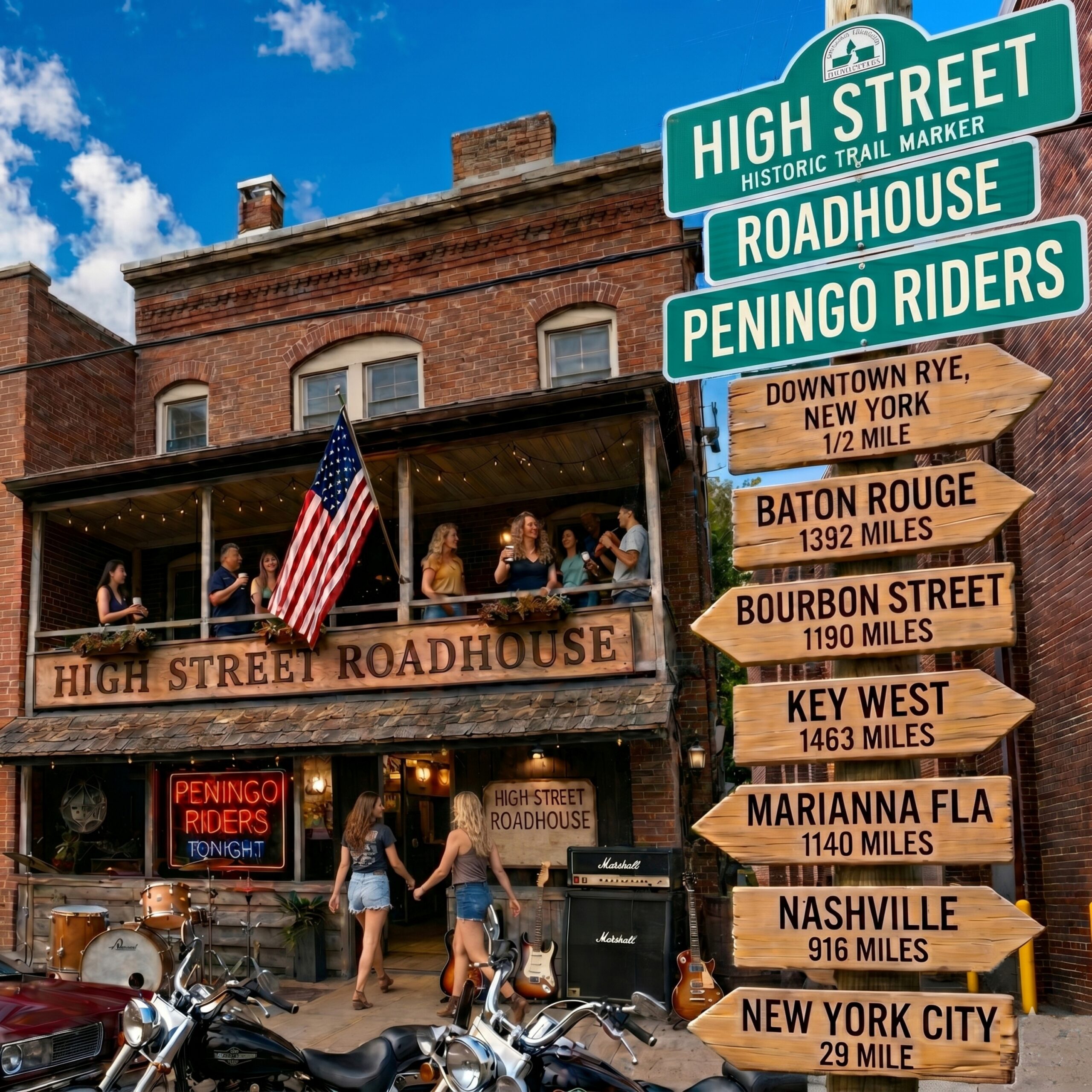
There are certain bars that feel less like businesses and more like pieces of local mythology, places whose names get mentioned in passing by people who know exactly what they are talking about and everyone else simply has to wonder. Peningo Riders’ “High Street Roadhouse” captures that feeling from the first turn of the wheel, delivering a swaggering, guitar-driven rock track that sounds as though it has just emerged from a smoky back room with a story it is not quite ready to tell. Released on August 7, the single takes its inspiration from the real-life Rye Roadhouse, formerly known as the High Street Roadhouse and, before that, Over the Bridge, transforming a tucked-away New York venue into the setting for a musical adventure filled with grit, mystery, heat, and attitude. Eddie Pellon and Russ Davis understand that a song about a place does not necessarily need to describe its walls, tables, or address in literal terms. Instead, they capture its atmosphere. “High Street Roadhouse” feels crowded without sounding claustrophobic, rowdy without losing its sense of control, and familiar in the way that the best neighborhood joints can feel familiar even to someone walking through the door for the first time. The Peningo Riders bring their Southern rock foundation into an environment where funk, Cajun flavor, and barroom rock can collide naturally, creating a sound that feels both regional and wonderfully difficult to pin down. There is a sense that anything could happen here. A guitarist might wander in, a stranger might have a secret, the kitchen might still be serving gumbo at an unreasonable hour, and the band certainly has no intention of slowing down. That sense of possibility becomes one of the track’s greatest strengths.
Musically, “High Street Roadhouse” thrives on contrast. The guitars carry the muscle, but they are not operating in isolation; they are surrounded by rhythmic movement and colorful textures that provide the song a character considerably broader than straightforward Southern rock. The Cajun influence introduces a touch of swampy heat, while the funk elements add a loose, physical pulse beneath the harder-edged guitar work. Then comes the baritone sax, smoky and substantial, providing precisely the kind of unexpected presence that makes the arrangement feel like a living room full of characters rather than a sterile studio construction. That saxophone seems tailor-made for the song’s environment, conjuring dim lights, late-night conversations, spilled drinks, and a band that knows the difference between playing loudly and playing with attitude. The driving drum crescendos help push everything forward, giving the track an engine that never seems content to idle. Against that rhythmic momentum, the blistering riffs provide the electricity. Peningo Riders are clearly interested in rock and roll as something physical, something that should move the listener rather than merely occupy the background. Yet there is enough stylistic color here to keep the experience from becoming predictable. The Louisiana-meets-New-York concept could easily have become a gimmick, but the music makes the geographical collision believable. Southern grit meets metropolitan edge; swamp atmosphere meets neighborhood-bar culture. Instead of choosing one identity, the song lets those worlds rub against each other until sparks fly. The result is a track with a distinctly American character, but one that feels less like a postcard and more like a night spent discovering a place whose appeal is difficult to explain once the sun comes up.
The mystery surrounding the Roadhouse also gives “High Street Roadhouse” an intriguing narrative dimension. The venue’s reputation as a hidden gem across the tracks, along with its connections to notable figures from the wider rock world, makes it the perfect subject for a song that wants to suggest more than it reveals. The Roadhouse has been associated with musicians and performers ranging from Warren Haynes to members of the Spin Doctors, Ace Frehley, and prominent Grateful Dead tribute acts, lending the location a pedigree that feels earned rather than manufactured. But Peningo Riders wisely do not turn the track into a roll call of famous names. Instead, those associations sit behind the song like the stories told by regulars after midnight: fragments of local history that make the place seem larger every time someone talks about it. That is where the track’s “backroom mystery” becomes particularly effective. You can almost imagine the characters lurking at the edges of the narrative: people who have been coming here for years and newcomers still trying to figure out what they’ve stumbled into. The music reinforces that ambiguity. It rocks with enough intensity to announce itself, yet the baritone sax and rhythmic shifts create little pockets of shadow. It feels deliberately cinematic, as if the listener has arrived halfway through a movie and must reconstruct the story from the music. The title itself feels like a sign glowing somewhere beyond the main road, promising another few hours of noise, conversation, food, and unpredictability. Rather than simply celebrating a venue, Peningo Riders turn it into a character—one with history, secrets, and enough musical credibility to keep attracting people who understand that the most memorable places are rarely the obvious ones.
The timing of “High Street Roadhouse” also adds an intriguing dimension to its impact because Peningo Riders arrive here with genuine momentum behind them. Their previous summer anthem, “Duck That Jeep,” climbed to #12 on the Hypeddit Rock Top 100, establishing a growing audience for the duo’s unapologetically guitar-centered approach. Even before its official release, “High Street Roadhouse” reportedly reached the #1 spot on the Hypeddit charts through fan demand, suggesting that listeners were already waiting for another installment from the Peningo Riders Express. Within 24 hours of the August 7 release, the single had also received international broadcast attention through the UK-based Red Berry Radio’s Crash N Burn Show. Those developments are useful context, but the music itself remains the more convincing argument for why the track has generated such enthusiasm. “High Street Roadhouse” does not sound designed around chasing a trend. It sounds like two musicians enjoying the sheer possibilities of rock and roll: turning up the guitars, pushing the drums, throwing in some funk, seasoning the arrangement with Cajun character, and letting a baritone saxophone walk through the middle of it all like it owns the room. The references to “Love Ain’t Everything” and “Pawn Shop Guitar” further suggest a body of work rooted in the same affection for lived-in, guitar-driven storytelling. There is a sense of continuity here, but also an appetite for widening the palette. The Peningo Riders are not abandoning their rock identity to experiment; they are expanding the definition of what their rock can contain. That distinction gives “High Street Roadhouse” its personality. It is loud, but it is not one-dimensional. It has swagger, but there is craftsmanship beneath that swagger.

Ultimately, “High Street Roadhouse” succeeds because Peningo Riders understand that great rock songs can make a place feel mythic without making it feel artificial. The track turns a hidden New York musical haunt into a meeting point between cultures, sounds, and generations, drawing a line from the humid musical traditions of Louisiana to the rougher streets of New York and allowing both worlds to speak through the arrangement. The blistering guitar riffs provide the obvious rush, the drums keep the whole thing charging forward, and that smoky baritone sax supplies the distinctive after-hours flavor that separates the song from a conventional Southern-rock workout. More importantly, there is warmth beneath all that noise. The Roadhouse is presented as a place where music, food, characters, and history overlap—a joint where the gumbo stays hot, the stories continue to circulate, and nobody seems particularly interested in checking the clock. Peningo Riders capture that spirit with enough confidence to make the listener want to be there, preferably near the stage, with the night still young and the next song already waiting. In an era when rock can sometimes feel overly polished or carefully packaged, “High Street Roadhouse” embraces the rough edges that make guitar music exciting in the first place. It has the sweat, mystery, humor, volume, and unpredictability of a genuine local institution. Eddie Pellon and Russ Davis are not merely writing about a legendary hangout; they are building a sonic version of it, one riff and drum crescendo at a time. By the final moments, the song leaves behind the satisfying sensation of having discovered somewhere you were not necessarily supposed to find. And that may be the greatest compliment for a track built around a hidden musical secret: “High Street Roadhouse” makes you want to follow the noise across the tracks and see what is happening inside.
For more information, follow PENINGO RIDERS
WEBSITE – FACEBOOK – SPOTIFY – YOUTUBE – INSTAGRAM