
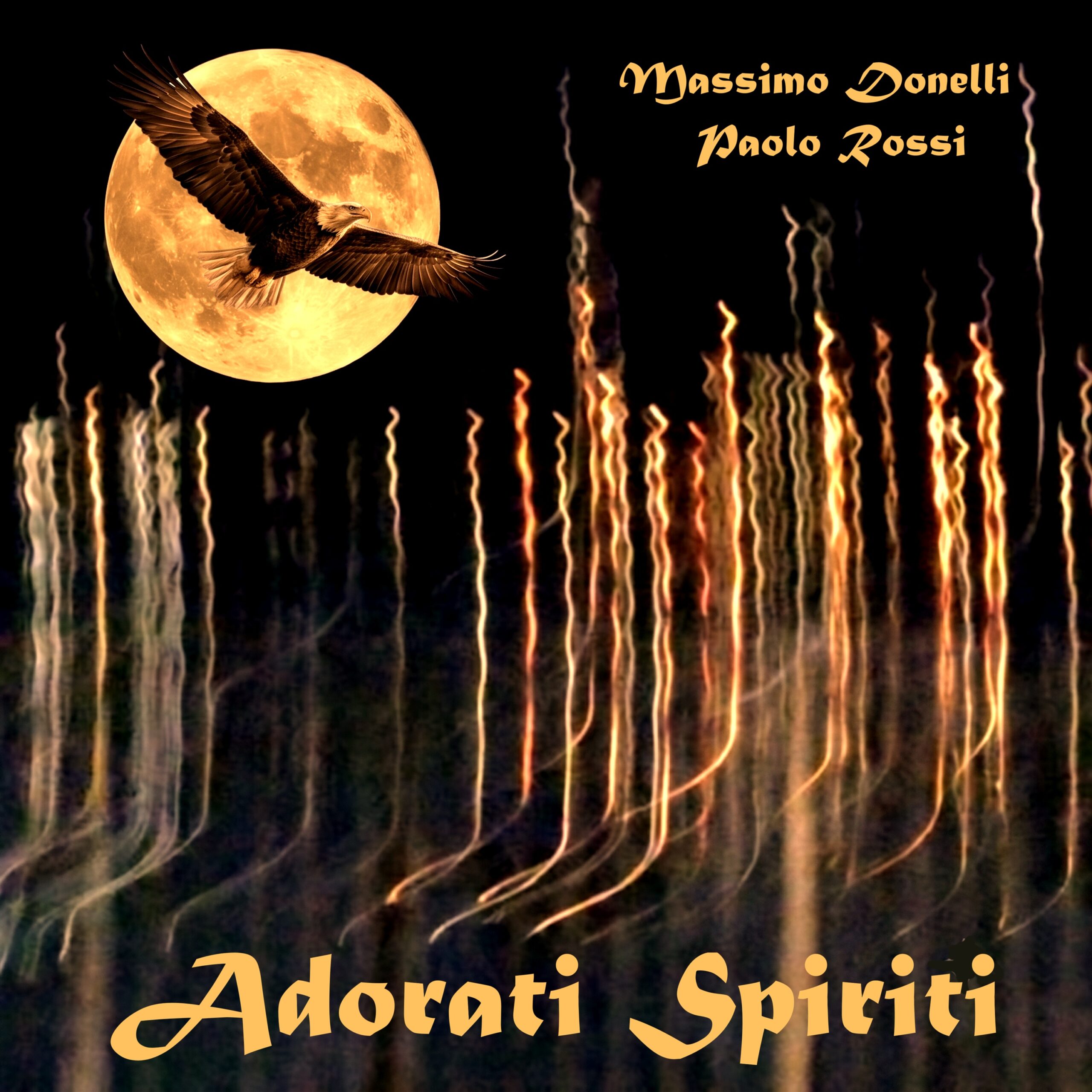
Some concept albums are constructed around elaborate fictional worlds, while others use a particular story to ask questions that extend far beyond the characters who inhabit it. Adorati Spiriti, the ambitious collaboration between Massimo Donelli and Paolo Rossi, belongs firmly to the latter category. Built around the story of Chayton, an old Cheyenne man seeking to pass his understanding of heritage and values to Tokala, a younger man growing up in a profoundly different social and cultural environment, the album explores what happens when inherited identity encounters a changing world. Its setting provides the narrative framework, but the questions it raises are considerably broader: What should a generation preserve? What can safely be allowed to change? Does moving forward necessarily require leaving something behind? Across nine tracks, Donelli and Rossi approach these questions through a fusion of progressive rock, jazz-fusion, world music, and poetic songwriting, creating an album that feels less like a conventional collection of songs than an unfolding dialogue. The project has an appealing ambition because it does not present its central conflict as a simplistic battle between tradition and modernity. Chayton advocates for the past, while Tokala represents progress. Instead, their relationship creates a space where inheritance can be reconsidered. The album’s deeper proposition is that cultural memory does not have to function as an anchor preventing movement; it can also become a source of orientation. That distinction gives Adorati Spiriti its intellectual and emotional foundation.
“Nelle orme il canto” provides an especially appropriate entrance into this world because its very premise evokes the relationship between following inherited footsteps and discovering an individual voice. From the beginning, Adorati Spiriti is interested in the idea that what is passed down does not have to remain static. A tradition survives not simply because it is repeated, but because someone chooses to carry it, interpret it, and ascribe it meaning in a new context. The song therefore functions as more than an opening chapter to the narrative; it establishes the album’s central philosophy. There is a productive tension between the tracks left by those who came before and the freedom of the person walking them now. That tension continues into “Il cerchio che unisce,” where connection and continuity become central themes. The image of a circle is particularly effective within the album’s conceptual framework, as it suggests neither a straight return to the past nor a clean break from it. It suggests continuity, recurrence, relationship, and movement without a definitive point at which one generation simply replaces another. Donelli and Rossi use that idea to establish one of the album’s most important observations: identity is not necessarily something frozen in a particular historical moment. Each generation receives something, interprets it through its circumstances, and inevitably changes the shape of what it eventually passes forward. Heard in sequence, these early tracks make the album feel like a conversation beginning to take form, with music providing the space in which memory and contemporary experience can meet.
As Adorati Spiriti progresses, its narrative becomes increasingly expansive rather than remaining confined to a literal account of Chayton and Tokala. “Ovunque” and “Danza su danza” introduce a greater sense of movement, reinforcing the idea that heritage is not something that exists only in a museum-like relationship with the past. The album is constantly moving, and that movement is important to its meaning. There is a temptation in stories about cultural inheritance to romanticize an earlier world while presenting the modern one as inherently corrosive, but Adorati Spiriti takes a more nuanced route. Its central concern is not whether change should happen; change is already happening. The question is what remains meaningful within that process. “Ovunque” suggests a widening of perspective, while “Danza su danza” adds an almost kinetic dimension to the album’s philosophical exploration. Together, they prevent the narrative from becoming overly static or solemn. The listener is not simply being asked to contemplate history but to experience an ongoing process of transformation. Musically, this section is where the progressive and world-oriented dimensions of Donelli’s writing become particularly useful to the concept. The stylistic breadth allows the album to move between different emotional and atmospheric spaces rather than settling into a single predictable vocabulary. Rossi’s lyrics provide the literary thread, keeping these changes in musical character connected to the broader narrative. The result is an album that behaves like a journey, with each composition representing another stage in the conversation between inheritance, identity, and possibility.
The middle of the album brings an especially evocative shift with “Mitena (nata sotto la Luna nuova),” whose title alone introduces a sense of mystery and personal mythology. At this point, the opening tracks have developed the world enough for the album’s ideas to feel less abstract and more intimate. “Mitena” contributes another human dimension to the larger discussion, while “Splendore” extends the project’s interest in beauty, memory, and the things considered worthy of preservation. These songs help demonstrate that Adorati Spiriti is not interested in heritage merely as an intellectual concept. What is inherited has emotional value precisely because it is connected to people, memories, relationships, stories, and ways of understanding existence. The album’s language of spirituality and remembrance therefore becomes inseparable from its human characters. There is also an appealing sense of visual imagination running through the project. Titles invoking the new moon, splendor, spirits, circles, footsteps, and journeys naturally encourage the listener to construct images around the music. This contributes to the album’s cinematic quality without requiring it to behave like a film score. Instead, the compositions and lyrics create their own internal landscape. Donelli’s progressive-rock instincts allow the material room to develop, while the jazz-fusion influence introduces flexibility and movement. World-music elements further broaden the sonic palette, allowing the album’s thematic interest in cultural identity to be mirrored by a musical language that refuses to remain within one narrow genre. Importantly, the various influences are presented as components of a larger artistic framework rather than as disconnected stylistic exercises.
At the heart of the album sits “Adorati Spiriti,” the title track and one of the project’s principal emotional focal points. By this stage, the themes of spirituality, ancestry, memory, and identity have already been established, allowing the title composition to gather those ideas into a more concentrated expression. The spirits invoked by the title can be understood within the album’s narrative as part of the continuing relationship between past and present, but the song’s significance reaches beyond any single literal interpretation. Memory itself can become a kind of presence. The people, values, stories, and experiences inherited from previous generations may no longer exist in precisely the same form, yet they continue to influence how later generations understand themselves. This is where Adorati Spiriti finds one of its most compelling conceptual distinctions: remembering does not necessarily mean retreating. Chayton’s role is not simply to convince Tokala that the past was better; it is to help him recognize that a future without memory can become disconnected from the experiences that shaped it. At the same time, the younger generation cannot simply reproduce the past unchanged because its circumstances are different. The title track therefore sits at the intersection of remembrance and adaptation. Its emotional weight comes from the recognition that inheritance carries responsibility but also freedom. What we receive from previous generations is not necessarily a finished object. It can be something we examine, understand, reinterpret, and eventually hand onward in a form that remains meaningful.
The album’s musical construction reinforces that conceptual complexity. Massimo Donelli is responsible for the compositions, while Paolo Rossi contributes the lyrics and co-produces the music, and their collaboration gives Adorati Spiriti a clear division of creative strengths while maintaining a unified artistic identity. Donelli’s musical vocabulary draws from progressive rock, jazz-fusion, and world music, genres that naturally accommodate development, contrast, atmosphere, and thematic ambition. Rossi’s poetic approach to the lyrics adds another layer, ensuring that the album’s narrative does not depend solely on its musical arrangements to communicate its ideas. There is also an unusual contemporary component in the creative process: artificial intelligence is employed to alter and develop aspects of the music. Rather than becoming the central selling point of the project, the technology functions as another tool within a broader artistic process. That distinction matters because the human concept remains the album’s driving force. The technology does not replace the underlying collaboration between two musicians returning to a shared passion after pursuing professional lives in other fields. Instead, it becomes part of the album’s exploration of what happens when older artistic impulses encounter newer methods. In that sense, even the making of Adorati Spiriti subtly echoes its subject matter. The project itself brings together established musical influences, contemporary technology, literary storytelling, and a renewed collaboration, demonstrating that continuity and innovation do not necessarily have to be opposing forces. The past can remain present while the creative process continues to evolve.
“Il Tramite” introduces another significant stage in the album’s progression, with its very concept suggesting a passage, connection, or intermediary state between different worlds. Within the broader narrative, that makes it an appropriate precursor to the album’s closing movement. Chayton and Tokala exist at different points in history and experience, but the album repeatedly asks the listener to consider what can connect them rather than what separates them. “Il Tramite” consequently feels important because transition is not simply a condition affecting the younger generation. Everyone involved in the story exists within a process of change. The older generation must decide what and how to communicate; the younger generation must decide what to receive, question, and transform. The idea of a bridge becomes particularly resonant here. A bridge does not erase the distance between two places, but it makes movement between them possible. That is effectively what Adorati Spiriti attempts to create between memory and modernity. The album’s progressive structure allows this transition to feel gradual rather than abrupt. Instead of announcing a final answer, Donelli and Rossi let the themes accumulate across the sequence, allowing the listener to recognize recurring ideas in different forms. The result is a work that rewards attention to its overall arc because individual songs acquire additional meaning through their position within the larger narrative. By this stage, the album no longer feels like a collection of tracks about heritage; it feels like a sustained argument for the possibility of carrying heritage forward without treating it as an obstacle to change.

That argument reaches its clearest expression with “Now go,” a title that immediately introduces forward momentum and gives the closing section of Adorati Spiriti a sense of release. Crucially, the album does not conclude by suggesting that Tokala must turn away from the contemporary world and return to an earlier way of life. It suggests that the traditions associated with Chayton’s generation do have a place in the future. Instead, the final movement proposes something more productive: take what matters and continue. The imperative contained in “Now go” can therefore be understood as an affirmation of movement informed by memory. The past has been acknowledged, examined, and received; now the younger generation must live. That conclusion prevents the album from becoming nostalgic in the narrow sense. Nostalgia looks backward and often wishes to remain there. Adorati Spiriti, by contrast, looks backward to understand what might be carried forward. This moment is where the story of Chayton and Tokala becomes a useful framework for a much larger human question. Every generation inherits languages, customs, stories, values, creative traditions, and memories, but every generation also encounters circumstances that its predecessors could not have anticipated. Preserving identity therefore cannot simply mean freezing it. It requires discernment. Some things need to be protected precisely because they provide continuity and meaning; other things can evolve because adaptation is part of survival. “Now go” captures that tension with striking economy, bringing the album’s narrative to a point where departure is not abandonment but the next stage of inheritance.
Ultimately, Adorati Spiriti is most successful when it treats heritage not as a relic but as a living conversation. Massimo Donelli and Paolo Rossi use the story of Chayton and Tokala to explore questions that reach beyond the specific setting of the album: how do people remain connected to where they come from while adapting to where they are going, and what responsibilities accompany the act of passing something meaningful from one generation to another? The nine-track sequence gives those questions room to develop, moving from the footsteps and inherited song of “Nelle orme il canto” through the connecting circle of “Il cerchio che unisce,” the movement of “Ovunque” and “Danza su danza,” the atmospheric and personal dimensions of “Mitena” and “Splendore,” the spiritual center of “Adorati Spiriti,” and the transitional energy of “Il Tramite” before arriving at the forward-looking “Now go.” Musically, progressive rock, jazz-fusion, and world influences provide a suitably expansive framework, while Rossi’s poetic lyrics and Donelli’s compositions keep the narrative at the center. Even the use of AI becomes relevant as part of the album’s wider creative conversation between established practices and emerging possibilities. Most importantly, however, Adorati Spiriti does not reduce its central question to a simple choice between past and future. Its more thoughtful proposition is that meaningful inheritance can make movement possible rather than prevent it. The album ultimately asks listeners to consider what they would carry if everything around them began to change—and what they would refuse to forget. In doing so, Donelli and Rossi turn a story about two generations into a broader meditation on memory, identity, creativity, and the difficult but necessary art of moving forward without losing sight of where the journey began.
For more information, follow Massimo Donelli-Paolo Rossi
FACEBOOK – SPOTIFY – YOUTUBE – INSTAGRAM