
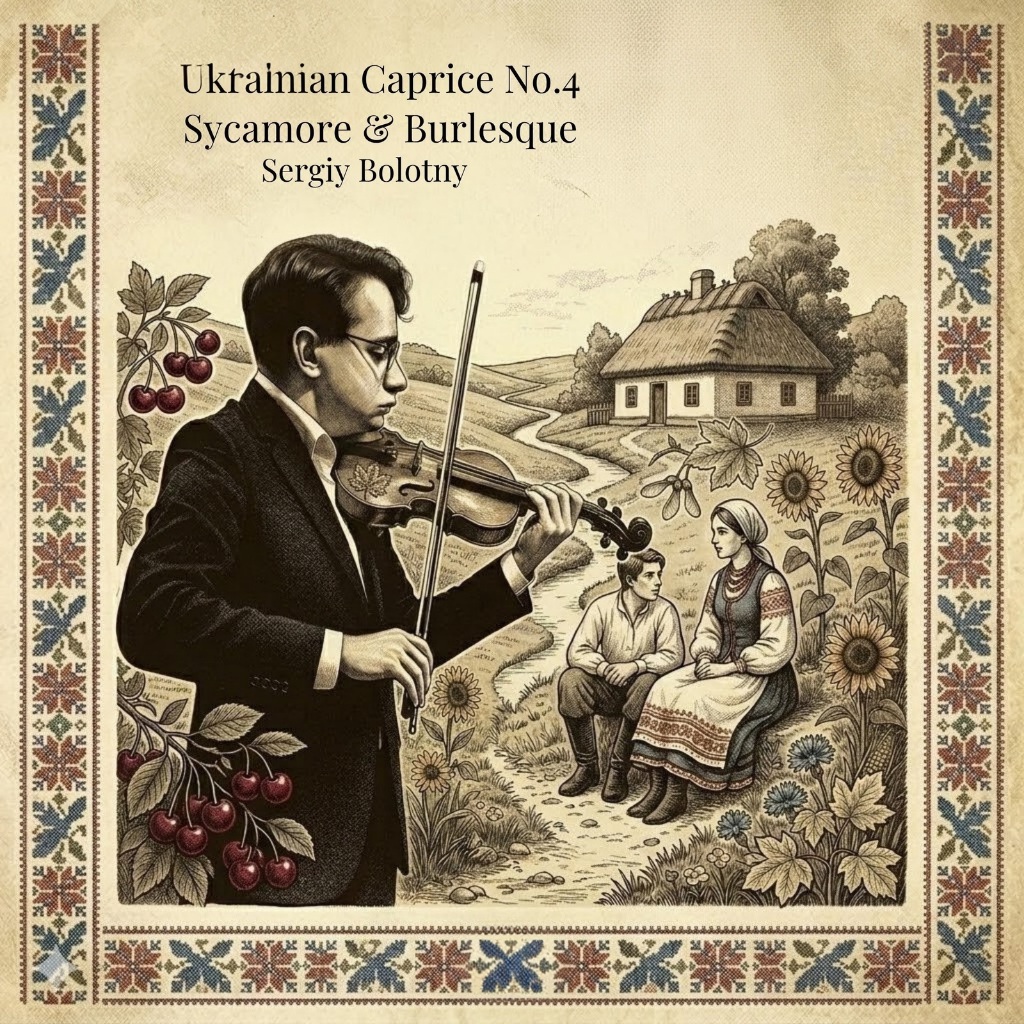
Sergiy Bolotny’s “Ukrainian Caprice No. 4: Sycamore & Burlesque” is a striking demonstration of how deeply rooted musical heritage can be transformed without losing its emotional identity. Rather than treating Ukrainian folklore as something to be preserved behind glass, the Ukrainian-born concert violinist and composer brings it into a technically demanding contemporary solo setting, allowing the traditions behind the composition to speak through the expressive possibilities of the acoustic violin. The piece draws inspiration from Taras Shevchenko’s melancholic poetry, particularly “Teche voda z-pid yavora” (“Water flows from under the sycamore”), while also incorporating the spirit of traditional festive Ukrainian dances. That combination immediately creates an intriguing artistic tension: melancholy and celebration, reflection and movement, and lyrical restraint and virtuoso abandon. Bolotny structures the work around two contrasting sections, “Sycamore” and “Burlesque,” and the contrast between them is central to its appeal. The opening movement is intimate and cantabile, allowing the violin to breathe through a melody steeped in Slavic lyricism and shadowed by darker harmonic colors. There is an almost vocal quality to the phrasing, as though the instrument is quietly recounting an old story whose emotional meaning has survived across generations. It is a patient beginning, and its restraint makes what follows all the more dramatic. Rather than rushing toward virtuosity for its own sake, Bolotny first establishes an emotional landscape, giving the listener a reason to care about the melody before unleashing the more athletic personality of the second movement.
The “Sycamore” section is where the poetic foundation of the piece becomes particularly vivid. Inspired by Shevchenko, whose writing occupies an important place in Ukrainian cultural history, the movement carries a sense of longing that is communicated entirely through the violin. Without the need for a vocal line, Bolotny uses phrasing, tone, dynamics, and harmonic tension to suggest the emotional weight contained within the source material. The cantabile writing allows individual notes to feel almost like spoken syllables, while the brooding harmonic depth beneath the melody prevents the music from becoming merely decorative. There is a beautiful tension between simplicity and sophistication here. The underlying melodic character feels rooted in folk expression, yet Bolotny approaches it with the awareness of a seasoned concert performer and composer. His experience as assistant second concertmaster with the Noord Nederlands Orkest and his education in Lviv, Kyiv, and Vienna provide a broad musical foundation, but “Ukrainian Caprice No. 4” never sounds like an academic exercise in cultural reconstruction. It feels personal and immediate. The violin remains close to the listener, and the natural acoustic resonance of the recording preserves that intimacy. Rather than surrounding the instrument with excessive studio effects, the production allows the physical character of the performance to remain audible. Bow against string, resonance within the room, and the subtle variations in articulation all contribute to the impression that the listener is witnessing a live musical gesture rather than hearing an overly polished studio artifact.
Then comes “Burlesque,” and the entire character of the piece changes. The contemplative atmosphere of “Sycamore” yields way to a fiery, mischievous movement in which Bolotny demonstrates just how far the acoustic violin can be pushed while remaining musically expressive. Rapid spiccato passages, energetic string crossings, quick shifts in register, and playful rhythmic figures create a sense of controlled turbulence. This is where the title “Burlesque” becomes particularly appropriate. The music seems to grin as it moves, balancing technical difficulty with humor, theatricality, and rhythmic vitality. Yet the virtuosity never feels detached from the folk foundation of the composition. Instead, the athletic writing evokes the physical energy of traditional festive dance, translated into the vocabulary of a solo concert violinist. Bolotny’s bow becomes almost percussive at moments, generating an impression of movement that makes the listener imagine dancers rather than simply admire the mechanics of the performance. That is an important distinction because technically impressive violin playing can sometimes become an exercise in display, but here the technique serves the personality of the music. The rapid passages are exciting precisely because they communicate something: exhilaration, playfulness, momentum, and a sudden release from the melancholy that preceded them. The transition therefore feels almost theatrical. One moment the listener is immersed in an introspective landscape beneath the sycamore; the next, the music has burst into motion. The contrast provides the caprice a narrative quality, turning the two movements into complementary expressions of the same cultural imagination.
Bolotny’s achievement also lies in how he makes a solo violin sound remarkably expansive. Without the support of an ensemble, he has to create both the melodic foreground and the rhythmic energy that propel the piece, and the composition is designed to exploit that challenge. The acoustic violin becomes an unusually versatile storyteller, shifting from singing lyricism to sharp articulation, from sustained emotional lines to rapid-fire gestures. This breadth places “Ukrainian Caprice No. 4: Sycamore & Burlesque” comfortably within a contemporary classical landscape while preserving a distinctive connection to Ukrainian musical heritage. Listeners drawn to the neoclassical atmosphere of Max Richter or Ólafur Arnalds may appreciate the piece’s ability to create emotional space, while admirers of Paganini or Eugène Ysaÿe will recognize the technical ambition embedded in its virtuosic passages. Hilary Hahn’s association with precision and expressive clarity provides another useful point of reference, although Bolotny’s musical identity remains rooted in his own cultural and compositional perspective. His ongoing Ukrainian Caprices and Little Dutch Rhapsodies projects demonstrate an interest in bringing historical European folk traditions into dialogue with the concert repertoire, and this latest caprice feels like a particularly vivid example of that philosophy. There is no attempt to force the old and the new into a seamless uniformity. Instead, their differences become part of the music’s character. Folk melody, literary inspiration, classical technique, and contemporary performance practice coexist in a piece that feels both historically conscious and unmistakably alive.
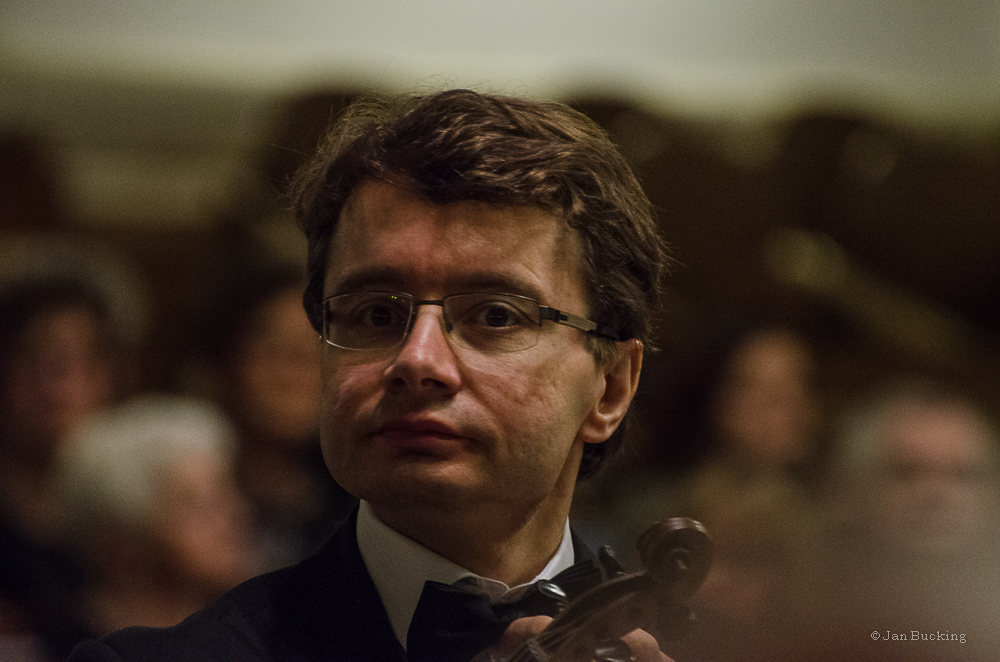
Ultimately, “Ukrainian Caprice No. 4: Sycamore & Burlesque” is compelling because it understands that heritage can be both reflective and exuberant. Its first movement looks inward, drawing emotional weight from Shevchenko’s poetic world and allowing the violin to sing with a distinctly Slavic lyricism. Its second movement looks outward, transforming the energy of Ukrainian festive dance into a dazzling display of spiccato, string crossings, rhythmic play, and acoustic virtuosity. Together, the two sections create more than a showcase for technical ability; they form a miniature journey through contrasting emotional states, united by a strong cultural identity. The natural room presence of the recording is especially important because it preserves the physical immediacy of Bolotny’s playing, allowing the listener to hear the instrument as an acoustic object rather than an abstract digital sound. His performance has both precision and personality, and the technical demands never eclipse the musical story. “Ukrainian Caprice No. 4” ultimately demonstrates why the caprice remains such a fascinating form for a composer-performer: it provides room for discipline and freedom, tradition and invention, and seriousness and play. Bolotny takes those possibilities and imparts them a distinctly Ukrainian voice. What begins beneath the quiet shadow of a sycamore eventually erupts into movement, color, and virtuoso celebration, leaving behind a piece that feels at once respectful of its cultural roots and confidently alive in the present.
For more information, follow SERGIY BOLOTNY
WEBSITE – FACEBOOK – SPOTIFY – YOUTUBE – INSTAGRAM