

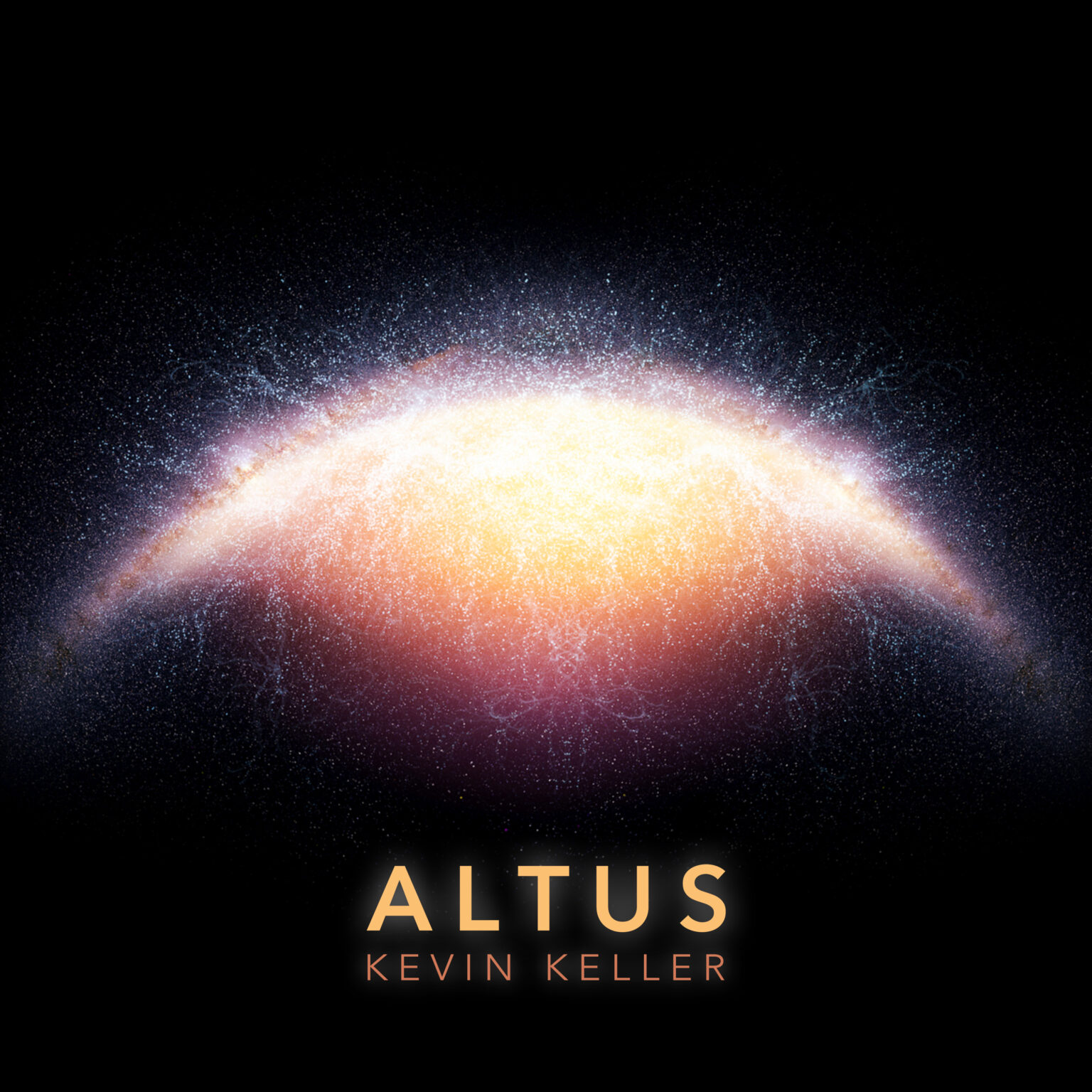
There are composers whose music entertains, others whose work challenges the listener, and a particularly rare few whose compositions seem capable of transporting us somewhere beyond the ordinary boundaries of experience. Kevin Keller has consistently occupied that third category for me. Across more than three decades of recording, the American composer has demonstrated an extraordinary ability to move between ambient electronics, minimalism, sacred choral music, classical chamber compositions, and atmospheric techno without sacrificing the distinctive musical identity that makes his work so compelling. His melodies possess an unmistakable emotional intelligence, his arrangements demonstrate exceptional sensitivity, and his production has always been distinguished by an almost architectural attention to detail. Keller is, quite simply, one of those musical treasures whose continued creativity deserves considerably more recognition. With Altus, his 16th album and a deeply rewarding 51-minute instrumental journey, he revisits the synthesizers that helped shape his earliest recordings while bringing the wisdom, sophistication, and spiritual awareness accumulated throughout his career into a wonderfully expansive new musical statement. Released October 30, this remarkable collection feels less like a return to familiar territory than an exploration of somewhere Keller has never quite been before.
What makes Altus particularly fascinating is the sense of discovery that permeates its ten compositions. Following Evensong and Arcadia, albums that explored vocal music, medieval plainchant, and more explicitly human dimensions of spiritual reflection, Keller returns to a predominantly electronic instrumental landscape. Yet there is absolutely nothing retrogressive about this shift. Instead, his synthesizers seem to have acquired new expressive possibilities, their electronic voices interacting with acoustic instruments in ways that feel increasingly organic and emotionally sophisticated. His approach is neither excessively technical nor concerned with demonstrating the capabilities of particular instruments. The Elta Solar 42N, Moog Grandmother, Roland Juno-106, Serum, Omnisphere, EastWest Quantum Leap, and Fender Telecaster become components of a much larger expressive vocabulary, serving the compositions rather than defining them. Recorded and mixed at Mariner’s Gate in New York, with mastering by Chris Frasco in Nashville, the album benefits from remarkable clarity and spaciousness. Every texture seems to occupy precisely the right place, yet the music never feels clinically arranged. Keller has an extraordinary instinct for allowing electronic sounds to breathe, soften, shimmer, and occasionally darken without losing their emotional continuity. His own description of the creative process is revealing: he was not illustrating a predetermined idea but discovering something, with the music seemingly understanding its destination before he consciously did. That philosophy becomes increasingly apparent as the album unfolds.
The opening “Mirror of Change” establishes the album’s contemplative atmosphere with extraordinary patience. A high-register electronic tone initially hovers in isolation, gradually modulating and receding before returning in deeper, more resonant forms. There is something wonderfully understated about this beginning. Rather than immediately establishing a conventional melody or rhythm, Keller invites the listener to settle into a sonic environment, allowing the smallest changes in texture and intensity to become meaningful. Over its seven-minute duration, the composition slowly transforms, incorporating pulsating percussion, airy synthesizer currents, delicate harp-like strumming, and eventually graceful piano figures that emerge from the surrounding atmospheric haze. The effect is less a dramatic progression than a gradual awakening, with the music revealing itself in successive layers. “The Messenger” provides a delightful contrast, introducing a considerably more buoyant and playful energy. Its tinkling bells, bubbly electronic figures, and heartbeat-like rhythmic pulse create an infectious sense of movement, while the ringing melodic elements possess an almost festive warmth. There is something reminiscent of the anticipation surrounding the Christmas season here, although the composition never becomes overly sentimental. Instead, its cheerful exterior conceals a subtle sense of mystery, demonstrating Keller’s ability to make even relatively playful instrumental music feel emotionally multidimensional.
For me, however, “The Sacred Chord” is the album’s most immediately affecting composition and ultimately my favorite track. Its gorgeous acoustic piano theme seems to materialize from a suspended atmosphere of shimmering synthesizer washes, creating the sensation that time itself has momentarily ceased to matter. The piano is beautifully restrained, allowing each phrase to unfold with natural grace while the surrounding electronic textures provide an almost weightless sense of space. There is a remarkable balance between intimacy and expansiveness here: the melody feels personal enough to inhabit one’s private thoughts, yet the sonic environment surrounding it suggests something immeasurably larger. I found myself imagining what might happen if Erik Satie and Brian Eno somehow discovered a shared musical language, with Keller occupying the improbable meeting point between their respective sensibilities. The comparison is not intended to diminish his originality; quite the opposite. He has developed an expressive vocabulary sufficiently distinctive to make such imaginative associations feel illuminating rather than derivative. “Illumination” extends the album’s celestial atmosphere into deeper territory. Its languid melodic movements float above prominently mixed bass notes, while soaring synthesizer passages introduce an intriguing tension between darkness and radiance. The lower frequencies give the composition a physical grounding, preventing its more ethereal elements from drifting into abstraction. This is deep-space music with a welcoming, almost comforting presence, its shadowy foundations making the brighter melodic details all the more beautiful.
One of Altus’s most exhilarating moments arrives with “The Quickening Air,” a composition that suddenly brings the listener back to earth without sacrificing the album’s immersive atmosphere. The acoustic piano takes center stage, delivering a delightful, lively melody that moves with an almost mischievous sense of momentum. Beneath it, a gently insistent sequencer establishes a rhythmic foundation, while sparkling string-like electronic textures and what sounds like a hammered dulcimer engage in an animated musical conversation. The interplay is particularly captivating because Keller never allows the arrangement to become crowded. Each instrument seems to understand precisely when to step forward and when to recede, creating a spirited exchange that feels spontaneous despite its evident compositional precision. There is an almost jazzy quality to the movement of the piano, and the quicksilver electronic patterns provide an exhilarating counterpoint to its acoustic warmth. This is Keller at his most kinetically expressive, demonstrating that contemplative music need not remain perpetually slow or subdued. The composition possesses genuine lift, a sense of air rushing through an open window, and its infectious energy provides an essential counterbalance to the album’s more introspective passages. It also reinforces one of Keller’s greatest strengths: his ability to make contrasting musical personalities coexist naturally within a coherent artistic vision.
“Reflections Below” subsequently draws the listener back into a quieter, more introspective landscape. A simple piano motif gradually develops through subtle variations, accompanied by soulful upper-register synthesizer tones and lower electronic currents that seem to seep into the arrangement from somewhere beneath the surface. The composition’s beauty lies in its understatement. Keller does not need elaborate melodic statements or dramatic crescendos to sustain attention; he understands that a carefully placed note, a slight change in resonance, or the gradual emergence of another texture can communicate more than an entire arrangement filled with unnecessary activity. “The Gatekeeper” continues this contemplative mood, building around a persistent five-note motif that acquires an increasingly solemn character through the introduction of deep bass notes. There is something almost ceremonial about its progression, as though the listener is approaching a threshold that cannot be crossed without a moment of reflection. The composition’s restrained intensity is particularly effective, giving the album a subtle sense of psychological depth. These are not simply atmospheric interludes placed between more substantial pieces. They are integral chapters in a musical narrative whose movement is primarily emotional, encouraging listeners to consider the relationship between memory, uncertainty, and whatever lies beyond the boundaries of immediate understanding.
The album’s final stretch is arguably its most spiritually evocative. “Constellations of Silence” begins with a beautiful pipe-organ melody possessing a distinctly Bach-like elegance, its solemn harmonic language immediately establishing an atmosphere of reverence. Keller’s production surrounds the organ with an almost impossibly peaceful stillness, allowing the melody to resonate without becoming overwhelmed by additional instrumentation. The result feels less like an attempt to recreate sacred music than an exploration of the emotional qualities that make such music enduringly powerful. There is an unmistakable spirituality here, although it is not dependent upon religious doctrine or explicitly theological statements. Rather, the composition seems to express a profound respect for silence, contemplation, and the possibility of finding meaning in moments when ordinary language becomes inadequate. “The Motion of All Things” follows with a beautifully restorative character. Its opening notes feel like the gradual emergence of consciousness after a restful sleep, immediately suggesting the image of a sunrise slowly illuminating an otherwise darkened landscape. The melody develops with patient elegance, creating a sensation of renewal that feels earned rather than artificially imposed. Having traveled through the album’s deeper and more introspective passages, the listener encounters something resembling emotional clarity, a gentle recognition that movement and stillness are not opposing forces but essential parts of the same experience.

Then comes “Altus,” the majestic seven-minute title track that brings the journey to its most compelling destination. Ominous, slowly fluctuating ambient textures establish the foundation, while the wordless vocal contributions of guest artist Sofía Campoamor introduce an extraordinary human dimension. Her ethereal, almost angelic tones float above the brooding electronic pulse, creating a sense of transcendence without resorting to grandiose gestures. The vocal textures are especially effective because they remain integrated into the musical environment rather than dominating it. A few graceful piano notes provide warmth and intimacy, their delicate presence offering a grounding counterpoint to the surrounding atmosphere. As the voices gradually rise, the composition achieves a quietly overwhelming beauty, suggesting not an arrival at some definitive conclusion but the opening of an entirely new perspective. Campoamor’s contribution is crucial to this emotional transformation, and Keller’s decision to introduce vocals only at this final stage makes their appearance feel particularly meaningful. After nine predominantly instrumental compositions, the human voice becomes a kind of revelation, an unexpected reminder that even the most expansive musical journeys ultimately return us to something profoundly personal. The title itself, suggesting elevation or height, seems entirely appropriate for a composition that feels simultaneously grounded and suspended somewhere above the ordinary world.
Ultimately, Altus is one of those albums that rewards complete immersion rather than casual listening. Its ten compositions form an unusually coherent progression through wonder, uncertainty, contemplation, and recognition, with every track contributing something essential to the larger experience. Keller’s achievement is not simply that he has returned to the electronic instrumentation of his earlier work, but that he has transformed it through decades of exploration across ambient chamber music, sacred compositions, minimalism, and more experimental sonic territories. The contrasts throughout the album are particularly striking: the playful buoyancy of “The Messenger” against the solemnity of “The Gatekeeper,” the spirited movement of “The Quickening Air” against the suspended stillness of “Constellations of Silence,” and the intimate piano passages against the expansive electronic environments surrounding them. I would single out “The Sacred Chord” as my personal favorite, although the title track’s vocal transcendence and “The Quickening Air”’s exuberant momentum come remarkably close. There is also something deeply satisfying about the way the album closes, leaving the listener refreshed rather than exhausted, contemplative rather than overwhelmed. Whether Keller consciously intended a spiritual journey or simply followed the musical possibilities as they emerged, Altus possesses an unmistakable sense of reverence for beauty, silence, and the transformative power of sound. At a time when music is so frequently consumed in fragments, this is a record that deserves to be experienced from beginning to end, preferably without interruption. Kevin Keller has once again demonstrated why his remarkable discography continues to inspire such affection, delivering an album that feels simultaneously familiar and genuinely revelatory. Altus is a graceful ascent into new creative territory, and one of his most rewarding invitations to listen, reflect, and simply be.
For more information, follow Kevin Keller
WEBSITE – FACEBOOK – SPOTIFY – BANDCAMP – YOUTUBE