

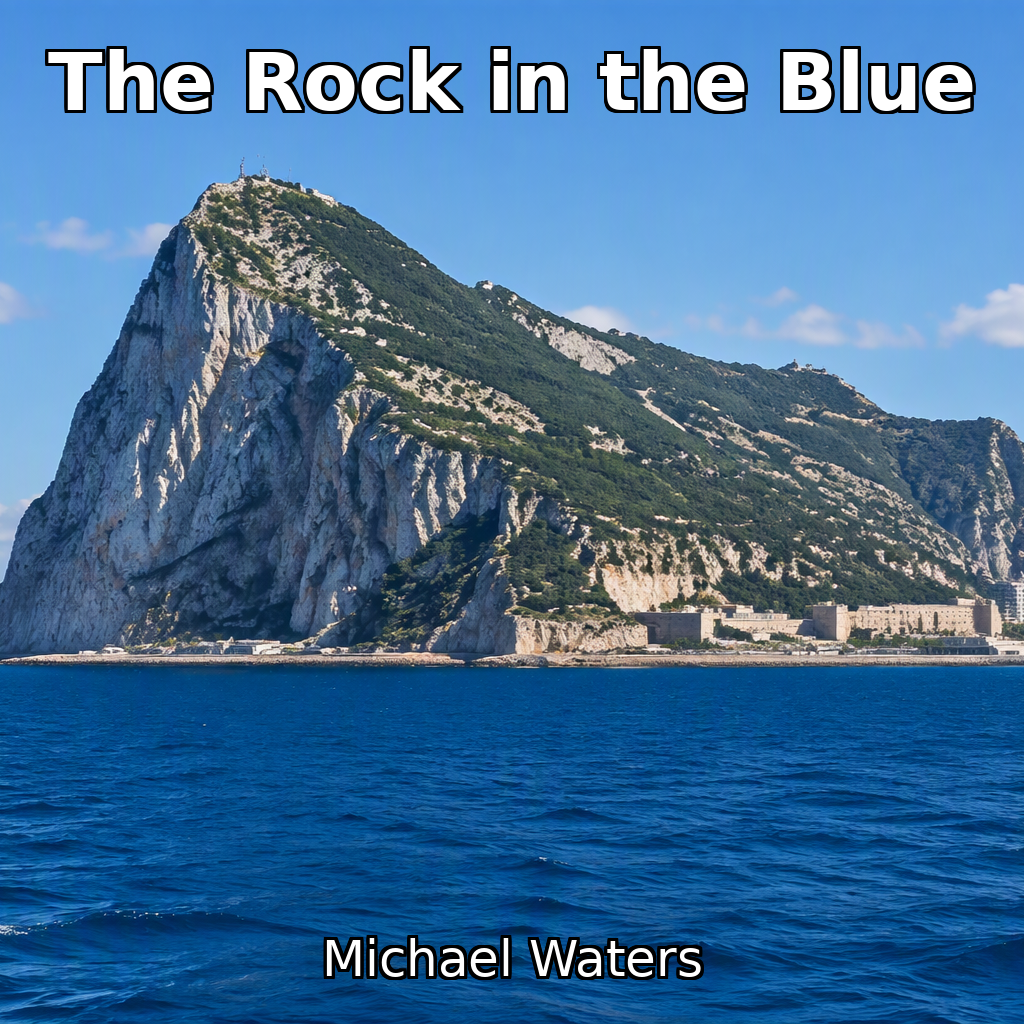
There are places in the world whose identity seems to extend far beyond their physical boundaries, where a distinctive landscape, a proud history, and a fiercely held sense of belonging combine to create something almost impossible to capture in words. Imagine standing beneath the towering limestone face of Gibraltar, with the deep Mediterranean blue stretching endlessly beyond its shores, the sunlight dancing across the water, and generations of stories seemingly embedded in every street and stone. It is a place that invites celebration, not necessarily through grand ceremonial gestures, but through the warmth, character, and collective spirit of the people who call it home. Michael Waters captures that feeling with “The Rock in the Blue,” an upcoming single that transforms a rather unusual songwriting assignment into an affectionate musical tribute with ambitions extending well beyond its geographical inspiration. Scheduled for release on 27 November, the song began life as an entry written for a competition to find a national anthem for Gibraltar. That origin might suggest something formal, stately, and burdened with the traditional expectations of patriotic music, but Waters has taken a decidedly different route. Rather than leaning heavily on pomp, solemn declarations, or the grandiose arrangements commonly associated with national anthems, he has placed melody at the center of the experience, aiming for something memorable, accessible, and emotionally inviting. It is an interesting creative decision because a successful anthem must accomplish more than simply describe a place or express national pride; it must give people something they can carry with them, something that can be sung together and remembered long after the music stops. “The Rock in the Blue” appears to embrace precisely that philosophy. Its title alone conjures a striking image, combining Gibraltar’s unmistakable geographical identity with the expansive beauty of the surrounding Mediterranean. Yet the song’s appeal is not intended to stop at the border. Waters hopes its warmth and melodic character will connect with listeners who have never visited Gibraltar, demonstrating that a genuine celebration of one particular place can also become a universally accessible expression of affection, belonging, and pride.
What makes this release particularly interesting is the way it fits into Michael Waters’ broader songwriting identity. Based in the UK, Waters has established himself as a songwriter whose creative interests move comfortably between pop, soft rock, adult contemporary, and indie ballads, with emotional storytelling and memorable melodies serving as the common thread. He writes both music and lyrics, giving his compositions a personal coherence that allows their narratives and musical identities to develop together. His approach is rooted in the understanding that a good song needs more than an attractive tune; it needs an emotional center capable of drawing listeners into its world. His catalogue demonstrates an appealing range, from reflective compositions dealing with more serious subjects to uplifting material designed to leave people smiling. In late 2025, he took an important step in bringing his songwriting ambitions to life by recording with world-class musicians in New York, an experience that helped shape the recordings associated with his 2026 releases. The results have been encouraging. “A Baby Of My Own,” performed by Kacey Greene, spent ten weeks on the World Indie Music Chart, reaching Number 12, while “The Boy Who Really Loved You,” performed by Below The Parapet, climbed to Number 4. These achievements suggest that Waters’ songwriting has found an audience that appreciates strong melodic construction and accessible emotional narratives. July brought another dimension to his work with “La La Love Song,” an infectiously energetic, feel-good composition carrying an unmistakable romantic beach atmosphere. Its success, reaching Number 1 in the World Indie Movie Chart, demonstrated his ability to create music with immediate appeal. He followed that brighter mood with “Requiem for Earth,” a deeply moving love song dedicated to the planet and its fragility, which came close to achieving similar chart recognition. September’s “We’re Much Better People Now” continued the positive momentum, reaching the Top 20. Taken together, these releases reveal a songwriter who is not interested in confining himself to a single emotional register. Instead, he moves between romance, optimism, reflection, and social consciousness, allowing each composition to find its own personality while maintaining a consistent commitment to melody. “The Rock in the Blue” therefore feels like a natural continuation of that creative journey, even as its subject introduces a slightly different kind of emotional celebration.
The most revealing connection is perhaps the one Waters himself draws between “The Rock in the Blue” and “Requiem for Earth.” The earlier composition approached the planet as a whole, expressing affection for its beauty while acknowledging its vulnerability and the responsibility humanity carries towards protecting it. The new single takes that expansive perspective and brings it down to a much more intimate scale. Instead of addressing the entire world, it focuses on one distinctive corner of it, treating Gibraltar as a place worthy of its own musical celebration. There is something rather lovely about that creative progression. The planet can sometimes feel too vast for an individual to comprehend emotionally, but a particular coastline, a familiar landmark, or a community with a shared history can make those larger feelings tangible. By concentrating on Gibraltar, Waters finds an opportunity to explore the emotional significance of place itself. The Rock is not simply a geological landmark; it is a powerful visual symbol, a recognizable part of the landscape, and an enduring source of identity. The surrounding blue provides the perfect contrast, suggesting openness, movement, and the wider world beyond the familiar shoreline. Even without relying on elaborate historical references or ceremonial language, that imagery offers plenty of material for a songwriter interested in creating an emotional connection. The challenge, of course, is making a song about a specific location resonate with people who have no direct relationship with it. Waters’ decision to prioritize tunefulness and memorability seems especially important here. An anthem should invite participation rather than demand admiration from a distance. It should feel like something people want to sing, not merely something they are expected to stand for. By moving away from the conventional pomp associated with the genre, he appears to be pursuing a more welcoming approach, one in which the melody becomes the bridge between local identity and wider appreciation. This is also where his adult contemporary and pop sensibilities could prove particularly effective. Those styles have long demonstrated an ability to turn personal sentiments into widely relatable musical experiences, and a well-crafted melodic hook can make an unfamiliar place feel surprisingly close. The ambition is not to dilute Gibraltar’s individuality but to celebrate it in a language that listeners everywhere can understand.
Another appealing aspect of “The Rock in the Blue” is its unusual position within a creative career that extends beyond music. The single arrives on 27 November, the same day Waters is releasing two new books, “Delight Them” and “The Grown-Ups’ Guide to Escaping the Friend Zone.” It makes for an unusually busy release date, placing his musical and literary work side by side and highlighting an artist whose creative interests are not confined to songwriting alone. There is something fitting about this simultaneous arrival. Whether working through a melody, developing a lyrical narrative, or exploring ideas in book form, Waters appears drawn to the possibilities of communication and the different ways stories can connect people. Music, naturally, offers a particularly immediate emotional language. A well-written song can establish an atmosphere within seconds, communicate affection without lengthy explanation, and leave an image lingering in the imagination long after the final note. That quality seems central to his approach. His previous releases have explored different subjects and emotional territories, but they share an appreciation for accessibility without abandoning substance. “The Rock in the Blue” presents another opportunity to put that philosophy into practice, using the idea of a national anthem as a starting point for something potentially more universal. There is also a welcome sense of ambition in the fact that Waters wants the song to travel beyond Gibraltar. A composition inspired by a particular community does not have to remain limited to that community, just as a love song about one person can resonate with countless others. The most successful expressions of affection often reveal something recognizable about the human experience, regardless of where they originate. In this case, the emotional ingredients are particularly inviting: pride in a place, appreciation for its beauty, attachment to its identity, and the simple pleasure of celebrating something that matters. With a release arriving alongside two books, Waters is certainly making 27 November a significant date in his creative calendar. Yet “The Rock in the Blue” has its own distinct purpose, offering a musical statement that deserves to be considered independently of the surrounding activity.

Ultimately, “The Rock in the Blue” represents an appealing continuation of Michael Waters’ commitment to emotionally engaging songwriting and memorable melodic expression. Its origins in a competition to create a national anthem for Gibraltar give it an interesting historical and cultural starting point, but its greater potential lies in the way it approaches the idea of celebration. Rather than relying on the grand gestures and ceremonial weight that listeners might associate with patriotic compositions, Waters has chosen to pursue something more tuneful, approachable, and enduring. That decision reflects the strengths already evident throughout his 2026 catalogue, from the romantic exuberance of “La La Love Song” to the environmental sensitivity of “Requiem for Earth” and the emotional storytelling of his other releases. The connection between the latter and this new single is particularly meaningful: one embraces the world in all its beauty and fragility, while the other turns towards a single remarkable place and gives it a musical embrace. It is a shift in perspective rather than a departure in philosophy. The central belief remains that music should make people feel something, whether that feeling is affection, nostalgia, optimism, pride, or a renewed appreciation for the world around them. There is something refreshing about a songwriter recognizing that a national tribute does not necessarily need to sound like a formal declaration. Sometimes the most enduring celebrations are those that make people smile, sing along, and feel connected to something larger than themselves. Gibraltar may provide the geographical inspiration, but the emotions behind the song have a much wider reach. “The Rock in the Blue” arrives with the promise of a melodic celebration that honors its subject without allowing its identity to become a limitation. If Waters succeeds in making listeners feel even a fraction of the affection and enthusiasm that inspired its creation, the song could find a home well beyond the Mediterranean shores it celebrates. After all, a place may be defined by its landscape, its history, and its people, but a memorable song can carry its spirit almost anywhere.
For more information, follow Michael Waters
WEBSITE – SPOTIFY – SOUNDCLOUD – YOUTUBE