



The release of “Lady Liberty” by Kelsie Kimberlin arrives as a thoughtful cultural statement rooted in questions of identity, belonging, and liberty. Released on March 27, 2026, the track pairs a reflective musical composition with a striking music video that draws heavily on national symbolism. At its heart stands the iconic Statue of Liberty, a figure long associated with the promise of opportunity and refuge. Kimberlin uses this emblem to explore a shifting emotional landscape within the United States, framing the monument not simply as a historical artefact but as a living metaphor for freedom under pressure. The result is a song that feels deeply personal and politically reflective, inviting listeners to reconsider the values traditionally associated with the American ideal.
Musically, “Lady Liberty” unfolds with a restrained yet emotionally charged arrangement that allows Kimberlin’s voice to carry the narrative weight. The production leans toward cinematic pop, emphasising atmosphere and clarity rather than dense instrumentation. Soft piano chords and gradual orchestral textures establish a reflective tone from the opening moments, allowing the melody to build slowly into a more expansive emotional space. Kimberlin’s vocal delivery remains controlled and deliberate throughout the track, projecting sincerity rather than theatrical drama. This restraint serves the song well, allowing its message to resonate without overwhelming the listener with excessive production flourishes. As the arrangement gradually expands, subtle percussion and layered harmonies deepen the sense of urgency embedded in the lyrics.
Lyrically, the song revolves around the symbolic meaning of liberty and the changing perception of the United States as a destination for those seeking safety and opportunity. Kimberlin references the well-known inscription associated with the Statue of Liberty—lines originating from the poem “The New Colossus” by Emma Lazarus—to emphasise the historic image of the nation as a welcoming refuge for immigrants. By contrasting that legacy with contemporary tensions surrounding immigration and national identity, the artist constructs a narrative that feels reflective and confrontational. The lyrics do not offer simple answers, but present a series of emotional observations about hope, disillusionment, and the fragile nature of democratic ideals. In doing so, Kimberlin places the song within a tradition of socially conscious pop that seeks to provoke conversation rather than provide resolution.
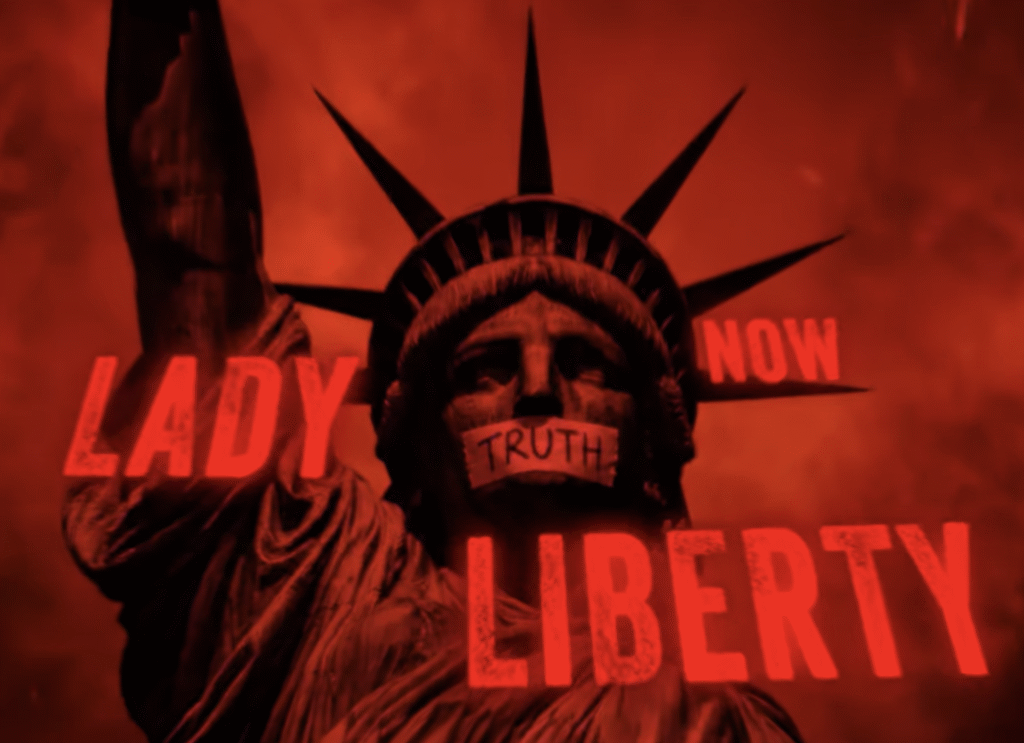
The accompanying music video intensifies this narrative through symbolic imagery. The Statue of Liberty appears surrounded by storms, its iconic torch dimming as cracks form in its foundation. One of the most arresting visual elements depicts the statue’s mouth taped shut, a stark image suggesting the suppression of speech and truth. These visuals are not subtle, but their dramatic presentation mirrors the urgency of the song’s message. By transforming a globally recognised monument into a suffering figure, the video invites viewers to consider whether the ideals associated with freedom are being challenged or diminished. The imagery also echoes Kimberlin’s broader artistic identity, which has increasingly engaged with themes of humanitarian concern and global justice.
Kimberlin’s personal background adds further resonance to the song’s themes. As the daughter of an immigrant and an artist with strong ties to Ukraine, her work frequently intersects with discussions of freedom, displacement, and national identity. Her humanitarian efforts have previously been recognised with distinctions such as the United Nations Humanitarian Award and the St. George’s Royal Medal of Honour, acknowledgements that reflect her engagement with global issues beyond the recording studio. These experiences shape the emotional authenticity of “Lady Liberty,” allowing Kimberlin to approach the subject as someone personally connected to the broader narrative of migration and belonging.
Ultimately, “Lady Liberty” stands as one of Kimberlin’s most overtly reflective releases to date. By merging symbolic imagery, restrained musical composition, and a socially aware lyrical perspective, the song succeeds in transforming a familiar national icon into a platform for dialogue about contemporary values. It is not a protest anthem in the traditional sense, nor is it purely introspective, but occupies a space somewhere between the two, where art and civic reflection intersect. In a musical landscape often dominated by fleeting trends, Kimberlin’s track reminds listeners that pop music can still function as a thoughtful medium for examining the ideals that shape collective identity.
For more information, follow Kelsie Kimberlin:
WEBSITE – FACEBOOK – SPOTIFY – YOUTUBE – TWITTER – SOUNDCLOUD