
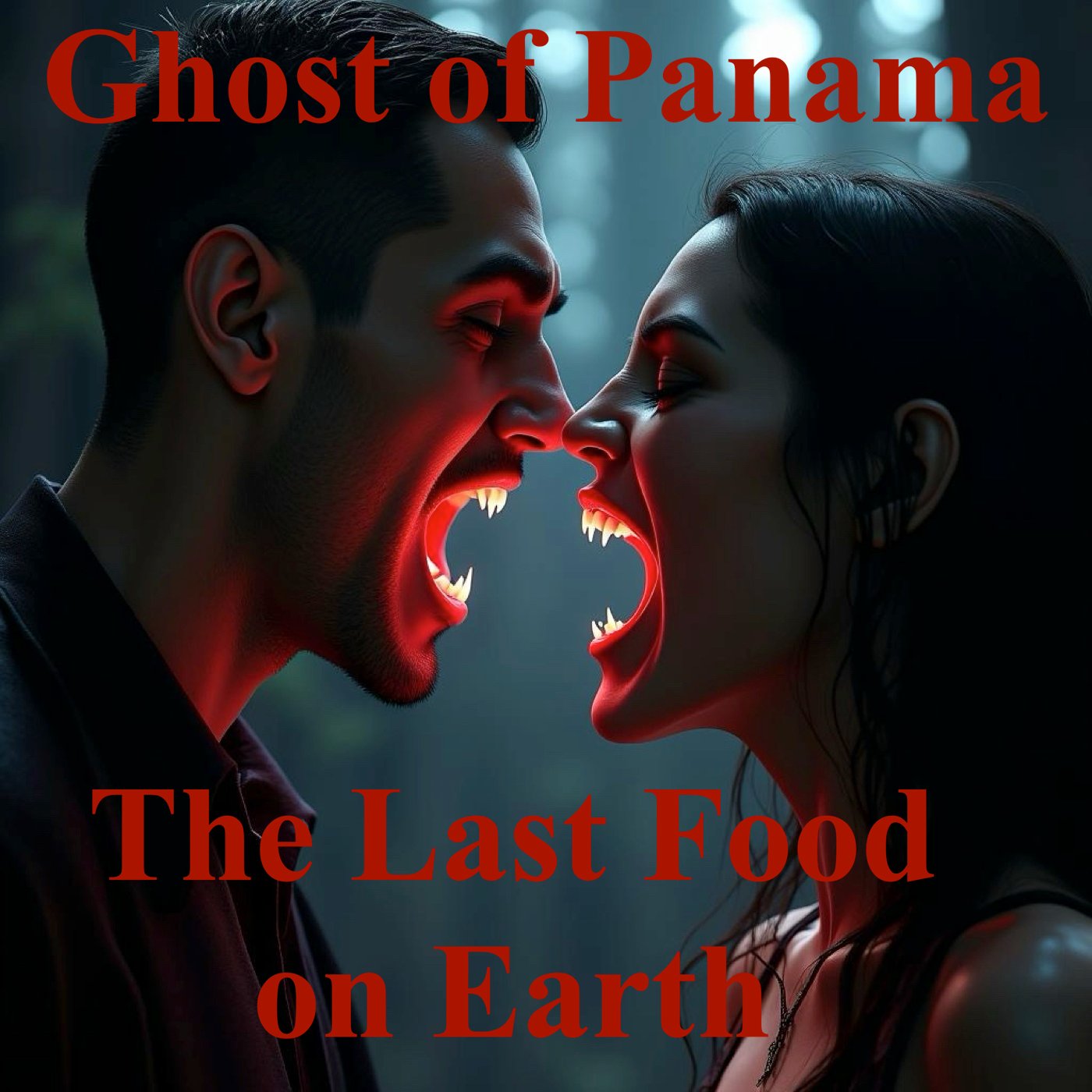
Concept albums can often struggle to find the balance between narrative and musical accessibility, often going too far into the story, where individual songs become secondary to the overall concept. Ghost of Panama avoids that pitfall with remarkable confidence on The Last Food on Earth, a ten-track collection that functions as an emotionally cohesive journey and a rewarding standalone listening experience. Already acknowledged by a trilogy of critically acclaimed EPs – The Wrecking of the Cargo King, Astral Days and Spectral Letters, and Before Records Began—Keith Welham and Cristabel Liu’s West London duo have shown a propensity for tackling familiar emotional themes from unusual perspectives. Their debut album takes that artistic philosophy and turns it into an immersive narrative, exploring the anatomy of a relationship from emotional captivity to eventual liberation. Ghost of Panama is about the evolution of heartbreak, exploring feelings of dependency, guilt, uncertainty, acceptance, and finally hope. The concept is a difficult premise that asks a lot from the listeners, but the duo’s thoughtful songwriting, inventive production, and steadfast commitment to atmosphere turn the album into an experience that rewards close attention. The Last Food on Earth, when the last notes fade, feels less like a collection of songs than the emotional document of a life changed beyond recognition.
One of the best things about the album is that it refuses to be pigeonholed by genre rules. Ghost of Panama channels the melodic sensibilities of 1980s alternative music, but with a restless punk and post-punk energy, all in a thoroughly modern package. There are familiar touchstones throughout the record, but they never obscure the duo’s own identity. Rather than resorting to nostalgia as a quick fix, Keith Welham and Cristabel Liu reinvent those sonic traditions with inventive arrangements and emotionally charged performances that feel decidedly contemporary. The album is a production that is both spacious and intense so that the quiet moments have as much impact as the explosive crescendos. Every musical decision feels driven by emotional necessity, not stylistic obligation, giving the record an organic quality and its conceptual frame a sense of authenticity, not made-upness. The album is an incredible balancing act of accessibility and experimentation, making even the most abstract passages emotionally intelligible. This delicate balance enables the listener to approach the record both on a surface level and an architectural level with the themes.
The album opens with the effective intro “The Lift,” which immediately establishes the emotional claustrophobia at the heart of the story. It creates a claustrophobic feel that naturally leads into “Stockholm Syndrome Reversed,” where psychological complexity begins to emerge through lyrics that explore emotional dependence from an unexpected perspective. This song is not about victimhood, but about the difficulty of recognizing an unhealthy attachment while still feeling drawn to it. This is one of the hallmarks of the album, this nuanced emotional writing. Ghost of Panama never gives in to easy stories; it always stands beside the contradictions of real relationships that can be unpredictable. “Half-Life” is one of the project’s most impressive achievements, for its emotional punch and its inventive production. The duo’s ability to subvert traditional songwriting without losing coherence is demonstrated by the use of breathing sounds and the unsettling rhythm of a Geiger counter recorded in London instead of conventional percussion. The final product is incredibly atmospheric, turning the mundane sounds of the environment into emotional instruments to enhance the sense of quiet decay in the song. It is experimental, certainly, but not for the sake of being so.
The middle section of the album is one of the most immediately engaging compositions as the story unfolds while remaining thematically consistent. “Damage” is one of the most potent melodic moments on the record, balancing emotional vulnerability with an infectious arrangement that never detracts from the seriousness of its subject matter. At the same time, “The Ultimate Maybe” captures the exhausting uncertainty that often follows emotional upheaval, portraying indecision not as a weakness but as a natural stage of healing. Few records investigate emotional ambiguity with such patience. Ghost of Panama allows the uncertainty to take its own emotional space, rather than rushing to easy answers, because the road to recovery is rarely an easy one. This willingness to sit in discomfort lends the album a remarkable psychological authenticity. When the melodies become more immediately memorable, the emotional complexity is still there, so that accessibility never comes at the cost of depth.
“Ghost of Your Perfume” is arguably the album’s most universally relatable moment among its standouts. The title itself suggests that memory lingers, and the song beautifully illustrates how everyday sensory experiences can reopen emotional wounds long after a relationship has ended. The piece, though, resists excessive melancholy, balancing sadness with quiet tenderness, acknowledging loss but retaining affection for what once was. Cristabel Liu’s lead vocal performance is particularly effective here, with an emotional restraint to her delivery that adds to the power of the words. Her voice is so expressive that it doesn’t need to rely on dramatic excess; the subtlest inflexions convey emotional nuance better than grand vocal flourishes ever could. Keith Welham’s instrumental contributions are equally important, textured arrangements that serve to support the vocal storytelling rather than compete with it. The duo has an intuitive musical chemistry that has been honed over years of writing together, and it shows in the deeply intertwined nature of their performances.
Later passages in the album grow increasingly expansive in scope and emotional ambition. The title track “Island” opens with a brooding sense of isolation that gradually unravels into the wide open spaces of “Siberia,” arguably the most cinematic of the album’s numbers. Here, Ghost of Panama accepts full-on spacious arrangements that evoke vast emotional and physical distances, reinforcing the narrative’s themes of loneliness, endurance, and transformation. The duo relies less on overt emotional cues and more on atmosphere in communicating meaning, letting instrumental textures bear as much narrative weight as the lyrics themselves. This confidence in musical storytelling is what sets the album apart from many other concept albums of the modern era that are heavily dependent on exposition. “Afterlife” continues this introspective momentum, exploring emotional survival in the wake of profound change, setting up the final chapter without resolving the story too early. Every song feels thoughtfully placed within the album’s framework, serving as both a standalone piece and a vital step in the larger emotional narrative.
The final track, “Northstar,” brings the album’s emotional arc to a deeply satisfying resolution. The last song, after nine songs full of doubt, sadness, self-reflection, and emotional rebuilding, gives a real sense of hope that feels earned, not made up. The slow build through the piece is representative of the slow emergence of hope after long suffering and the uplifting climax that recontextualizes everything before it. Crucially, Ghost of Panama does not imply that emotional healing erases pain from the past. Instead, “Northstar” accepts that hope coexists with, not in place of, memory. This emotional maturity keeps the ending from becoming sentimental while giving that sense of resolution that the narrative has patiently earned. It’s an ending that lingers, long after the music has stopped, leaving listeners to ponder not only the fictional relationship played out across the album but also their own journeys through love, heartbreak, resilience, and renewal.

The Last Food on Earth also deserves praise from a production standpoint. The album was recorded primarily in a modest project studio in West London and proves that artistic vision always wins over expensive resources. The imaginative use of found sounds recorded throughout the city gives the record a distinctive sense of place and underpins its emotional realism. Each production choice seems carefully considered, whether it’s the use of sparse arrangements to emphasize intimacy or embracing sweeping sonic landscapes that reflect the characters’ shifting emotional landscapes. The mix is clear, but not at the expense of atmosphere, so the finery of the instrumentals reveals itself naturally on repeated listens. The album also resists the constant temptation to over-polish every performance. Any small imperfections are kept to lend an emotional truth to the project, reminding the listener that vulnerability can often be more expressive than technical perfection. The album’s production approach is in line with the album’s central themes, and it emphasizes the album’s commitment to emotional honesty on all levels.
Ultimately, The Last Food on Earth cements Ghost of Panama as one of the most compelling new acts currently shaping the independent music landscape of London. Keith Welham and Cristabel Liu have created a debut album that is intellectually challenging but not inaccessible, emotionally devastating but not melodramatic, and musically adventurous but not unfriendly. From conceptual roots and complex songwriting to creative production techniques and intensely dedicated performances, the entire project coalesces to serve a singular artistic vision. The album’s take on relationships is so human because it embraces the complexity of the subject. With this, Ghost of Panama has made a record that will be listened to many times over and will reveal new emotional and musical details each time. The Last Food on Earth is not only an impressive debut full-length but also a bold artistic statement that highlights the duo’s incredible knack for turning deeply personal emotional experiences into compelling, universally relevant art. If this album is the next step in Ghost of Panama’s evolution, their creative journey is clearly just beginning.
For more information, follow Ghost of Panama
WEBSITE – TIKTOK – FACEBOOK – SPOTIFY – YOUTUBE – INSTAGRAM