

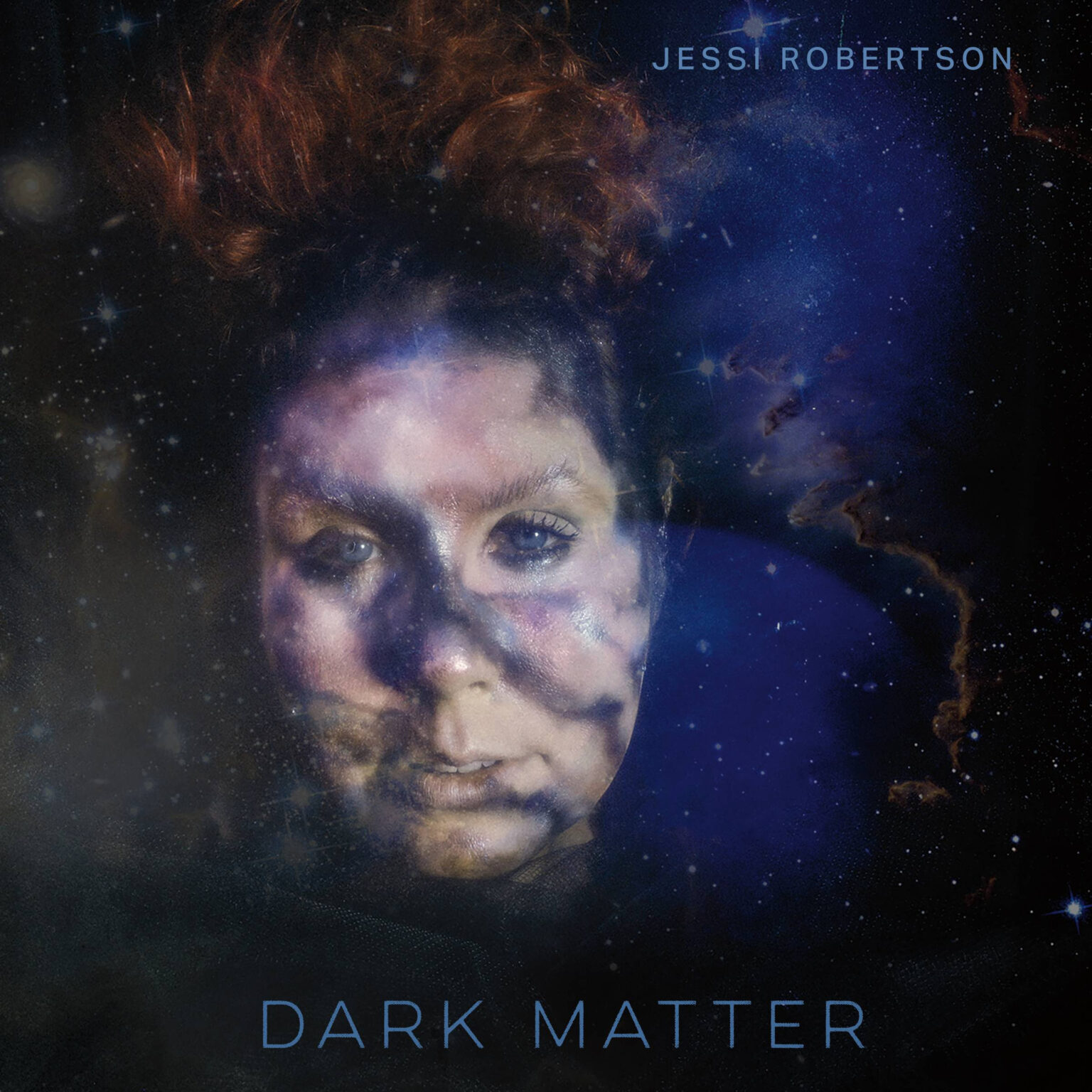
There’s a certain kind of quiet that follows self-discovery — not the peaceful kind, but the charged, electric stillness that hums with the knowledge that life will never be the same again. On Dark Matter, Nashville-based singer-songwriter Jessi Robertson captures that electric quiet and turns it into sound. Released on October 31, 2025, this album is as much an artistic statement as it is an act of personal reckoning. Robertson, once a fixture of Brooklyn’s indie underground and now a creative force in Nashville’s songwriter scene, merges her dual identities — urban grit and Southern lyricism — into something singular. Across eight haunting tracks, she uses the language of physics, astronomy, and dream states to explore the internal cosmos of identity, neurodivergence, and emotional rebirth.
The album’s title is fitting — Dark Matter refers not only to the unseen substance that holds galaxies together but also to the hidden parts of the self that make us whole. Robertson’s recent Autism Spectrum Disorder diagnosis becomes the gravitational centre of the record, drawing meaning and vulnerability into orbit around it. The songs here aren’t confessions in the traditional sense, but observations from someone who’s been mapping her own consciousness, decoding the mysteries of perception and emotion like a scientist studying the stars. The production, handled entirely by Robertson herself, mirrors that introspection: sparse, layered, and quietly cosmic. It’s an album that sounds like solitude — the kind that isolates and illuminates.
The opener, “Spooky Action at a Distance,” sets the tone with its hypnotic rhythm and spectral guitar work. The title references Einstein’s phrase for quantum entanglement — the phenomenon of particles affecting one another across vast distances — and Robertson uses it as a metaphor for human connection that defies logic or explanation. Her voice drifts between intimacy and detachment, simultaneously close enough to whisper and far enough to sound like an echo from another dimension. The programmed drums pulse softly under reverb-drenched guitars, creating an ethereal and grounded atmosphere. The song feels like an awakening — the moment when you realise that the universe within you is infinite but not always kind.
“Shadow War” deepens that tension, pulling listeners into an emotional battlefield where inner conflict reigns supreme. The arrangement is sharper here — brittle percussion, jagged guitar chords, and an undercurrent of distortion that mirrors the chaos of fighting one’s own mind. Robertson’s lyrics touch on masking, survival, and the subtle violence of constantly trying to appear “normal.” There’s a raw honesty in her phrasing, the way she sings about exhaustion without surrendering to it. It’s an anthem for anyone who’s lived in disguise, whose everyday feels like a balancing act between authenticity and acceptance. The track closes with a sudden drop into silence — a sonic metaphor for the emotional burnout that follows constant internal warfare.
By the time “In Dreams Awake” arrives, the record begins to shift from conflict to contemplation. The song unfolds like a slow sunrise through fog. Dreamlike synths shimmer around delicate guitar phrases, while Robertson’s vocals — weary but resolute — float above. The lyrics explore the thin boundary between dreams and waking life, asking what’s real when your perception of the world has always felt slightly out of phase. There’s beauty in that uncertainty, and Robertson leans into it. “I wake in another version of me,” she sings, capturing the surreal experience of self-discovery after years of unknowing. The track builds subtly, layering textures until it dissolves into ambient haze — a reminder that clarity often comes wrapped in confusion.
One of the record’s most striking moments arrives with “The First Law of Thermodynamics,” a title that could easily belong to a physics lecture but here becomes an emotional mantra. The song explores the idea that energy — and by extension, emotion — can never be destroyed, only transformed. The steady rhythm and circular chord progression evoke the cycle of self-renewal, of pain turning into resilience. Robertson’s voice rises and fractures, repeating the refrain “nothing’s ever lost, only changed” — a line that resonates beyond science. In her hands, it becomes a statement of survival, of learning to find beauty in transformation instead of fearing it.
Then comes “Einstein-Rosen Bridge,” perhaps the album’s emotional core. The title refers to a theoretical wormhole — a bridge between two points in spacetime — but in Robertson’s universe, it’s a bridge between the person she used to be and the one she’s becoming. Musically, it’s one of the album’s most cinematic moments: layers of echoing guitars, spectral harmonies, and minimalist percussion that feels like the slow heartbeat of the cosmos. Her voice is softer here, almost tender, as if she’s speaking to a younger version of herself. “I’ve built a tunnel through my fear,” she sings — and it feels like a confession, an acknowledgement that even black holes can lead to light.
The closing sequence of “Persistent Memory,” “Rogue Star,” and “Object of Desire” completes the emotional arc of Dark Matter with quiet grace. “Persistent Memory” is sparse and aching, built around a looping guitar motif that mirrors the way certain memories replay endlessly in the mind. “Rogue Star” introduces a sense of liberation — it’s looser, more expansive, the sound of breaking free from gravitational pull. The closing track, “Object of Desire,” brings the album full circle. It’s tender and haunting, exploring the strange duality of being the observer and the observed — a nod, perhaps, to Robertson’s lifelong experience of feeling out of sync with the world yet hyper-aware of it. The final notes fade like light from a dying star, leaving the listener suspended in reflection.

What makes Dark Matter so powerful is the courage behind it. Robertson doesn’t shy away from her neurodivergent identity; she builds her art around it, translating the complexities of perception and emotion into music that feels universal. The scientific metaphors — black holes, quantum bridges, thermodynamics — are not gimmicks, but symbols of how she understands the world: through systems, energy, and interconnectedness. It’s a deeply intellectual record, but also profoundly human. In an era obsessed with external validation, Dark Matter is an inward journey — one that invites listeners to confront their own unseen forces.
In the end, Dark Matter isn’t about darkness at all, but illumination — the kind that only comes when you dare to look into the void and find yourself staring back. Jessi Robertson has crafted an album that’s deeply personal and cosmically vast, a work that bridges science and soul, intellect and emotion. It’s a map of the invisible — proof that the heaviest parts of us, the ones we can’t always name or show, are the very things that hold us together.
For more information, follow Jessi Robertson:
Website – Facebook – Spotify – Instagram – YouTube – Bandcamp