
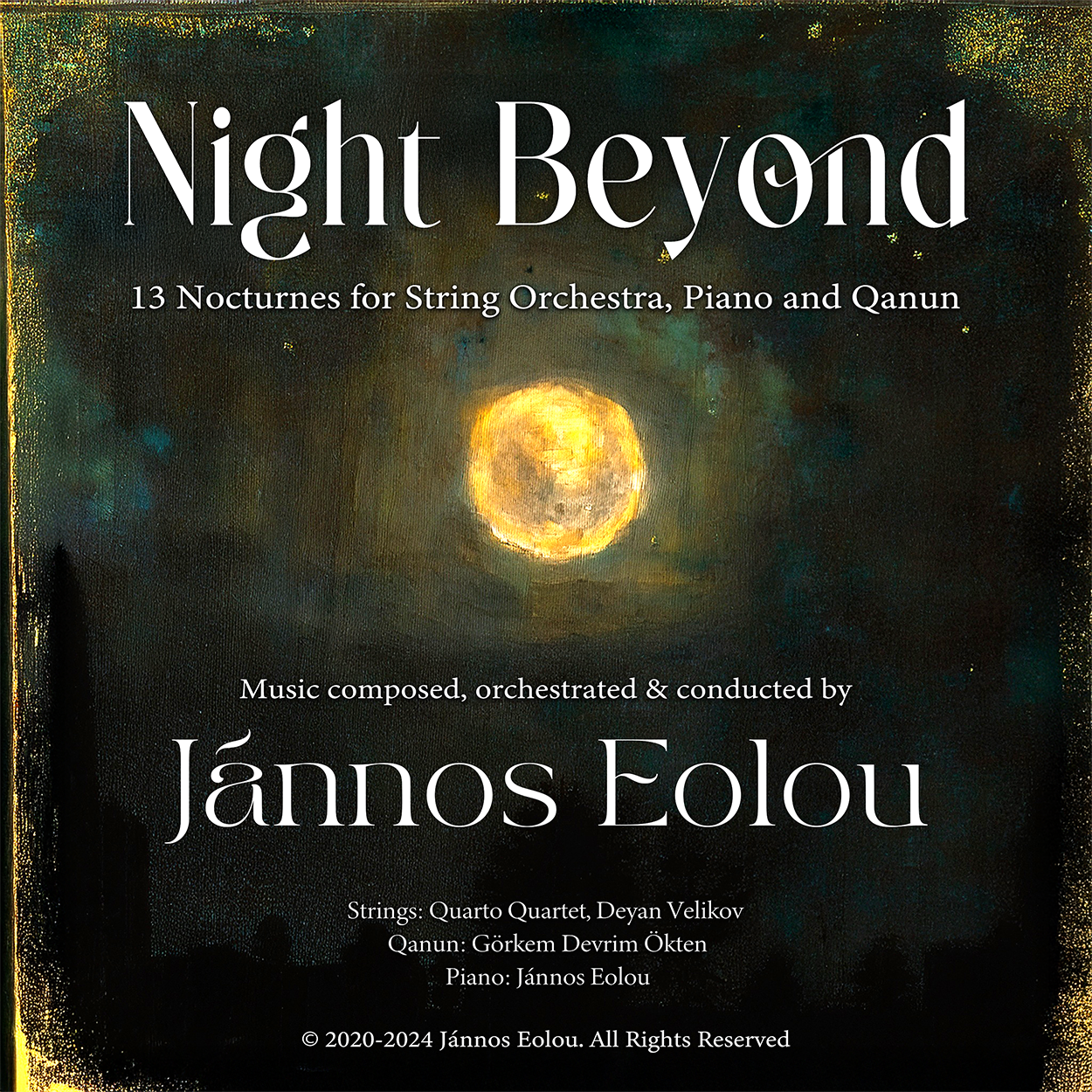
Jannos Eolou’s Night Beyond is a place you enter. Across thirteen nocturnes, Eolou invites the listener into a long, slow Mediterranean night where time loosens its grip and emotions drift like constellations overhead. Drawing from more than twenty-five years of compositional language rooted in string orchestra and piano, and enriched by the unmistakable warmth of the qanun, Night Beyond feels ancient and strikingly present. It is an album built on restraint rather than spectacle, atmosphere rather than climax; in doing so, it becomes deeply immersive. From the first notes, it is clear that this work is less about telling a story outright and more about creating a space where personal reflection, memory, and quiet wonder can unfold.
The concept at the heart of Night Beyond gives the album its emotional gravity. Eolou frames the night as the most primordial image of “everything”: a protective veil, a meeting point between the known and the unknowable, a symbol that contains both comfort and awe. Night, in his vision, is timeless yet constantly changing, a paradox that mirrors human experience itself. This philosophy seeps into every corner of the album. The music moves slowly, deliberately, as if aware that it is carrying centuries of starlight and the fleeting thoughts of the present moment at the same time. There is no rush here, no demand for attention; instead, the album gently encourages the listener to slow down and align with its pace, to exist within the music rather than skim across it.
“Unwatched Stars,” the opening track, sets the tone with remarkable clarity. The string orchestra unfolds with quiet assurance, creating a sonic canopy that feels expansive yet intimate. It evokes the sensation of standing alone beneath a sky full of stars no one else seems to notice, where silence feels alive rather than empty. The piano enters not as a soloist demanding focus, but as a companion, offering soft gestures that feel almost conversational. This opening piece establishes the album’s cinematic quality, though not in a grand, film-score sense. Instead, it feels like an inner cinema, scoring moments of introspection that rarely make it onto the surface of daily life.
As the album moves into “Your Breath” and “Kaleidoscope,” Eolou begins to explore subtler emotional shifts. These pieces are tender and inward-looking, shaped by small harmonic changes that suggest memory, closeness, and fleeting intimacy. There is a sense of emotional trust here: Eolou does not explain what the listener should feel, nor does he dramatise the moment. Instead, he allows the music to hover in ambiguity, creating room for personal associations to emerge. The qanun’s presence becomes more noticeable in these moments, adding a delicate shimmer that feels distinctly Mediterranean without ever leaning on obvious stylistic tropes.
“Breakwater” and “Under the Same Sky” expand the album’s sense of scale. Here, the string orchestra opens outward, hinting at coastlines, sea air, and moonlit horizons. These tracks feel communal in spirit, as if acknowledging the countless lives unfolding simultaneously under the same night sky. There is a quiet universality in this section of the album, a reminder that night belongs to everyone, regardless of geography or circumstance. The Mediterranean influence is not presented as a cultural label but as an emotional temperature: warm, fluid, and gently resonant, like stone walls holding onto the day’s heat long after sunset.
One of Night Beyond’s greatest strengths is its ability to explore heavy emotional territory without becoming burdensome. Tracks such as “Unwritten Letter” and “Due is the Night” feel reflective rather than sorrowful, circling thoughts left unfinished and emotions never fully expressed. The piano plays a particularly important role here, offering fragile, human-scale gestures against the sustained breath of the strings. These pieces capture the kind of late-night thinking where clarity and confusion coexist, where acceptance begins to form even as questions remain unanswered.
“Requiem for a Smile” emerges as one of the album’s most affecting moments. It carries the weight of loss, but not in a dramatic or despairing way. Instead, it feels like a quiet act of remembrance, holding onto warmth even as something gently recedes into the past. The music suggests gratitude alongside sadness, a recognition that what was once present still leaves a trace. This emotional balance—between melancholy and grace—runs throughout Night Beyond and gives the album its enduring resonance.
In “Your Hands” and “Perseids,” the album leans into intimacy and wonder. “Your Hands” feels close and tactile, as though the music itself is reaching out, while “Perseids” captures the fleeting beauty of a meteor shower with subtle surges and glimmers in the orchestration. These tracks highlight Eolou’s gift for translating natural phenomena into sound without imitation. Rather than mimicking falling stars, the music captures the feeling they leave behind: brief amazement, quiet joy, and the awareness of how small and connected we are beneath the vast sky.
As Night Beyond approaches its final stretch, “Vortex” and “Night in Pieces” introduce a gentle sense of unrest. The harmonies become slightly more unsettled, reflecting the restless thoughts that often surface in the deepest hours of the night. Yet even here, Eolou resists chaos. The tension feels purposeful, controlled, as if acknowledging that uncertainty is a natural part of reflection rather than something to be feared. These tracks act as a bridge between introspection and release, preparing the listener for the album’s closing moment.
“After You Left” concludes the album with a sense of quiet resolution. It feels like the final moments before dawn, when the night begins to loosen its hold without fully disappearing. There are no grand conclusions or dramatic statements, only space to breathe and to accept what has passed. Night Beyond ultimately rewards patience and attentiveness, offering layers of meaning to those willing to listen deeply. In a world driven by noise and immediacy, Jannos Eolou has created an album that honours stillness, continuity, and the profound humanity of the night itself.
For more information, follow Jannos Eolou:
Website – Spotify – YouTube – Facebook