
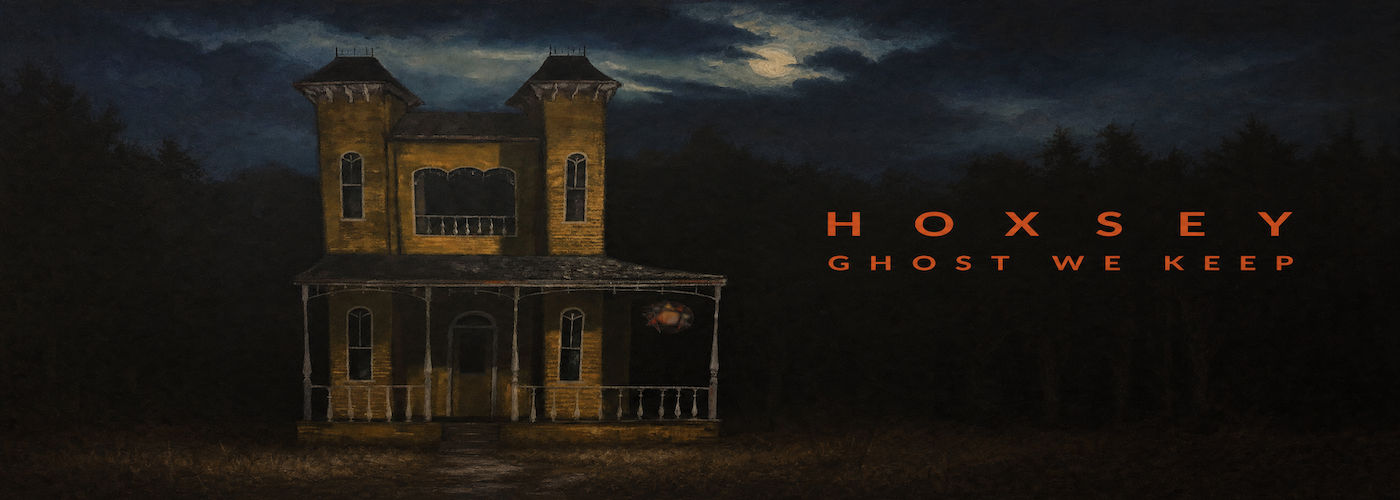
Some Halloween albums contain the obvious decorations already in place: predictable ghosts, familiar screams, theatrical effects, and a range of musical tricks meant to create a fleeting sense of terror. Then there’s Hoxsey’s Ghost We Keep, which understands that the most lasting ghosts are seldom the ones hiding behind a curtain. The 11-track album is out August 25, 2026. The album enters the darkness through a very different doorway, building a world of traveling circuses, forgotten towns, dusty roads, mysterious performers, and memories that won’t stay buried. Austin indie artist Hoxsey taps into a personal mythology for his alternative music, fusing indie rock, punk energy, gothic textures, acoustic elements, and experimental soundscapes into something that feels less like a traditional album and more like a film in the listener’s head. Hoxsey, who worked with Peppermilk, also describes the project as being produced in partnership with Mrs. Fields, creating an atmosphere that is both theatrical and intimate. Ghost We Keep certainly anticipates Halloween but does not depend on the holiday to prove it exists. Underneath the strange symbols and eerie images is an album about what remains when the lights go out. People we can’t forget, places we have abandoned, mistakes that continue to haunt us, and fragments of ourselves that somehow survive every attempt to move on.
The opening cut, “Skeleton Key,” is a suitably creepy invitation into this strange universe. There is no cheap jump scare of darkness; instead, the song creates a sense that something is waiting just outside the camera’s frame. The vocals are creepy, the drums pounding, and the pulse of the thing is just slightly off. It feels like you’ve come to some place after everyone’s gone home. The arrangement has a near-cinematic suspense to it, like the song is opening a locked door while deliberately revealing only some of what’s behind it. That is precisely where the title makes sense. The skeleton key is meant to open doors that were never meant to be closed, and Hoxsey treats the track as a kind of musical invitation to walk into rooms full of old memories. “Skeleton Key” doesn’t break down the album immediately but instead lets the atmosphere do the work. It has the vibe of an old roadside attraction, whose sign’s missing a few letters but still manages to attract curious travelers off the highway. The drums are pushing momentum, the vocals are injecting unease, and the textures surrounding them are hinting at a developing narrative. When “The Road” begins, the energy changes, and the change in tempo feels intentional. Suddenly, the listener is in motion, not just observing, plunging deeper into Hoxsey’s bizarre universe with the unsettling knowledge that there may be no clear way out.
And that sense of motion is one of the most compelling elements of Ghost We Keep. This is an album that seems to understand music in a physical way. You don’t just listen to these songs, you travel through them. Dirt roads, carnivals, abandoned spaces, and nocturnal landscapes become recurring psychological scenery, each track feeling like another stop on a journey with an uncertain destination. “The Introduction of Sgt. Capone” adds another character to the growing mythology, while “A Ride With the Four Horsemen in 1888” takes the storytelling into something more historical, fantastical, and purposely mysterious. The titles alone suggest that Hoxsey is not interested in the usual verse-chorus economy of a mere collection of songs. There is a cast here, a chronology, and a world outside the edges of each individual track. But the album never needs to spell everything out. That restraint is important because it creates room for the listener to step into the story. One hears the Four Horse Men as a piece of supernatural theater. Another hears them as symbols of mortality, history, or inevitable change. The music allows for both readings. Hoxsey’s diary-like approach to songwriting makes these larger-than-life characters feel oddly personal, as if they were taken from memory and made into carnival figures simply because ordinary language wasn’t strange enough to contain them.
Working with Peppermilk helps a lot in keeping that unpredictable vibe. What Ghost We Keep does is not fit into any one genre, and that’s not a weakness but part of its identity. Alternative rock provides a foundation, indie rock adds looseness and a melodic instinct, punk adds urgency, and gothic elements deepen the shadows around the material. Experimental touches prevent the arrangements from becoming too predictable, and acoustic add-ins can suddenly make the expansive theatrical world feel surprisingly close and human. “Charm Cider,” “Pixelated Whorror,” “Scratches Julian Man,” and “Corpses Ball Room” sound like titles of a deliberately distorted dream, titles that seem to belong to some forgotten poster advertising an attraction no one can quite explain. There’s also a mischievous streak to the darkness. Hoxsey doesn’t treat weirdness as something that has to apologize for itself. Instead, the album embraces eccentricity as a valid artistic language. It gives Ghost We Keep a pleasingly handmade feel, even when its ideas get grand. It’s as if the listener has come across a traveling troupe, who have spent years crafting their own private mythology, and instead of providing a tidy explanation at the gate, they just pull back the curtain and invite everyone in.
But the album wouldn’t have the same emotional staying power if it were nothing more than an elaborate collection of spooky characters and haunted scenery. What really makes Ghost We Keep stand out, though, is how the supernatural imagery stands for very human concerns. Memory, mortality, identity, nostalgia, abandonment, and regret are beneath the surface. The ghosts are compelling because they can be read as metaphors for the people and experiences that continue to exist long after they have physically ceased to exist. We all have places we carry with us. We remember people who have disappeared out of our lives, sometimes in love and sometimes in pain. There are choices we look back on and wish we had gone another way. In a song, a road, a smell, a familiar name, we encounter old versions of ourselves, without warning. Hoxsey translates those daily hauntings into an imaginative landscape where such feelings can become corporeal. The end result is an album that knows an important fact about nostalgia: remembering isn’t always comforting. There are times when the pain of memory is what makes it beautiful. Sometimes the past becomes more alive because it cannot be recovered. Ghost We Keep is poised in that contradiction, finding beauty in the disquieting truth that what we lose can still shape us.
This emotional depth is even more important in the quieter moments of the album. “Josaphina” is a quieter, more private counterpoint to the theatrical passages, a reminder that behind the carnival imagery is a songwriter who can take it down a notch and let vulnerability be the star. In the same way, “The Road” is more than a bridge to another part of the record. It moves at a faster pace—there is forward momentum, but there is an emotional ambiguity to that movement. A road can mean escape, discovery, freedom, or just the inability to stay in one place long enough to face what’s waiting there. On Ghost, we keep movement and memory always intertwined. The traveler moves on, but the ghosts travel. That thought lends a surprisingly pensive heart to the album. The theatrical characters may have the scenery by the throat, but the underlying question is intimate: what do we take with us when we leave? Hoxsey offers no easy answers, and the album is better for it. Rather, the songs let their odd environments act as mirrors. Carnival turns to memory. The road is time. The ghost is the part of the past that does not go away. The album’s quirkiness suddenly feels less like decoration and more like emotional architecture.
Hoxsey’s ability to make macabre images theatrical rather than simply frightening was shown again in “Corpses Ball Room.” The title immediately brings to mind a grotesque dance floor, but the larger context of the album implies something much more compelling: the dead are not there to scare the living; they are the very thing that continues to move inside our memories after its moment has supposedly passed. It also helps explain why Ghost We Keep works outside of the Halloween season. Its esthetic preoccupations may be rooted in autumnal gloom, ghosts, strange performers, and abandoned places, but its emotional preoccupations are universal. Halloween simply has the perfect visual language. Hoxsey can talk about death because the album has already created a world where death is part of the scenery. And it is an extraordinarily successful disguise: a record that at first seems to be a seasonal novelty but slowly unfolds into a meditation on permanence, disappearance, and the strange ways people endure through memory. Even the album’s more unusual moments contribute to this effect. Weirdness is the space between us and the normal world that allows us to explore difficult ideas without being heavy-handed. In the same stretch of music there is space for playfulness, eeriness, melancholy, theatricality, and reflection.
Ultimately, Ghost We Keep is at its most powerful when it doesn’t try to show it’s scary, but when it understands that haunting is a much wider emotional range. The sheer scale, imagination, and unique visual identity of the album are certainly a testament to Hoxsey’s ambition to create what could be a Halloween classic for generations, but the lasting appeal will probably come from everything that lies beneath that ambition. This is music about things that outlive us and memories that outlive their original circumstances. It’s about roads we took, people we knew, places we left behind, identities we outgrew, and mistakes that sometimes come knocking at the door long after we thought we locked it. Theatrical storytelling wraps the ideas, and genre-blending production gives them movement and atmosphere. By the end of the journey, Ghost We Keep feels less like a Halloween record than a haunted scrapbook: pages filled with faded faces, strange encounters, and half-remembered towns and stories that have changed slightly each time they’ve been told. Hoxsey has created a world that is strange enough to make you curious and human enough to make you know it. It’s that balance that makes the album memorable. Ghost We Keep is like a deserted carnival glowing faintly at the end of a dark road, inviting us to come closer, knowing that what awaits inside may be beautiful, ridiculous, unsettling, or sad. It could be all those things, all at once. And perhaps that’s the point. The ghosts we keep are rarely simple. They are part of the story we still carry, long after the carnival has packed up and gone.
For more information, follow HOXSEY
WEBSITE – FACEBOOK – SPOTIFY – YOUTUBE – INSTAGRAM