
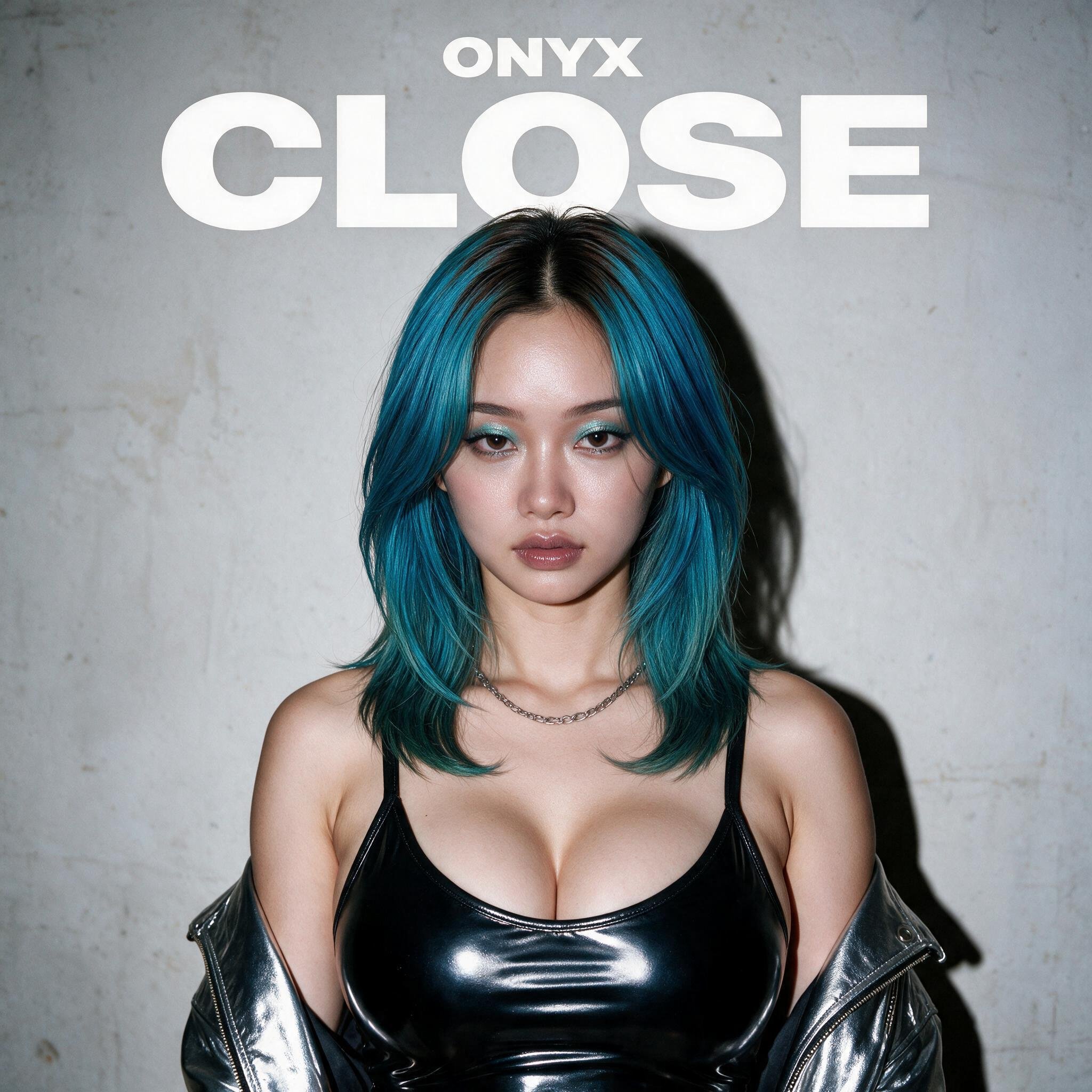
Novaix Onyx’s CLOSE is the kind of EP that understands how much can be communicated through a single word. Across six tracks—“Handle,” “Hold It,” “Loaded,” “Rush,” “Close,” and “Under”—Onyx builds a compact world where language, rhythm, attitude, and physical movement continually overlap. Every title carries two meanings, and that structural decision gives the project an intriguing conceptual backbone: each song occupies the space between what a word appears to mean and what it reveals once the music starts moving around it. Onyx is a Korean-American rapper and the first artist signed to Novaix Entertainment, and her sound sits in an unusually contemporary meeting point between UK dance music and Korean pop. Garage and house production provide the kinetic foundation, while a rapper-first vocal approach keeps personality and rhythmic delivery at the center. There is a polished dance-floor instinct throughout CLOSE, but the EP does not feel interested in becoming anonymous club music. Instead, it uses club language to explore control, proximity, attraction, resistance, and, eventually, the unsettling possibility of losing control altogether. That progression makes the project more compelling than a collection of six sleek dance tracks. Beneath the bass, drums, and hooks is a carefully constructed narrative about a woman who initially appears to dictate every boundary, only for those boundaries to become something she has to confront herself. The EP therefore works on two levels at once: it is immediate enough to move to, but its wordplay encourages listeners to look closer.
“Handle” provides a fitting entry point because the word itself immediately suggests command, capability, and pressure. To handle something can mean managing, controlling, or simply coping with what is placed in front of you. In the context of CLOSE, that ambiguity becomes part of Onyx’s persona. She enters the project with an air of someone who knows exactly where she stands and expects everyone else to adjust accordingly. The production’s UK dance influence gives that attitude a physical shape. Garage-derived rhythms are particularly effective for this kind of character because their skippy movement never feels completely settled; the groove keeps leaning forward, leaving just enough space for a rapper to play with timing and emphasis. Onyx’s vocal approach is similarly important. Rather than treating the voice as another layer of electronic decoration, the project puts rap instincts at the forefront, allowing phrasing and attitude to become rhythmic instruments in their own right. That approach connects naturally with the Korean pop side of the aesthetic, where hooks, performance, and sonic polish can coexist with sharply defined character. Yet CLOSE does not sound like it is trying to prove that these worlds can coexist. It simply inhabits the space between them. The result is sleek without being sterile, club-oriented without becoming predictable, and modern without abandoning the directness of rap. Even the EP’s recurring emphasis on short, loaded words reinforces the impression that Onyx is saying more than she initially lets on.
“Hold It” and “Loaded” deepen that sense of pressure while pushing the project further into physical territory. “Hold It” can sound like an instruction, a refusal, or a challenge depending on who is speaking and why. “Loaded,” meanwhile, carries an obvious sense of being armed with something, but it can also describe a person or situation saturated with tension, expectation, or emotional weight. The latter track is particularly significant because it predates the EP as a bass house single, giving listeners a point of entry into the world that CLOSE expands. Rather than feeling like an unrelated earlier release suddenly attached to a new project, “Loaded” makes sense as part of the EP’s larger vocabulary of pressure and control. Bass house gives the track a heavier physical presence, allowing the low end to function almost like a second voice. The contrast with the more skittering garage influences elsewhere in the project helps demonstrate the range available within Onyx’s dance-oriented framework. Across these tracks, control initially feels like a strength. The language is assertive, the beats are purposeful, and the vocal performance carries the confidence of someone who appears to know exactly what she wants. Yet there is already a hint that control can become performance. To maintain authority, one must continue to project it. That tension is essential to the EP because CLOSE is ultimately not about a character who possesses unlimited power; it is about what happens when the appearance of power begins to crack.
“Rush” is where that tension becomes especially compelling. The word describes speed, urgency, adrenaline, and emotional acceleration, but it can also describe the feeling of being overwhelmed by something that arrives too quickly to process. That duality fits perfectly within an EP concerned with the unstable relationship between control and impulse. Musically, the project’s dance vocabulary gives “Rush” a natural environment in which those ideas can collide. House music is built around repetition and release, while garage introduces rhythmic displacement and unpredictability, creating an ideal sonic metaphor for someone attempting to stay composed while everything around them accelerates. Onyx’s rapper-first delivery makes the emotional tension more immediate because rap can move from restraint to attack within a few syllables. The voice does not need a significant melodic range to create drama; rhythm, articulation, confidence, and the placement of words against the beat can do the work. This is one of the strengths of CLOSE: the project understands that dance music does not require emotional simplicity. A beat can make the body move while the lyrics suggest uncertainty. A hook can sound seductive while the narrative underneath it becomes increasingly defensive. The EP’s compact length works in its favor here because there is little room for the concept to wander. Each track introduces another shade of the same central tension, allowing the listener to recognize the pattern while waiting to discover where it will ultimately lead.
Then comes “Close,” the title track and conceptual center of the EP, where Onyx turns a deceptively simple word into the project’s most revealing metaphor. To be close is to be near someone, physically or emotionally; to close is to shut something, end access, or bring an opening to an abrupt finish. Those meanings coexist throughout the track, which is built on UK garage house at 134 BPM. Skippy two-step drums and off-grid snares dance around a steady four-on-the-floor kick, while stabbing organ bass and rolling sub frequencies provide the groove both bounce and weight. A sung, 90s-flavored vocal riff runs through every section, functioning as the track’s connective thread and giving the production a memorable melodic fingerprint. Yet the most effective structural choice comes in the second half, when Onyx shifts from smooth, low sing-talk into a sharp, fast rap verse. Rather than relying on a conventional EDM drop, that rap passage becomes the energy peak. It feels like the record suddenly finds another gear without abandoning its groove. Lyrically, “Close” is about proximity and refusal: everyone reaches the same point with Onyx, but nobody gets beyond it. The two verses play as a taunt, establishing the impression that she controls access completely. Then the bridge complicates everything. She is not standing outside guarding the door; she is inside, listening to it shut, and she did not close it. That reversal transforms the title from a flirtatious command into something much more ambiguous. Nearness has become separation. Confidence has become uncertainty. What sounded like control may actually be the experience of having control taken away.
“Under” brings that conceptual shift into sharper focus because the word itself can suggest position, submission, concealment, pressure, or something existing beneath the obvious surface. After the assertiveness established earlier in the EP, “Under” feels like a natural place for the project’s perspective to become less certain. This is where CLOSE reveals its most striking idea: control can begin as a boast, become a performance, and eventually become something that happens to you. That progression prevents the EP from being reduced to a straightforward collection of attitude-driven dance records. Onyx’s persona is compelling partly because she is not frozen in one emotional state. The early tracks encourage us to see her as someone setting the terms, while the later material suggests that those terms may not be entirely hers to dictate. The disclosed use of generative AI in Onyx’s performance and visuals adds another layer to that theme without needing to become the subject of the music itself. Novaix Entertainment openly identifies Onyx as an AI artist, while the songwriting, lyrics, arrangement, creative direction, and mixing decisions remain human-led. That distinction matters because CLOSE is fundamentally interested in the relationship between agency and performance. The project asks who is directing the scene, who is performing control, and who is actually experiencing the consequences. In that sense, the human-directed creative framework and generative performance model create an intriguing parallel with the EP’s own concerns, even as the songs remain focused on their own lyrical and musical world.

Taken as a whole, CLOSE is a sharp and tightly designed six-track EP that makes its biggest impression by refusing to separate clever wordplay from physical musical energy. “Handle,” “Hold It,” “Loaded,” “Rush,” “Close,” and “Under” each contribute another piece to a narrative in which control initially looks effortless before becoming increasingly complicated. The project’s Korean-American identity is reflected not through a forced fusion of genres, but through a natural coexistence of Korean pop sensibility, English-led lyrics with Korean woven into the hooks, and UK garage and house production built around movement. Reference points such as PinkPantheress, Sammy Virji, XG, and KiiiKiii help locate the sonic territory, but Onyx’s rapper-first approach gives the project its own center of gravity. Most importantly, CLOSE understands that a dance record can have an idea underneath its surface without sacrificing immediacy. These songs are built to groove, but they are also built around words that keep changing meaning as the EP progresses. By the time the title track reaches its abrupt stop instead of offering a traditional climactic release, it has prepared the listener for that refusal. Nothing is neatly resolved. The door closes, the music stops, and the ambiguity remains. That is an effective ending for a project so concerned with boundaries because CLOSE ultimately leaves us standing on the other side of one, wondering whether Onyx chose to shut it—or whether someone else did.
For more information, follow NOVAIX ONYX
SPOTIFY – YOUTUBE – INSTAGRAM – TIKTOK