
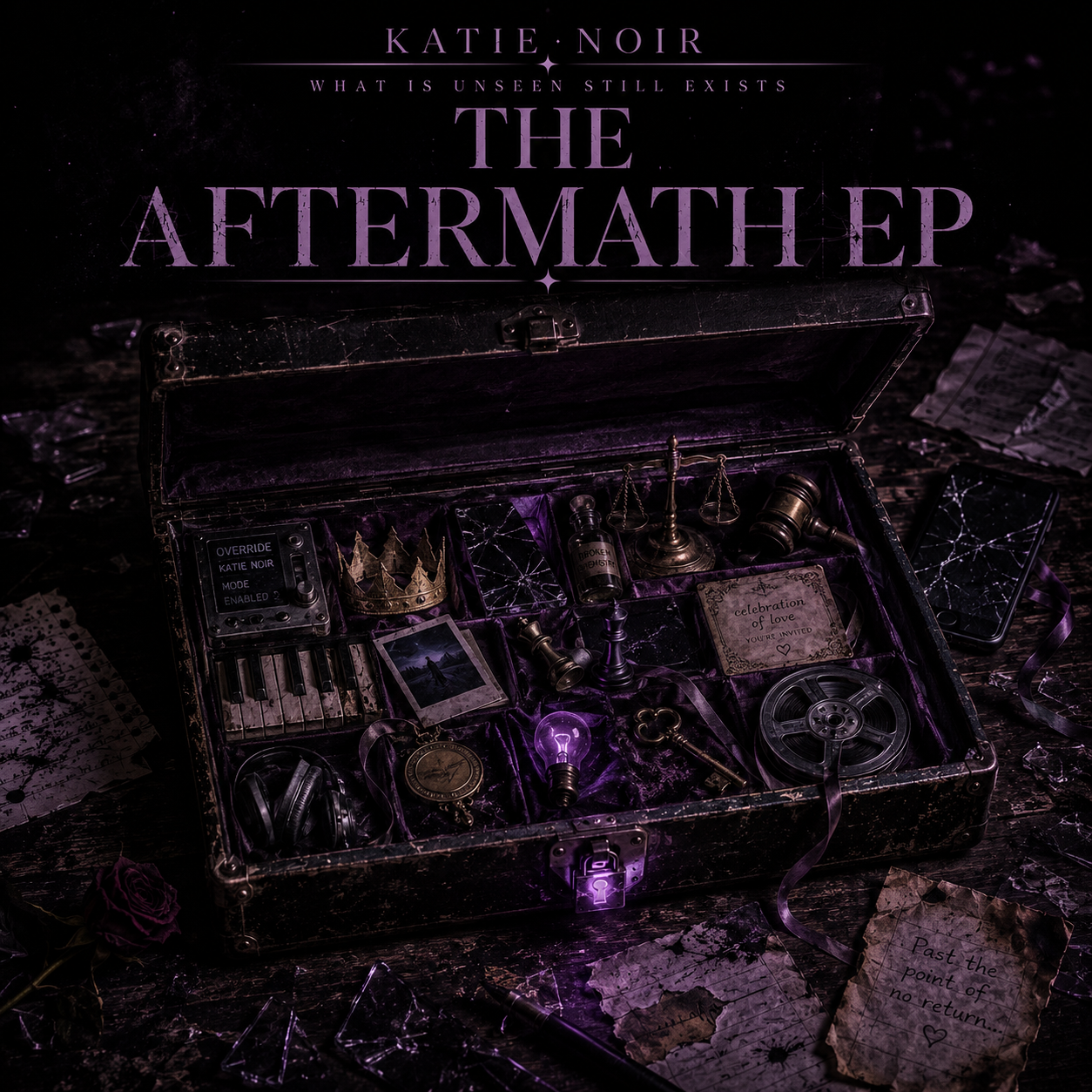
Katie Noir’s The Aftermath EP begins with an unusually compelling premise: what happens after you finally let people see the parts of yourself you have spent years protecting? Released on 7 September 2026 through Noir Records, the 15-track project functions as a direct continuation of her 23-song debut album, What Is Unseen Still Exists, but it is important that the result is not simply an extension of the same creative exercise. The debut represented a private inner world becoming music; The Aftermath documents what happened when that private world suddenly became public and began generating consequences. New relationships, changing friendships, industry encounters, increased visibility, uncomfortable exposure, and questions about identity all become material for a project that feels less like a collection of leftover songs than a second act written in real time. Noir divides the EP into five chapters—The Reality, The Vulnerability, The Healing, The Loyalty, and The Acceptance—and that structure gives the project a strong narrative spine without making it feel overly rigid. Musically, she moves through alternative pop, hip-hop, electronic textures, R&B, and cinematic songwriting, using each style as an emotional instrument rather than treating genre as a permanent destination. That flexibility suits an EP concerned with changing circumstances because the music itself is constantly adapting to whatever the story requires. The Aftermath understands that releasing deeply personal work does not conclude the emotional process that created it. Sometimes it begins another one. The songs exist, other people have heard them, and suddenly private thoughts can be interpreted, questioned, misunderstood, celebrated, or claimed by audiences who were never present when those thoughts were first formed. Noir turns that uncomfortable reality into the central dramatic force of the record, creating a project that feels immediate because its subject is not simply what happened in the past, but what continues to happen once the past becomes visible.
The opening chapter establishes that tension with a sequence that moves from defiance toward a much more complicated form of vulnerability. “Factory Preset” immediately rejects the idea that a person should simply conform to an externally programmed identity, setting an appropriately confrontational tone for a project concerned with the pressure of being seen and understood by others. “Paper Crown” then shifts the focus toward the less glamorous machinery surrounding artistic exposure: bureaucracy, distribution, systems, and privacy fears that nearly prevented the debut from reaching listeners in the first place. There is something fitting about placing these songs at the beginning because The Aftermath is not only about emotional consequences; it is also about the practical reality of putting intimate art into the world. The artist can control what she writes, but she cannot fully control what happens once the work begins moving through systems, platforms, audiences, and relationships. “Vulnerability Hangover” sharpens that idea by capturing the emotional crash that follows an act of honesty. There is a particular cruelty to realizing that something private cannot be made private again once it has been shared, and Noir turns that feeling into a memorable concept. The phrase itself sounds almost playful, but underneath it sits an uncomfortable psychological truth: vulnerability can feel liberating in the moment and exposing afterward. “If I Needed You Yesterday,” “No Love No Pain,” and “Hypocrite” deepen the instability, bringing attachment, absence, contradiction, and self-examination into increasingly personal territory. “Hypocrite” is especially intriguing because its emotional staging resembles a courtroom in which the accusation eventually turns back toward the person making it. Noir does not settle for the easy satisfaction of identifying contradictions in other people. She asks whether some of those same contradictions might exist within herself. That willingness to interrogate the narrator rather than automatically protect her is one of the EP’s defining strengths.
The third chapter, The Healing, changes the emotional temperature without pretending that healing is a straight line. “When I Play Piano” is particularly important because it presents music itself as a form of communication that does not necessarily require explanation. After so much verbal analysis, accusation, and self-questioning, the idea of simply playing an instrument becomes almost radical. Music can hold a feeling without forcing it into a conclusion. That idea connects naturally with Noir’s broader artistic identity as a songwriter and producer: sound is not merely the container for her stories but one of the ways she processes them. “Someone I Never Met” expands that concept beyond personal relationships, reflecting on the unseen influence of a writer and storyteller whom Noir has never personally known. It is an intriguing reminder that artistic intimacy does not always require physical proximity. A person can influence another person’s imagination from a distance, through words, stories, or creative work, becoming part of someone else’s inner world without ever knowing it. This fits beautifully into an EP about exposure because it complicates the usual idea of who gets to know whom. Noir is revealing herself to listeners she may never meet, while she herself can be moved by people whose lives remain outside her reach. That exchange is one of the strange privileges and vulnerabilities of making art. The project’s genre-hopping becomes meaningful here, too. Alternative pop can provide the immediacy of confession, hip-hop can sharpen a line of thought, electronic production can create distance or atmosphere, and R&B can introduce warmth and sensuality. Rather than making the EP feel stylistically scattered, these shifts mirror its emotional restlessness. Healing does not sound like one genre because the experience itself is not one-dimensional. Sometimes it requires silence, sometimes confrontation, sometimes humor, and sometimes simply finding a creative language spacious enough to contain uncertainty.
If the earlier songs establish the emotional stakes, “Game Over” and “I Prefer Jason” demonstrate that Noir understands something equally important: an honest project cannot remain miserable from beginning to end. Humor becomes another form of truth. “Game Over” carries a fiercely protective energy, while “I Prefer Jason,” the EP’s lead single, turns the idea of celebrity romance into affectionate satire. The fictional celebrity wedding at the center of the song provides Noir an opportunity to play with the contrast between polished spectacle and genuine personality, choosing warmth and authenticity over the fantasy of perfection. Its pop and hip-hop energy introduces a lighter, more mischievous side of her writing and prevents The Aftermath from becoming emotionally monochromatic. That tonal variation is crucial because real aftermaths are rarely composed exclusively of grief. People joke while they are hurting, laugh during stressful periods, become irritated by trivial things, and find absurdity in situations that once seemed overwhelming. Noir allows those contradictions to remain visible. Then the EP turns toward loyalty with “Still The Best,” “Worth The Light,” and “Steady Heart,” songs that widen the emotional lens beyond the narrator and toward women who have become significant parts of her world. Grief, betrayal, creativity, friendship, and self-worth converge across this section. There is an especially valuable distinction in the idea that another person’s dishonesty does not have to become a definition of your value. That sentiment could easily become generic in less specific writing, but within the larger architecture of The Aftermath, it feels connected to the project’s recurring concern with allowing other people’s reactions to determine how one sees oneself. Loyalty here is not blind devotion. It is the recognition that meaningful relationships can survive disappointment while still requiring boundaries, honesty, and self-respect.
“Abandoned” brings the project’s emotional argument inward again, and its premise may be among the EP’s most quietly devastating. The song asks who protects the person who is perpetually busy protecting everyone else. That question exposes a particular form of self-neglect that can hide behind productivity, responsibility, usefulness, and even generosity. Someone can become extremely skilled at turning distress into something productive while never actually addressing the distress itself. For an artist, that can be especially complicated because pain can become material: heartbreak becomes a lyric, disappointment becomes a melody, and confusion becomes a finished production. Creating something meaningful from suffering can be empowering, but it does not automatically mean the suffering has been resolved. This distinction gives The Aftermath considerably more depth. Noir is not presenting creativity as a magical cure; she is examining both its power and its limitations. The EP can transform difficult experiences into art, but art cannot necessarily undo what caused them. That realization leads naturally into “Point Of No Return,” which closes the project with a title that captures its central truth. Once the songs have been released, the private experiences inside them cannot simply be reclaimed. Katie Noir is searchable. The stories exist outside their original context. Listeners have their own interpretations. The world has answered. Yet the ending does not feel defeated. Acceptance here is not the same as declaring everything healed. Instead, it is an acknowledgment that certain doors only open one way. There is maturity in recognizing irreversibility without pretending it has no cost. Noir does not offer a convenient emotional bow around the project. She accepts that exposure changes things, that vulnerability leaves traces, and that making pain useful is not necessarily the same as recovering from it.

What ultimately makes The Aftermath EP so compelling is the way Katie Noir understands that the story of an artist does not stop when the artwork is released. At 21, she has already built a strikingly deliberate creative identity around the tension between emotional openness and personal privacy. Her songs can reveal an enormous amount about the inner world while the person behind them remains protected, and that distinction becomes especially meaningful on a project specifically concerned with what happens when private material enters public space. Her debut, What Is Unseen Still Exists, explored friendship, mistakes, ordinary life, fear, meaning, and hope across 23 tracks; The Aftermath asks what those revelations caused once they were no longer hers alone. The answer is messy, absurd, painful, affectionate, suspicious, grateful, angry, and ultimately accepting. That emotional range is reflected in the music, which refuses to settle into a single genre because Noir herself refuses to reduce experience to a single emotional register. There is defiance beside tenderness, satire beside grief, loyalty beside disappointment, and ambition beside the desire to remain unseen. Even the five-chapter structure feels less like a neat progression from pain to recovery than a series of rooms the listener moves through, sometimes returning to feelings that were supposedly left behind. That is perhaps the most convincing thing about the record: it does not confuse chronology with healing. The aftermath is not what comes after the story; it is the story continuing under different conditions. By the time “Point Of No Return” arrives, Noir has not erased the consequences of making herself vulnerable. She has learned to live with their existence. The Aftermath EP therefore stands as both a sequel and a statement of artistic philosophy—a record about what happens when the private becomes public, but also about the remarkable ability of songwriting to make sense of what follows. Noir takes the exposure, the confusion, the laughter, the grief, and the unanswered questions and turns them into another chapter. The result is an ambitious, emotionally layered EP that proves the aftermath can be just as revealing as the event that caused it.
For more information, follow KATIE NOIR
WEBSITE – SPOTIFY – SOUNDLOUD – YOUTUBE – INSTAGRAM