
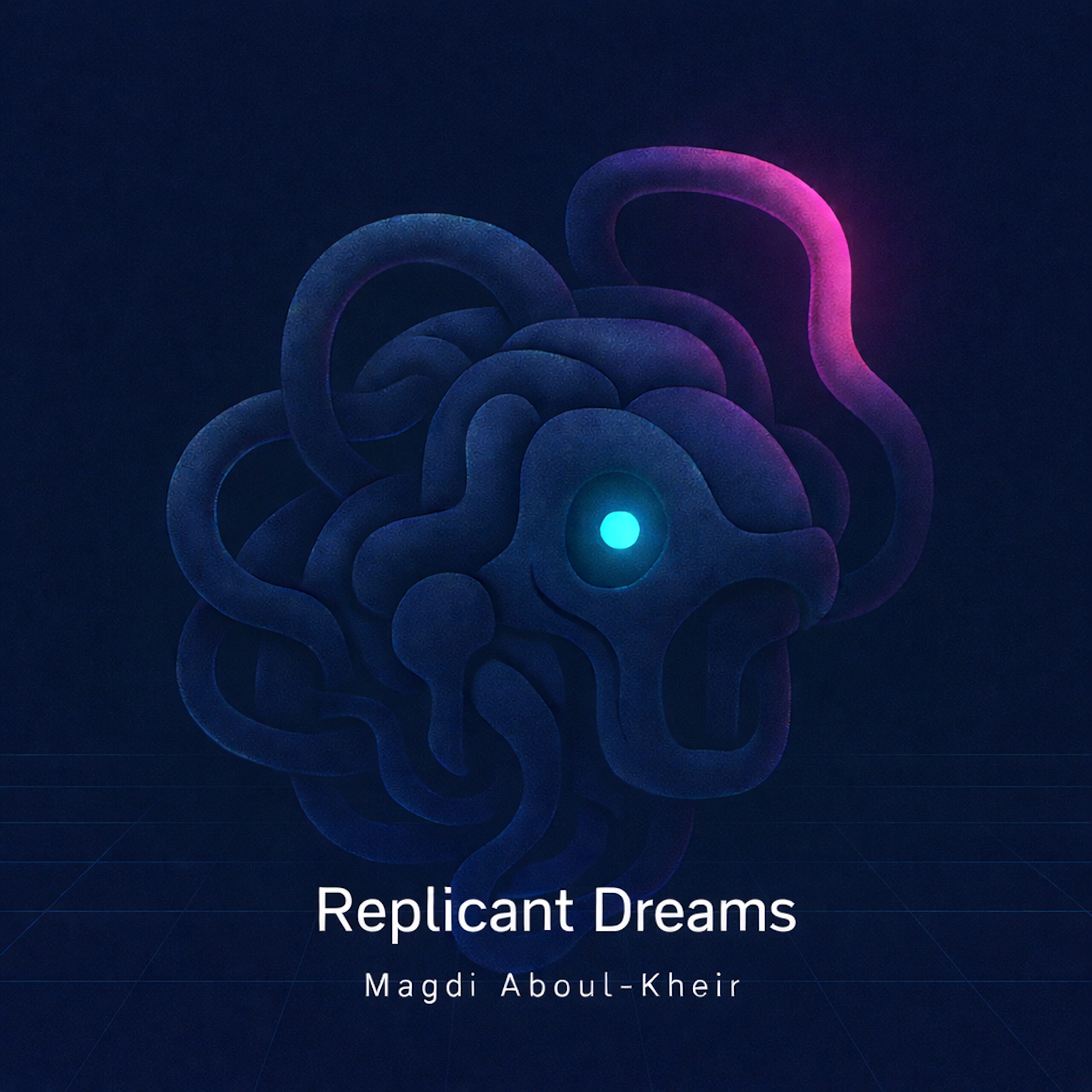
Magdi Aboul-Kheir’s Replicant Dreams feels like the soundtrack to a science-fiction film that exists somewhere between memory and imagination, a place where vintage synthesizers illuminate futuristic cities, machines march beneath artificial skies, and even androids are capable of discovering something resembling love. Across nine tracks, the Germany-based composer constructs an expansive retro-futuristic universe that draws heavily from the sonic vocabulary of 1980s science fiction while remaining firmly rooted in his own fascination with melody, emotion, and cinematic storytelling. The result is a spiritual sequel to Yesterday’s Future, but the scale has grown considerably. Where that earlier work explored retro electronic possibilities with a sense of playful nostalgia, Replicant Dreams feels more cinematic, more emotionally ambitious, and more invested in the idea that electronic music can tell a story without requiring a conventional narrator. Aboul-Kheir arrives at this project with an unusually broad musical background, having worked across minimal music, chamber and orchestral composition, pop, jazz-inflected instrumentals, ambient music, vintage-electro textures, and intimate piano miniatures. That range is important because it prevents the synthwave aesthetic from becoming a costume. The synthesizers may glow with an unmistakable retro character, but the musical thinking behind them is considerably deeper. Strings, orchestral gestures, atmospheric pads, rhythmic electronics, and piano-derived sensibilities all coexist because melody remains the connective tissue. There is a romantic quality to Aboul-Kheir’s approach, too. Even when he is imagining cyborgs, spaceships, industrial corridors, and distant planets, he is ultimately interested in feeling. Replicant Dreams may look toward the future, but its emotional language remains profoundly human.
“Vector Drive” makes an immediate case for the album’s cinematic ambition by refusing to ease the listener gently into its world. Instead, a low-pass-filtered sub-bass pulse begins moving across the stereo field, creating a sense of restrained mechanical energy before the filter gradually opens and reveals a fast-paced rhythmic framework. The arrival of the 124 BPM hi-hat pattern and sidechained analog kick feels like the moment an engine suddenly ignites. Sawtooth arpeggiators begin racing beneath a lead synth melody that possesses an almost vocal quality, and the entire arrangement gathers momentum with remarkable precision. It is easy to imagine neon reflections sliding across a windshield as some futuristic vehicle tears through a sleeping city. Yet what makes the track work is not simply its retro production vocabulary. Aboul-Kheir understands that propulsion needs melody, and the lead synth gives the rhythmic machinery something expressive to say. The layering is clean and purposeful, allowing individual elements to contribute to the sense of movement rather than collapsing into a wall of sound. This is one of the album’s recurring strengths: the music can be technically detailed without feeling emotionally sterile. “Vector Drive” establishes a world in which technology has a pulse, and it does so with enough melodic personality to ensure that the listener is not merely observing the machinery but becoming part of its journey.
From there, “Orbital Beauty” demonstrates how dramatically Aboul-Kheir can change the atmosphere without breaking the album’s continuity. The sharp propulsion of “Vector Drive” gives way to crystalline synth tones, slowly expanding ambient pads, electric piano, a descending and ascending synth bassline, and delicate woodblock percussion. The effect is almost weightless. If the opening track represented motion through a neon metropolis, “Orbital Beauty” feels like the moment the camera pulls away from the city and reveals the planet beneath it. The airy vocoder pads have an almost breathing quality, adding a subtle organic presence to an otherwise electronic environment. That detail is particularly effective because it reinforces one of the album’s central ideas: artificial sounds can still communicate human sensations. There is no need for a conventional vocal performance when a synthesizer can rise and fall like a breath or when a simple piano phrase can suggest longing. The track’s spaciousness also reveals Aboul-Kheir’s ambient instincts, connecting Replicant Dreams to the atmospheric sensibilities of his earlier Nubes Sonorae (Ambient Cloudscapes) while giving them a more cinematic setting. “Orbital Beauty” is not simply an interlude between energetic tracks; it is a fully realized environment. Its slow accumulation of sound creates the sensation of floating above Earth, looking toward a glowing horizon in complete silence. It is beautiful precisely because it does not hurry.
Then the album abruptly changes temperature with “Cyborg Legion,” one of its most forceful excursions into industrial territory. The track arrives with a menacing beat, dry bit-crushed snare, metallic percussion, harsh basslines, synth brass, and a stuttering robotic voice that seems to emerge from some distant mechanical command center. The vocoder performance functions almost like the track’s principal character, transforming the human voice into something deliberately artificial. If “Orbital Beauty” imagined technology as something capable of wonder, “Cyborg Legion” imagines technology as an organized force. The rhythmic insistence gives the track a sense of marching inevitability, and the combination of distorted textures and mechanical vocal gestures makes it easy to picture an army of machines moving through enormous industrial corridors. There is a playful cinematic quality to that imagery, recalling the exaggerated futuristic worlds of classic science-fiction cinema without becoming a direct imitation of any particular soundtrack. More importantly, the track provides necessary contrast. Replicant Dreams would lose some of its dramatic personality if every song existed at the same emotional temperature. “Cyborg Legion” supplies aggression and weight, giving the album’s futuristic fantasy a darker side. It also demonstrates Aboul-Kheir’s ability to move from ambient spaciousness to rhythmic intensity while retaining his commitment to clear musical ideas. Beneath the metallic surface, there is still composition, structure, and melody. The machines may be marching, but the composer remains firmly in control.
The title track, “Replicant Dreams,” then becomes the emotional heart of the album, and its opening could hardly be more intimate. Tape saturation introduces the faint character of an analog recording before a reverberated three-note piano arpeggio establishes the central emotional space. The simplicity is striking after the preceding material’s density. An analog synthesizer pad and soft mid-tempo kick gradually enter, but the composition never loses the intimacy of those first piano notes. Most fascinating is the lead synthesizer patch designed to resemble the vocal qualities of a pianist or soulful singer. That choice captures the album’s philosophy in miniature: technology is being used not to erase human expression but to imitate, extend, and reinterpret it. The title “Replicant Dreams” therefore becomes more than a science-fiction phrase. It suggests artificial beings experiencing something profoundly human, but it also suggests music itself as a kind of emotional replication machine, taking memories, gestures, voices, and feelings and translating them into sound. Aboul-Kheir’s classical piano background is especially evident here. Even when the instrumentation is electronic, his sensitivity to phrasing and melodic contour remains apparent. The piece does not need an elaborate arrangement to communicate emotion. A few carefully chosen notes, warm analog textures, and an expressive lead line are enough to make the futuristic concept feel unexpectedly intimate. This is where the album’s imaginative premise finds its emotional justification.
“Leaving Earth” expands that emotional language into something grander and bittersweet. A powerful sub-bass drop launches the track before a complex sixteenth-note synth pattern begins building toward its climax. Electronic tom fills then explode into a soaring, vibrato-rich melody, while synth-brass chords and shimmering bell textures add scale around it. The title gives the music its emotional direction, and the composition captures a curious mixture of triumph and loss. Leaving Earth can be imagined as an exhilarating liberation, but it is also an irreversible departure from home. Aboul-Kheir allows both feelings to exist simultaneously. The soaring melody suggests discovery, possibility, and the exhilaration of entering the unknown, while the harmonic weight underneath hints at everything being left behind. That duality makes the track one of the album’s more affecting moments. “Stardust Drift,” which follows, takes the opposite approach. Instead of reaching outward with dramatic force, it settles into a dreamlike suspension built from polyrhythmic synth pads, detuned plucks, dark bass, subtle electronic shakers, and warm synthesizer tones that move between major and minor colors. It functions as a natural breather, but it is far more than a pause button. The music seems to float without a destination, encouraging passive dreaming and introspection. Together, these two tracks demonstrate Aboul-Kheir’s understanding of pacing: one pushes toward the stars while the other simply drifts among them.

Energy returns with “Stellar Metamorphosis,” another track where the album’s retro-futuristic vocabulary becomes particularly vivid. A dry synth stab and immediate filter sweep introduce a rapidly oscillating arpeggio over a steady four-on-the-floor kick, and the arrangement gradually becomes more layered as two lead synths appear to communicate with one another above a heavy bassline. There is a fascinating sense of transformation in that musical dialogue. The two synth voices almost behave like characters, answering and challenging each other while the rhythm maintains its forward momentum. The title suggests rebirth, and the music reflects that idea through its constant movement and accumulation. The effect is energetic without becoming chaotic. From there, “Deep Space Departure” pulls the listener into a considerably more isolated environment. Its sparse opening—sub-bass, echoed finger snap, and stretches of silence—creates an almost unnerving amount of space. A cello-like synthesizer then introduces a legato melody that functions like a distant voice, while restrained hi-hats, low-end swells, and pitched-down vocal pads provide just enough texture to prevent the track from disappearing into silence. The emotional sensation is one of vastness and solitude. Space here is not merely beautiful; it is overwhelming. The track captures the loneliness that can accompany exploration, reminding us that leaving familiar territory always carries some psychological cost.
By the time “Lunar Meditation” arrives, Replicant Dreams has traveled through speed, wonder, machinery, romance, departure, transformation, and isolation, and the closing track wisely chooses not to end with another explosion of synths. Instead, it opens with soft rainfall-like white noise and a gentle sine-wave drone before slowly introducing chord progressions without drums or aggressive bass. Breath-like vocal textures hover around the ambient harmonies as the chords rise and fall with a tidal quality. The effect is deeply calming, almost like watching the final images of a science-fiction film fade slowly into darkness. It is also an appropriate conclusion to an album so concerned with movement. After all the propulsion of “Vector Drive,” the mechanical force of “Cyborg Legion,” the emotional departure of “Leaving Earth,” and the expansive solitude of “Deep Space Departure,” the final destination is stillness. That choice reveals what ultimately makes Replicant Dreams more than a collection of retro synth experiments. Aboul-Kheir uses nostalgia as a doorway rather than a destination. He clearly loves the colors, rhythms, and imaginative possibilities of vintage electronic music, but he is not simply attempting to recreate the past. His classical training, experience with orchestral writing, understanding of ambient space, and instinct for melody allow him to turn those sounds into something personal. Across all nine tracks, the futuristic imagery never overwhelms the emotional core. Whether imagining mechanical armies or lonely travelers beyond Earth, Aboul-Kheir keeps returning to wonder, longing, romance, and the search for meaning. Replicant Dreams ultimately feels like a film without a screen, a science-fiction epic told entirely through melody, rhythm, texture, and atmosphere. It invites the listener into a glowing 1980s-inspired future but gives that future a beating human heart. The machines may march, the spaceships may depart, and the stars may stretch endlessly ahead, but Aboul-Kheir’s greatest achievement is ensuring that something recognizably human remains at the center of the journey.
For more information, follow Magdi Aboul-Kheir
FACEBOOK – SPOTIFY – SOUNDCLOUD – BANDCAMP – INSTAGRAM