
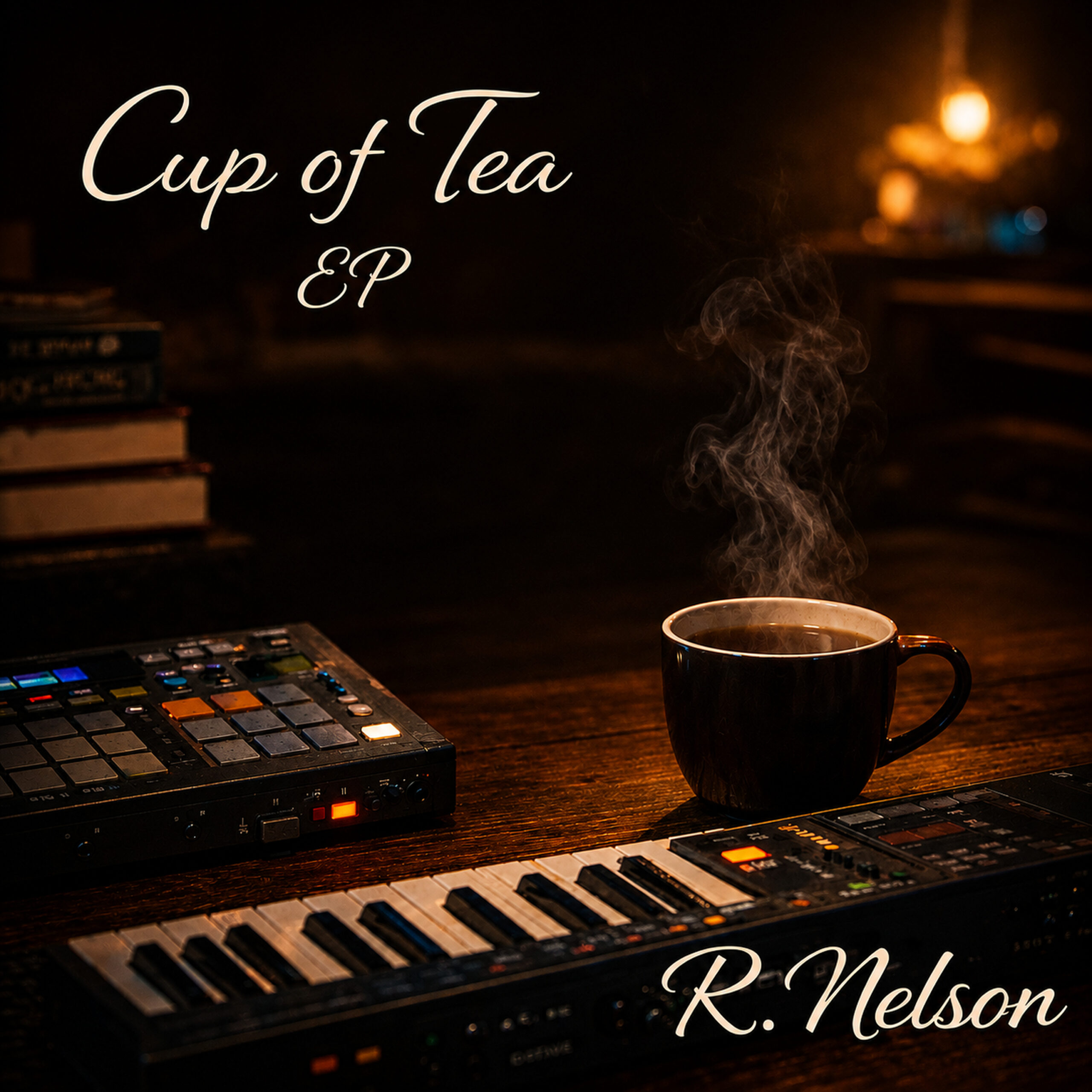
R. Nelson’s Cup Of Tea EP is the kind of release that understands a song does not necessarily have to end when the original recording is finished. Sometimes, a strong musical idea contains enough personality, emotional ambiguity, and rhythmic character to support an entire world of its own. Across six tracks, the Washington, D.C.-based artist, songwriter, and producer takes the central concept of “Cup Of Tea” and examines it from different angles, allowing production changes, alternate versions, new perspectives, and collaboration to gradually expand what initially appears to be a simple premise. Originally introduced through Nelson’s 2026 full-length Songs and Music by R. Nelson, Vol. 1: Grown Man Energy, “Cup Of Tea” now receives a much more intimate examination here. Rather than treating the EP as a collection of leftovers or variations assembled for convenience, Nelson approaches it almost like a director revisiting one scene from different camera positions. The original establishes the foundation, the alternate and early versions reveal the architecture underneath, and the later tracks widen the emotional lens. That approach is particularly fitting for an artist whose work frequently combines songwriting, production, and narrative storytelling. Nelson has described Grown Man Energy as a “movie for the ears,” and Cup Of Tea feels like the decision to pause that movie, zoom in on one particular relationship, and discover that there is far more happening inside the scene than the first viewing suggested.
The opening “Cup Of Tea” therefore carries considerable responsibility, because it establishes the musical language that the remaining five tracks will spend the EP questioning, reshaping, and extending. R. Nelson’s fusion of R&B, soul, groove-based production, and Washington, D.C.’s deeply rhythmic musical identity gives the project an immediate sense of movement without sacrificing the conversational quality of the songwriting. There is something inherently warm about the phrase “cup of tea” as a romantic metaphor. It suggests preference, familiarity, comfort, attraction, and the simple pleasure of finding something that feels right. Nelson takes that everyday expression and gives it enough personality to become a relationship concept rather than merely a clever lyrical phrase. His background across generations of Black music tradition is important here because the music does not need to shout to establish its identity. Soul can live in a pocket. R&B can communicate through a groove as much as through a vocal declaration. And D.C.’s musical history has always understood the power of rhythm as a form of conversation. Nelson draws those sensibilities together in a way that makes “Cup Of Tea” feel approachable while still belonging to a larger artistic framework. The track functions as the EP’s thesis: attraction can be playful without being shallow, and a familiar phrase can become surprisingly expressive when an artist allows it enough room to breathe.
That foundation becomes more fascinating when “Cup Of Tea (Def Alt)” arrives. Alternate versions are often treated as bonus material, but in this project the distinction between them becomes part of the storytelling. The “Def Alt” interpretation invites the listener to hear how much of a song’s identity is contained in its basic ingredients and how much comes from the decisions made during production. Nelson’s producer instincts become just as important as his songwriting instincts because changing an arrangement can change the emotional temperature without changing the fundamental idea. The listener already knows the destination, but the route feels different. Then comes “Cup Of Tea (Early Draft),” which adds another layer of intimacy by pulling the curtain farther back. Early drafts can be fascinating because they reveal an idea before it has been polished into its final form. They preserve traces of uncertainty, experimentation, and possibility. In the context of this EP, that version effectively allows listeners to compare the finished identity of “Cup Of Tea” with its formative stages. Heard together, the original, “Def Alt,” and “Early Draft” make a compelling argument for creative development itself. Nelson is not simply presenting one song three times; he is showing that a musical identity can remain recognizable while its presentation changes. That makes the first half of the EP feel almost like a production workshop disguised as a listening experience.
The emotional perspective shifts beautifully with “You’re My Cup Of Tea,” and this may be the moment when the EP’s concept expands most naturally beyond the original song. Instead of remaining locked inside Nelson’s initial perspective, the project introduces a female response, effectively turning a monologue into a conversation. That change matters because romance is rarely interesting when only one person has the opportunity to speak. The original concept establishes attraction from one direction; the response introduces reciprocity, and suddenly the metaphor has another emotional dimension. “You’re My Cup Of Tea” does not simply repeat the sentiment with different wording. It answers it. That creates the feeling of two people discovering that the preference might be mutual, that the attraction is not happening in isolation, and that what initially sounded like a declaration can become an exchange. Nelson’s storytelling instincts are particularly effective in this transition because he understands that sequencing can communicate narrative just as clearly as lyrics can. By placing the response after the alternate and early versions, the EP has already taught us to listen for different interpretations. Now it gives us one of the most important interpretations of all: another person’s perspective. The result is warm, playful, and relational without becoming overly sentimental. It feels less like a romantic slogan and more like a musical conversation that has finally received an answer.
“Perfectly Steeped (Two Cups of Tea)” takes that conversation one step further, and the title itself captures the EP’s central sense of humor and affection. The tea metaphor has now evolved from identifying a personal preference into describing compatibility between two people. There is something deliberately charming about the idea of two cups being “perfectly steeped,” because it transforms romance into a process of timing, balance, patience, and preparation. Tea has to be given time to become what it is supposed to be, and relationships, in their own way, require the same willingness to let something develop rather than forcing it into existence. That gives the track a thematic role beyond simply adding another song to the sequence. It feels like the natural consequence of the previous tracks. The first “Cup Of Tea” introduces the attraction, “You’re My Cup Of Tea” supplies the response, and “Perfectly Steeped (Two Cups of Tea)” suggests what happens when two perspectives begin occupying the same emotional space. Nelson’s ability to build a story from recurring imagery is one of the EP’s strongest qualities. He does not abandon the original metaphor once it has served its purpose; he keeps returning to it until it develops new meanings. This is also where his broader narrative approach becomes especially apparent. Like chapters in a short musical story, the songs share vocabulary, atmosphere, and thematic DNA while still performing different functions.
The closing “I Didn’t Change, I Expanded,” featuring Geese Da Goon, gives the EP an unexpected but satisfying final dimension. The title alone sounds like a statement about artistic and personal evolution, and that idea fits naturally with everything that has come before. Change and expansion are not always the same thing. To change can imply becoming something else; to expand suggests becoming more of what you already are, gaining experience without abandoning the core identity that existed beforehand. That distinction is particularly meaningful on a project built around alternate versions and reinterpretations. R. Nelson has spent the EP demonstrating that one musical idea can become several things without losing its original character, so ending with “I Didn’t Change, I Expanded” feels almost like a mission statement. The appearance of Geese Da Goon strengthens that sense of continuity, especially because the track also connects to Geese Da Goon’s Outside project. Rather than closing the EP inside a sealed-off world, Nelson leaves a door open into another artist’s musical universe. It becomes a bridge between catalogs, between collaborators, and between stories. The collaboration also reinforces the broader identity of Ashy Knuckle Productions, where individual artists can operate independently while still creating connections across projects. As an ending, it feels less like a conclusion than an extension of the conversation.

Ultimately, Cup Of Tea EP succeeds because R. Nelson understands that repetition does not have to mean redundancy. The six-track release repeatedly returns to one central idea, but each return adds context: the original statement, the alternate interpretation, the early blueprint, the answering voice, the shared relationship metaphor, and finally the broader idea of expansion through collaboration. That structure makes the EP more thoughtful than its deceptively casual title might initially suggest. There is warmth here, but there is also craft. Nelson approaches the material simultaneously as a songwriter, producer, storyteller, and curator of his own musical world, allowing each track to reveal something about how songs evolve and how relationships can be understood from more than one perspective. His grounding in R&B, soul, go-go, and Black musical traditions provides the project with the project its rhythmic foundation, while his D.C. perspective and narrative ambitions keep it from feeling generic. Most importantly, Cup Of Tea demonstrates the value of following an idea rather than abandoning it once the first version is complete. What began as one song on Grown Man Energy becomes a six-track exploration of attraction, interpretation, partnership, artistic process, and growth. By the time the final notes arrive, the listener has heard much more than six versions or variations of a theme. They have watched one musical idea steep, change temperature, acquire another voice, find companionship, and finally expand beyond its original cup. That is a small concept with a surprisingly generous heart, and R. Nelson gives it enough musical imagination to make the entire EP worth sitting down with slowly.
For more information, follow R. NELSON
WEBSITE – FACEBOOK – SPOTIFY – BANDCAMP – YOUTUBE