
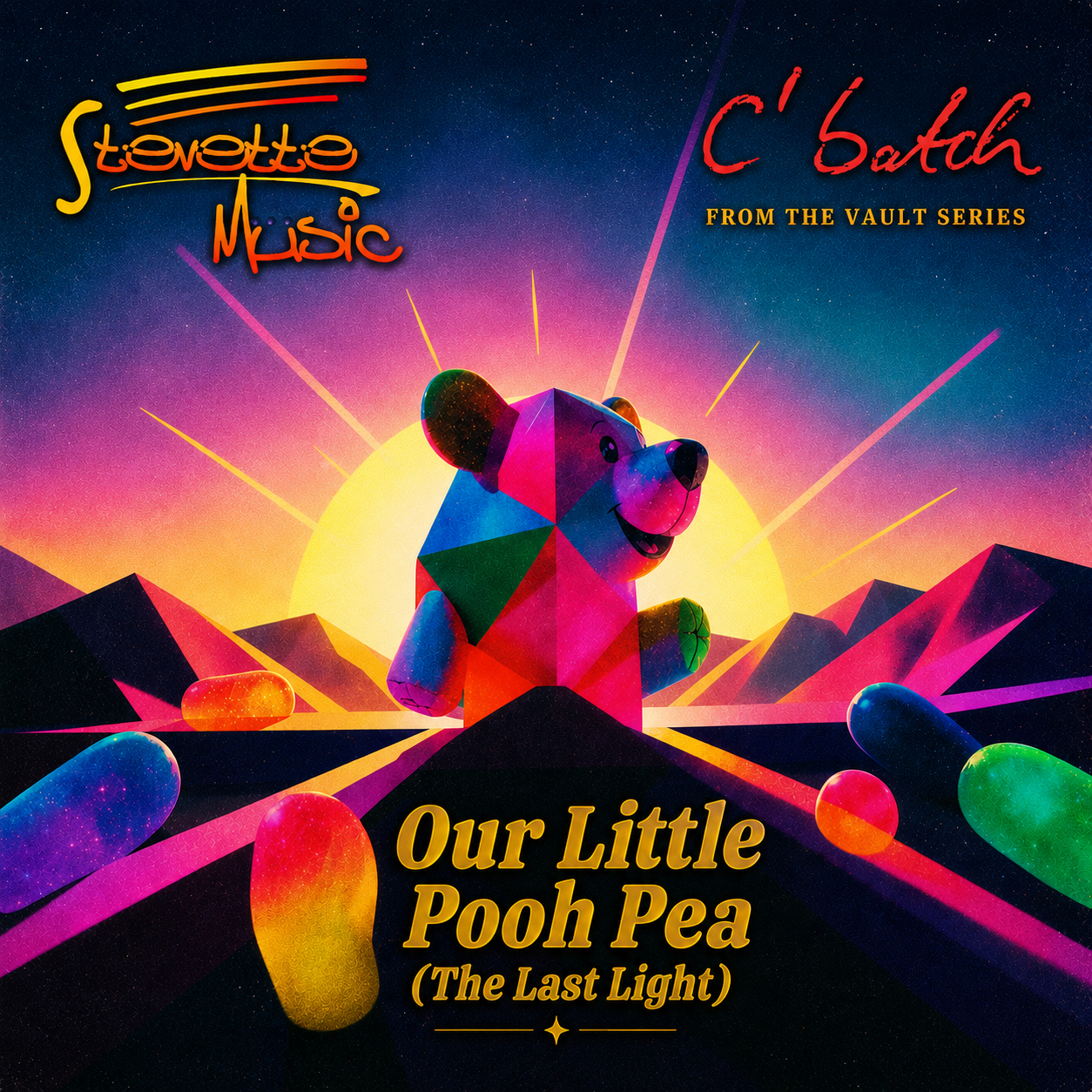
There is something inherently cinematic about a piece of music that refuses to explain itself. C’batch’s “Our Little Pooh Pea (The Last Light) 4 – Cinematic” embraces that quality from the outset, creating an instrumental landscape in which the listener is invited to supply the images, memories, and emotions. Rather than relying on lyrics to establish a narrative, the track places a solo guitar performance at the center and allows its phrasing to carry the emotional weight. The story behind that guitar part makes the recording even more intriguing. Originally performed by C’batch over his composition “Round & Round,” the solo could easily have remained attached to its first musical home. Instead, C’batch heard another possibility within it. He extracted the performance from its original context and built an entirely different environment around it, effectively turning one song into the raw material for another. That process captures something essential about his creative philosophy: music does not necessarily have a single final form. A performance can survive its original arrangement, acquire new meaning, and become the starting point for another artistic journey. In this case, the guitar sounds less like a normal lead instrument and more like a narrator moving through a huge, mostly unexplained landscape. Its organic presence lends the track a human center, while the surrounding electronic and atmospheric textures expand the space around it. The result is a composition that feels simultaneously intimate and expansive, as though a solitary musician has been placed inside the soundtrack to a film that exists only in the listener’s imagination.
The phrase “The Last Light” provides a particularly evocative doorway into the track’s emotional world. It suggests an ending, but not necessarily a hopeless one. Light at the edge of darkness can represent farewell, memory, survival, transition, or the first indication that something new is about to emerge. C’batch wisely leaves these possibilities unresolved. There is no lyrical statement directing the listener toward one definitive interpretation, and that absence becomes one of the recording’s strengths. The guitar can sound reflective without becoming sentimental, while the atmospheric production allows its melodic lines room to breathe. In another setting, the same performance might have functioned simply as an expressive guitar solo within a more conventional song. Here, however, its relocation changes the way it is perceived. Without a vocalist competing for narrative attention, every phrase becomes more exposed. The listener is encouraged to notice the shape of the melody, the emotional pauses, the movement of the performance, and the relationship between the guitar and the electronic backdrop. C’batch’s production does not attempt to bury the original playing beneath layers of technology. Instead, the electronics function as atmosphere, widening the frame around the guitar and giving the piece an almost dreamlike scale. This is where “Our Little Pooh Pea (The Last Light) 4 – Cinematic” finds its identity. It occupies a space somewhere between ambient music, electronic experimentation, dream pop, and instrumental soundtrack composition, yet it never feels like a genre exercise. The guitar remains the anchor, preserving an organic quality within an otherwise spacious sonic environment.
What makes the track particularly compelling is the sense that its arrangement is built around discovery rather than simple reproduction. C’batch is not merely presenting an old guitar solo again; he is asking what else that performance might become. That distinction matters. Revisiting archival material can easily become an exercise in nostalgia, especially when an artist has accumulated decades of recordings and ideas. C’batch takes a more active approach, treating his archive as a living creative resource rather than a museum. His background helps explain that instinct. As a composer, guitarist, producer, recording artist, and co-founder of Stevette Music, Inc., he has spent decades moving between jazz, soul, R&B, rock, funk, reggae, electronic music, and cinematic expression. “Our Little Pooh Pea (The Last Light) 4 – Cinematic” reflects that refusal to remain confined to one musical language. The guitar gives the recording its physical and emotional grounding, while the programmed and atmospheric elements introduce another dimension, allowing the performance to float beyond the boundaries of its original arrangement. There is a quiet experimentalism in that process. Instead of recording something new simply for the sake of novelty, C’batch looks backward and discovers something unfinished—or perhaps something that had not yet revealed its full potential. The track therefore becomes a conversation between different moments in the artist’s creative life. The original guitar performance belongs to one composition, but the imagination surrounding it belongs to another period and another artistic perspective. Hearing those layers coexist imparts the single a subtle sense of time passing, with the past providing the raw material for the present rather than functioning as something fixed and untouchable.
The cinematic quality of “Our Little Pooh Pea (The Last Light) 4 – Cinematic” also comes from its ability to suggest scenes without actually depicting them. One can imagine the music accompanying a character walking through an empty landscape at dusk, a final look backward before departure, or the quiet closing moments of a story whose outcome is deliberately left unresolved. Yet the track does not need those images to work. Its atmosphere is sufficiently open that listeners can attach their experiences to it. Someone might hear a farewell; another listener might hear solitude; another might simply hear the pleasure of a guitar performance surrounded by spacious sound design. That flexibility is especially valuable in instrumental music because there is no verbal narrative to limit the emotional vocabulary. C’batch provides the listener room rather than filling every available space with information. The electronic textures help create depth, but the guitar remains recognizably human, and that contrast gives the recording much of its character. There is something almost paradoxical about the title’s suggestion of finality and the music’s sense of continuation. “The Last Light” sounds like an ending in concept, yet the track itself exists because C’batch refused to let an earlier performance remain finished in its original form. A guitar solo that once belonged to “Round & Round” has been given another life, another setting, and another emotional purpose. In that sense, the music quietly argues against the idea that an artistic moment ever has to remain permanently fixed.

Ultimately, “Our Little Pooh Pea (The Last Light) 4 – Cinematic” is compelling because it demonstrates how much possibility can remain inside a single performance. C’batch takes something previously recorded and hears beyond its original boundaries, transforming an existing guitar solo into the emotional centerpiece of a new instrumental composition. The result is not simply an archival curiosity but a fully realized atmospheric work, one that uses electronic and ambient textures to turn a personal guitar performance into something broad enough to feel cinematic. Its strength lies in restraint: rather than explaining its meaning, it creates enough space for meaning to emerge. The listener is given the title, the guitar, the atmosphere, and the suggestive idea of “the last light,” then left to determine what that light represents. Within the larger Our Little Pooh Pea (The Last Light) EP, the track also illustrates C’batch’s ongoing interest in examining musical ideas from multiple perspectives, allowing familiar material to reveal unfamiliar qualities. That approach connects naturally with his broader Vault projects, where music from different stages of his career can be revisited and reimagined through contemporary production. Our Little Pooh Pea (The Last Light) 4 – Cinematic therefore feels like more than just a new arrangement of an old performance. It is an example of creative continuity—proof that a recording can carry its history without being trapped by it. C’batch lets the guitar remember where it came from while giving it somewhere new to go, and in that space between memory, atmosphere, darkness, and light, he creates a cinematic instrumental that feels open-ended, reflective, and quietly alive.
For more information, follow C’BATCH
WEBSITE – FACEBOOK – SPOTIFY – YOUTUBE