

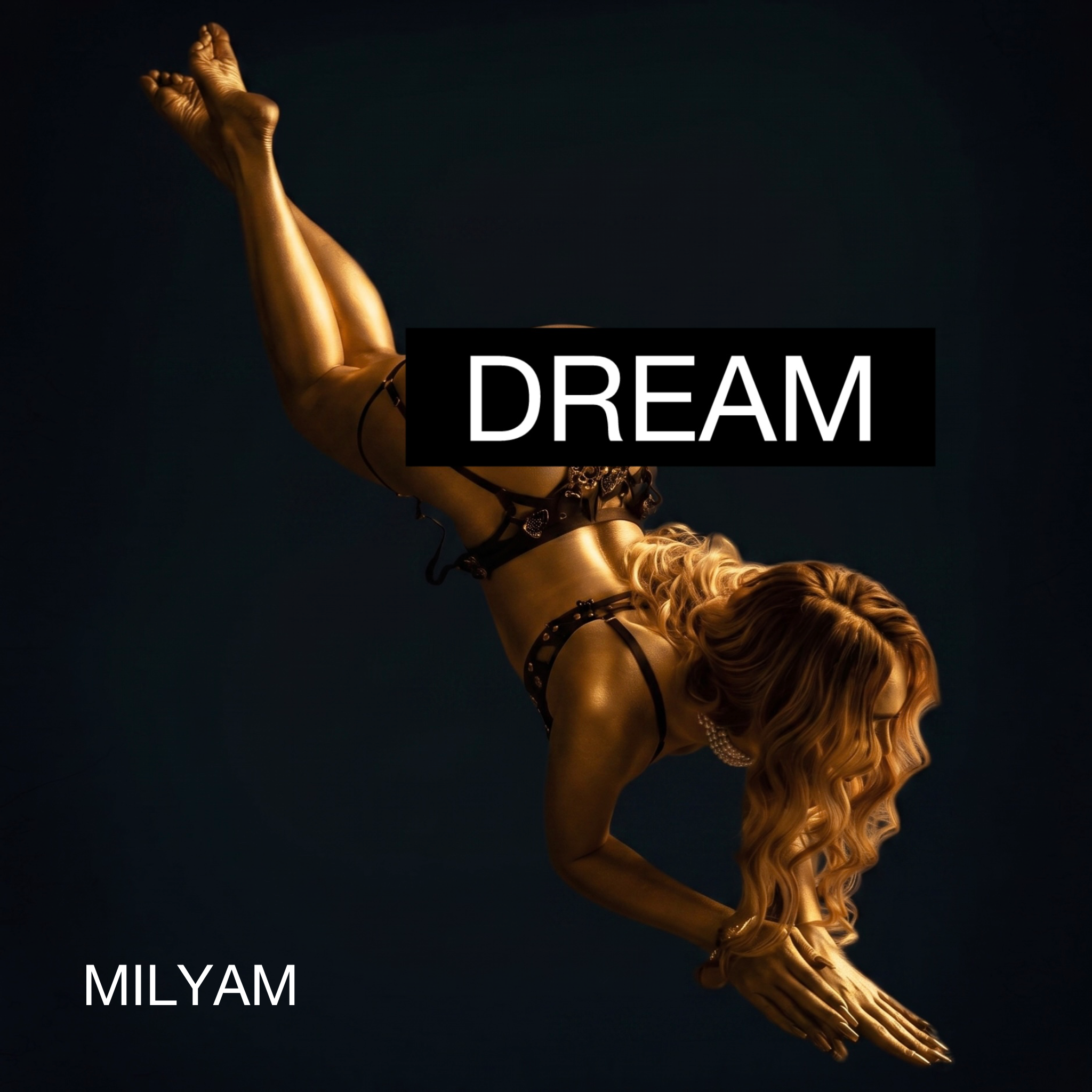
Milyam’s “Dream” is the sort of track that understands the value of restraint. It doesn’t start with a dramatic hook or an overblown production but rather begins almost like a held breath, slowly drawing the listener into the uncertain space between sleep and waking. It’s that odd mental zone where the imagination appears as real as fact, and the subconscious mind quietly redefines everything around it. Milyam endows the track with a nocturnal identity, as if it were made for headphones, late-night train rides, solitary drives, or those moments when the world outside has gone quiet. There is something deliberately intimate in the way the record is constructed. It doesn’t ask for attention; it earns it. The atmosphere is dark but not oppressive; mysterious but not vague; and emotionally vulnerable without lapsing into melodrama. “Dream” knows that the most moving music is often the music that leaves space for the listener to come in.
That philosophy is immediately evident in the production. The song is built on a heavy, chest-thumping bassline, giving it a physical pulse under an otherwise airy arrangement. Around it, glistening percussion flutters in delicate bursts, and subtle synth textures and carefully controlled reverb create an almost weightless environment. It’s like every sound has been given bit of room room to breathe, and that sense of space is part of the storytelling.” Milyam eschews extra layers in the mix, letting silence and negative space become active ingredients. The result is atmospheric in the truest sense of the word: one feels surrounded by the music rather than standing in front of it. There are suggestions of trip-hop and art rap in the rhythmic architecture, but “Dream” never feels like an exercise in imitation. The production has a distinct identity with a heavy low end balanced by delicate details that come and go like fragments of half-remembered dreams.
Milyam’s vocals are arguably the song’s greatest strength. Her voice floats through the production with a high, lush quality that is almost ethereal, but her confidence in her phrasing keeps the performance grounded. She does not sing as if she were trying to prove anything. Instead, she sounds like someone whispering a secret in the dark, and it is that distinction that provides the track much of its emotional pull. Her phrasing moves with the rhythm, instead of sitting stiffly on top of it, creating a loose hypnotic motion that fits the subject matter of the song. Her feather-light delivery is particularly effective set against the rumbling bass underneath. It is a constant tug-of-war between weight and weightlessness, between being anchored and being adrift. Milyam’s voice also allows for a natural movement between melody and a more conversational cadence, which solidifies its position somewhere between pop, alternative music, and art rap without having to commit to any one genre.
The writing is equally effective in refusing to over-explain itself. “Dream” toys with the line between illusion and reality, using nocturnal imagery and shards of thought, leaving the listener to piece together the meaning rather than offering a tidy conclusion. That’s a bold move in songwriting. The song knows that dreams don’t have a straight narrative, and the lyrics work on a similar logic, moving through impressions and sensations rather than rigid explanations. The uncertainty is the main emotional movement. What is displayed? What is recalled? What is really going on? Milyam never really answers those questions, and the ambiguity lends the track its lingering quality. The chorus, too, doesn’t give in to the temptation of ballooning into anything oversized. Instead, it appears to swell a bit, allowing the emotional mood to deepen without breaking the spell. There’s a lot of discipline to that approach. Every pause, every inflection of the voice, every movement of the bass, and every atmospheric texture serve the same central feeling of being suspended between consciousness and dream.

Ultimately, “Dream” succeeds because it is clear about the experience it wants to create and does not compromise that vision. It is built on atmosphere, intimacy, and the quiet tension of uncertainty. Milyam shows that you can make something powerful without filling every second with sound or an explanation. It’s a track that grows on you slowly, the details revealing themselves gradually—the low-end pulse, the shimmering percussion, the subtle vocal bends, and the spaces between phrases, all of it slowly coming into focus. There’s an appealing independence to the record, too, that feels like it’s made from artistic instinct rather than a desire to fit neatly into an existing commercial template. “Dream” ends where it began, somewhere between sleep and waking, but the journey makes that uncertainty feel oddly comforting.
For more information, follow MILYAM
WEBSITE – SPOTIFY – YOUTUBE – INSTAGRAM