

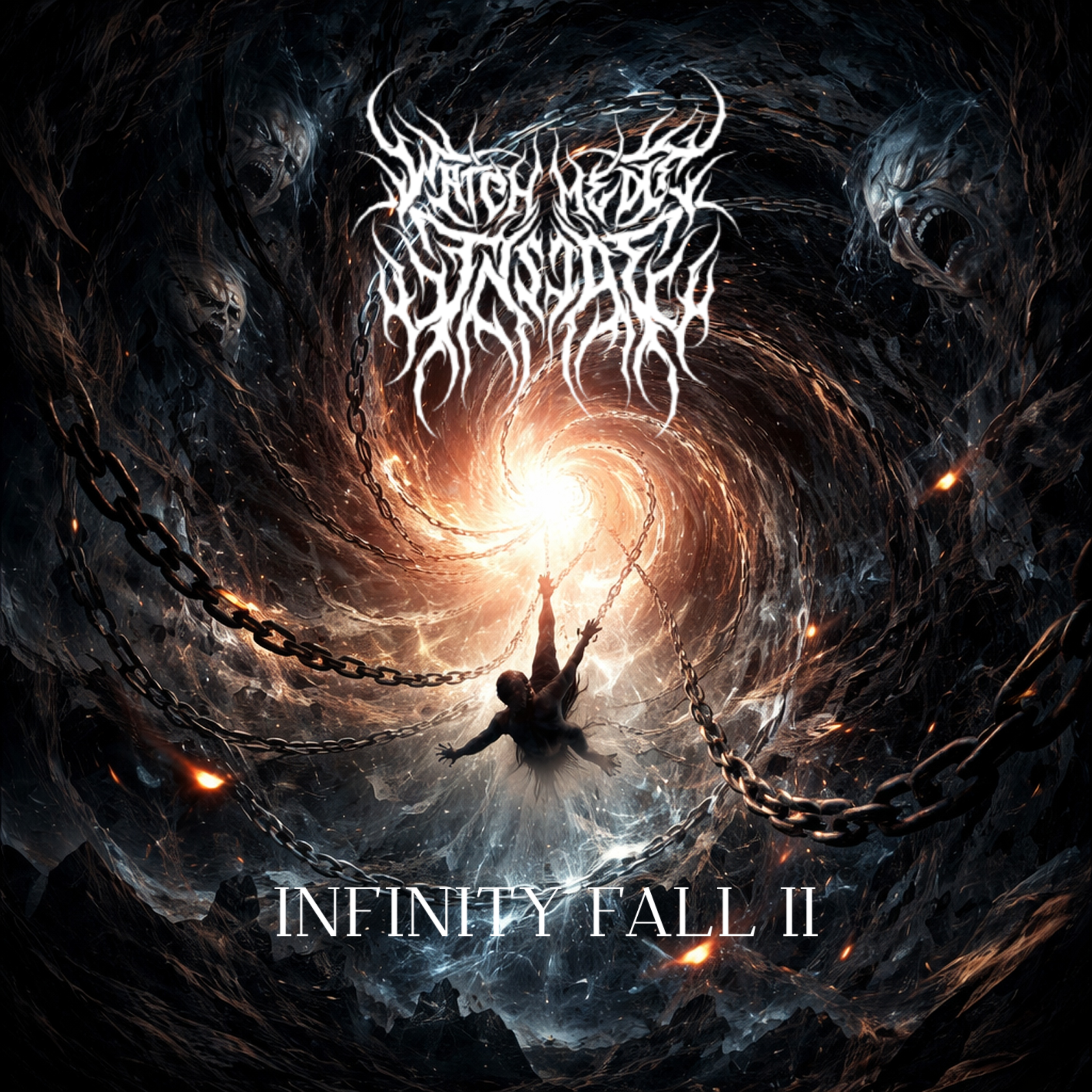
Experimental music has long served as a vessel for examining the darker and more ambiguous corners of human consciousness. With “Infinity Fall II,” the enigmatic project Watch Me Die Inside deepens its ongoing exploration of psychological fragmentation and existential unease. The track does not attempt to offer comfort or resolution, but functions as an immersive sonic meditation on instability and identity. Continuing the narrative framework established in earlier releases, “Infinity Fall II” pushes the concept of collapse beyond a singular dramatic event and reframes it as an endless condition—an unbroken descent that becomes its own reality. The result is a listening experience that feels less like a traditional song and more like a psychological landscape unfolding in real time.
From its opening moments, the track establishes a sonic environment built on tension and contradiction. Layers of sound seem to hover between clarity and distortion, inviting listeners into a space where melody and disorientation coexist. The arrangement balances moments of luminous melodic phrasing with dense, almost suffocating textures that continuously reshape the musical terrain. This careful manipulation of contrast creates an unsettling beauty; the listener senses structure forming, only for it to dissolve moments later. Such instability is clearly intentional, reflecting the thematic core of the piece. The music mirrors the sensation of losing footing in an endless fall, where moments of perceived stability quickly evaporate into uncertainty.
The production design deserves particular attention for how effectively it sustains this psychological tension. Rather than relying on abrupt shifts or explosive climaxes, the track evolves gradually, allowing subtle details to guide the emotional progression. Each sonic layer contributes to an atmosphere that feels expansive and claustrophobic at once. The soundscape stretches outward with ambient space, yet its dense textures keep the listener anchored in a sense of confinement. This paradox—freedom and restriction existing simultaneously—becomes one of the track’s most compelling characteristics. Through meticulous sound design, the project constructs a world where beauty and instability constantly collide.
Lyrically and conceptually, “Infinity Fall II” moves even further away from conventional storytelling. The voice within the track does not narrate events or resolve emotional conflicts but acts as an observer documenting a condition. This approach reinforces the philosophical framework behind the project, where identity itself becomes fluid and uncertain. The creative figure known as Aleph remains deliberately undefined, emphasising the idea that the work exists beyond individual authorship. The song’s words and atmosphere suggest a profound realisation: control was never truly present to begin with. Rather than dramatising the moment of collapse, the track reveals collapse as the default state of existence—a quiet, ongoing recognition rather than a sudden catastrophe.

Ultimately, “Infinity Fall II” stands as a striking continuation of the conceptual universe being constructed by Watch Me Die Inside. Within the broader framework of the project’s so-called “Autopsy” fragments—systematic sonic examinations of human vulnerability—the track represents a critical turning point. Collapse is no longer something to fear or resist; it becomes a permanent environment through which perception must navigate. For listeners willing to engage with its unsettling introspection, the piece offers a rare kind of artistic honesty. It does not promise healing, redemption, or clarity, but offers recognition: a stark yet strangely poetic acknowledgement of the instability that often lies beneath the surface of human experience.
For more information, follow Watch Me Die Inside:
WEBSITE – SPOTIFY – YOUTUBE – INSTAGRAM – TIKTOK