
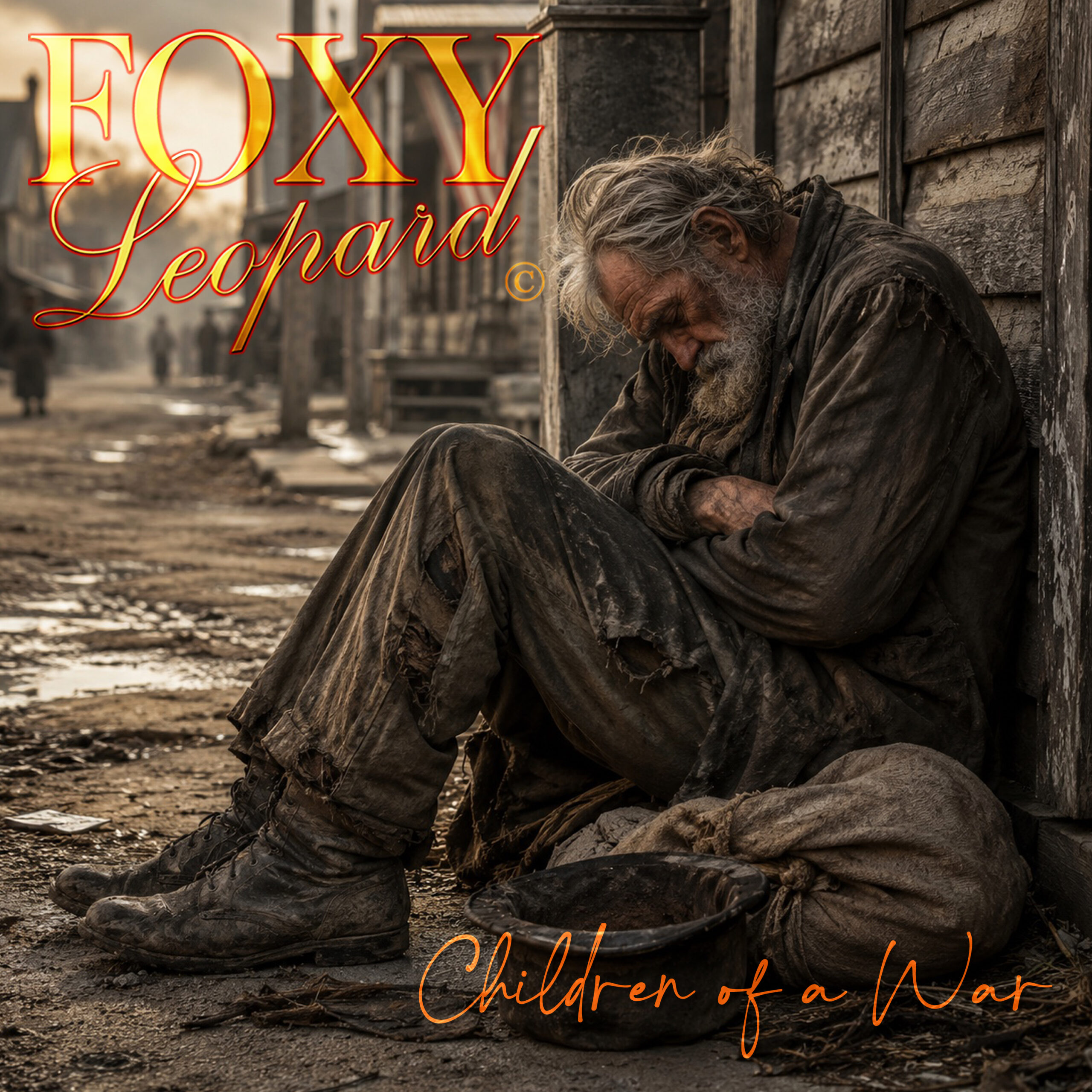
Most war songs are about the battlefield: the marching, the gunfire, the fallen, the flags, and that moment when the last shot is followed by silence. The lead single from the forthcoming album After, “Children of the War,” by Foxy Leopard, picks up right where those familiar stories tend to end. The armies have gone home, the speeches have been made, the flags have been folded, and history has begun to decide the conflict’s meaning. But ordinary men and women remain, with consequences that no military equipment can store away, no memorial speech can contain. That’s the most powerful insight of the song. Its ‘children’ include not only those born in the physical ruins of war but also anyone whose life has been forever changed by a war they did not begin, control, or even necessarily understand. Foxy Leopard tackles that idea in a series of intimate human portraits, starting with an old man asleep on the roadside. His war is purposely unnamable so that the figure can become something beyond a historical character. Maybe his fight is literal, or maybe it is poverty, grief, memory, loneliness, or the accumulated exhaustion of a life. When the narrator asks if anyone might help him win it, the question becomes quietly confrontational, and the responsibility is placed in the hands of the listener. There is no big instruction, just a choice: stop and acknowledge someone else’s struggle or keep on walking. In that simplicity, “Children of the War” introduces itself as a song less interested in explaining suffering than in asking what we do when we encounter it.
The second verse further develops this theme, moving from the old man to a woman waiting for someone who will never return home. Her war continues even though the man she has been waiting for is no longer fighting on a battlefield. Instead, the void has created another kind of challenge: to raise children with one less pair of hands, to bear burdens that once might have been shared, and to create an ordinary life around an extraordinary loss. Foxy Leopard wisely shuns turning her into a stereotypical emblem of wartime tragedy. Instead, she is pictured as one of the many individuals for whom a war fought far away becomes a domestic reality. Her story is in part based on Zee James, wife of Jesse, whose story appears in the adjacent “The Outlaws of Peace,” but the song does not attempt to make this woman a literal biographical portrait. She becomes an emotional reference point, and that distinction gives the character more universality. There is something quietly novelistic in the way the stories connect across After. The songs do not function as isolated singles with convenient thematic parallels but rather as parts of the same larger human landscape, where individual lives collide over the results of war. Thus, the woman waiting at home extends the meaning of the title. The children of war are not necessarily defined by the place of violence. They can be the families left behind, the people forced to be strong because someone else didn’t come back, the generations raised in circumstances they didn’t choose. The song’s emotional power comes from its refusal to draw a clear line between wartime and peacetime. For those who suffer loss, the aftermath can be a battlefield of its own.
Then Foxy Leopard introduces the children themselves, and the choice of arrangement is especially inspired. The song isn’t for the slick, big sound of a movie kids’ choir but rather for a small bunch of young voices, imperfect. Their sound is somewhat rough around the edges, and that’s exactly why it works. They speak with a bluntness that stands contrary to the complicated language adults use to talk about conflict. Different men, different roads, different minds, different goals: the children need no elaborate political explanations to understand that people can want things that are simply different. It seems their voices cut through the fog created by the adults around them. There’s vulnerability to the unpolished, but there’s also authenticity. A perfectly technical choir might have sent “Children of the War” toward the emotional language of a Hollywood memorial sequence, with its predetermined tears and obvious catharsis. Foxy Leopard makes something smaller and more human, nearer the atmosphere of a village hall at dusk. That is a key to what this song is about. The children don’t sound like symbolic angels coming down to convey us a message; they sound like real young people trying to make sense of a complicated world. They also change the emotional direction of the song. The older characters have spent their lives carrying battles, absences, and memories, and the children are the possibility that another response still exists. Their voices acknowledge what happened, and they suggest that inherited suffering does not have to become inherited hatred. It’s a subtle but important difference, and it makes the track feel hopeful without watering down its sadness.
The music arrangement is just as disciplined, relying on subtraction rather than excess. In the middle is a male voice, weathered and hoarse, a texture that carries the weight of a voice that sounds like it’s endured more than it cares to admit. Foxy Leopard employs sparse single notes on a steel-bodied resonator guitar, with restrained percussion and carefully placed harmonica accents around it. The guitar’s metallic resonance gives the recording a dusty, weathered quality, and the harmonica adds another layer of rural melancholy without turning the song into a genre exercise. Audible breaths, string noise, loose timing, and other small imperfections remain in the recording, creating the feeling of a performance that has been played rather than manufactured. The end result naturally evokes the late-career gravel of Johnny Cash and the atmospheric restraint of dusty western landscapes of Ennio Morricone, but “Children of the War” ultimately finds its own moral and emotional vocabulary. The roughness of the sound is important because the subject is rough. If every vocal entry were perfectly corrected, every instrumental transition clinically polished, a story about people living with the unfinished consequences of conflict would lose something. Here, the human imperfections weave into the story. The gaps between phrases matter too. The arrangement understands silence can be as emotionally telling as sound, and the song continually provides its characters room to breathe without pushing every beat toward a dramatic payoff. This restraint makes the subsequent emergence of the children’s voices all the more significant. Foxy Leopard doesn’t build a wall of sound but expands the circle of voices slowly.
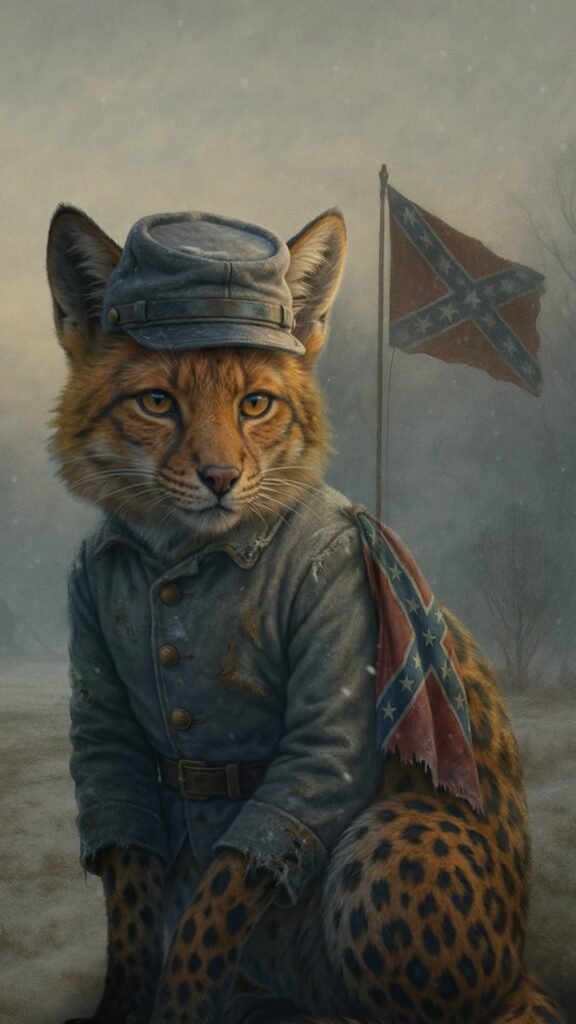
There’s also a cool creative story behind the recording process, particularly the use of artificial intelligence throughout its development. More than 40,000 words were exchanged, and more than 1,250 generations, edits, extensions, and remixes were explored, and yet the finished recording does not sound like a technological demonstration. Perhaps that is one of its greatest achievements. The process seems to have been one of the kind of painstaking selection more usually associated with sculpture, trying possibilities, discarding them, finding what distorts the emotional intention, and gradually removing what does not belong. Some editions failed because a voice changed character near the end. Others failed because a single child appeared when a group was needed or because a few seconds of silence broke the momentum. The answer in the end wasn’t to make the song bigger but to make it smaller. That choice is very much in keeping with the music itself. “Children of the War” gains power from intimacy, imperfection, and restraint, and the production ultimately caters to those qualities, not competes with them. Most importantly, the listener does not need to know how many iterations preceded the final version for them to understand the emotional effect. It’s its own thing, the finished song. Technology may have been the journey, but it is not the destination. What’s left is a piece that’s purposely human-sounding about human consequences, based on the uncomfortable truth that wars can officially end a long time before their emotional repercussions do. And when the last verse comes round again to the old man beside the same shop, still not quite able to say what he is fighting for, the song reaches its most moving point. There is no triumphant ending, no convenient victory, no assurance that his struggle will go away. Instead, the children present the opportunity for help. The song’s quietest and most meaningful act of resistance is the decision to not walk away. Sometimes the most powerful ending is not a statement that all will be right, but a promise to stay present. Foxy Leopard knows this truth. “Children of the War” leaves its characters where real life often leaves people: carrying what happened, uncertain about what comes next, but no longer alone. In that lack of a closure, the song finds something far more permanent than a big finish. It finds compassion and chooses to offer it as though it were the beginning of the next step.
For more information, follow FOXY LEOPARD
WEBSITE – FACEBOOK – SPOTIFY – YOUTUBE