

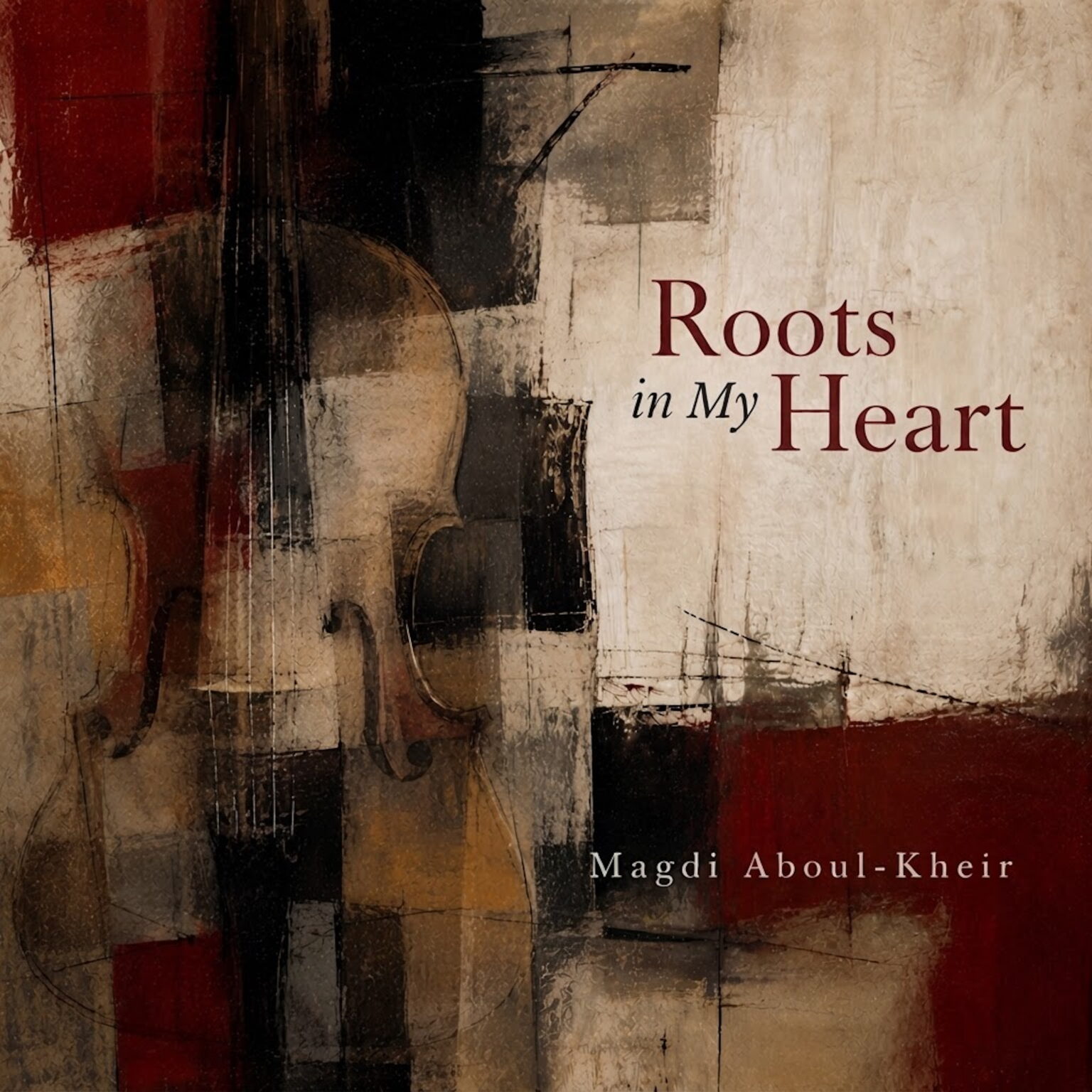
There is something wonderfully human about music that doesn’t feel the need to shout to be heard. In an era where so much contemporary listening is shaped by relentless stimulation, enormous production gestures, and the expectation that every moment should compete for attention, Magdi Aboul-Kheir’s Roots in My Heart offers a different kind of invitation. Released on November 6, 2026, the ten-track album finds the Germany-based composer and pianist exploring the emotional possibilities of acoustic chamber music, allowing strings, woodwinds, and piano to communicate through intimacy rather than spectacle. Its romantic warmth is immediately apparent, but this isn’t merely a collection of compositions designed to produce a soothing atmosphere. There is a thoughtful emotional landscape underneath the comforting harmonies, one that moves between affection, remembrance, melancholy, playfulness, and the quiet exhilaration of being alive. Aboul-Kheir understands that the most meaningful human experiences are rarely emotionally straightforward. A beautiful encounter can carry the shadow of a farewell; a moment of happiness can become precious precisely because it cannot last forever. Roots in My Heart approaches these contradictions with considerable sensitivity, offering music that feels less like an exercise in classical refinement and more like a personal conversation with the listener. Its melodies linger, its arrangements breathe, and its emotional warmth gradually becomes the defining quality of an album that rewards patience.
Aboul-Kheir’s artistic background provides an illuminating context for this return to acoustic chamber instrumentation. Classically trained as a pianist, he has spent considerable time exploring musical territories that extend well beyond traditional concert-room expectations. His catalogue includes the retro-synth explorations of Into the Retroverse and Replicant Dreams, the atmospheric expanses of Nubes Sonorae (Ambient Cloudscapes), the electroacoustic intimacy of Slow Heat, and the romantic orchestral imagination of The Garden of Make Believe. Elsewhere, One Last Dance and The Piano Has Been Dreaming reveal a more miniature approach to expression, with felt piano and grand piano providing intimate settings for reflective musical ideas. That breadth matters because it suggests a composer who understands how different sound worlds can communicate different kinds of emotion. On Roots in My Heart, however, the emphasis is firmly on the expressive possibilities of traditional acoustic instruments. Rather than treating this as a retreat into familiar classical territory, Aboul-Kheir seems to be bringing the accumulated knowledge of his varied musical adventures into a more concentrated setting. His interest in modern pacing, atmospheric depth, and emotional accessibility remains present, but the instrumental palette gives those qualities a distinctly organic character. The result feels like a meeting between formal musical craftsmanship and an instinctive desire to make something immediately felt.
One of the album’s most appealing qualities is its production, which places unusual importance on the physical presence of the instruments. The recording avoids the flattened intensity associated with excessive compression, preserving the natural dynamic differences between delicate passages and fuller ensemble movements. There is room to hear the subtle friction of bow against string, the gentle mechanics of piano keys, and the lingering decay of sound within the recording space. These details aren’t decorative additions; they help establish an intimate listening environment in which the musicians seem to occupy a shared room rather than an abstract digital landscape. The strings possess a warmth that allows their phrasing to unfold naturally, while the woodwinds introduce softer colors and counter-melodies that enrich the surrounding harmonic movement. Piano arpeggios provide an anchoring presence, supporting the ensemble without imposing an overly rigid framework. The spatial arrangement is particularly effective, allowing the instruments to retain their individuality while remaining connected to the larger musical conversation. That sense of separation and togetherness mirrors the album’s emotional concerns rather neatly: individual voices, individual experiences, and individual memories can coexist within something larger. The production is consequently immersive without becoming overwhelming, inviting the listener closer instead of attempting to impress through sheer volume or technical excess.
Across its ten original compositions, Roots in My Heart establishes a melodic language that favors emotional recognition over abstract complexity. Sweeping violin phrases and expressive cello lines give the music much of its romantic character, while clarinet and flute introduce lighter, more delicate shades into the arrangements. The interplay is central to the album’s appeal. Rather than having one instrument constantly dominate, Aboul-Kheir allows the various voices to respond to one another, creating an organic sense of movement that feels conversational. There is an appealing fluidity to the arrangements, with themes allowed to emerge gradually, gather emotional weight, and settle into harmonies that feel comforting without becoming entirely predictable. The music’s accessibility is not a weakness; it is part of its expressive purpose. Aboul-Kheir is interested in melodies that can be remembered, felt, and carried beyond the immediate listening experience. His emphasis on lyrical phrasing gives the compositions a quality that sometimes resembles an unspoken narrative, as though each instrumental line were attempting to articulate a thought that words could never quite capture. That approach creates an emotional connection without demanding that listeners understand the formal mechanics behind the music. One can simply follow the melody, recognize its tenderness, and allow the experience to unfold.
Romance provides the album’s central thread, but its emotional range extends considerably beyond conventional expressions of devotion. Dreams, encounters with nature, quiet farewells, and the simple pleasure of being present all contribute to the collection’s shifting perspectives. This variety is particularly important because romantic music can easily become trapped in a single emotional register, especially when warmth and consonant harmony remain its dominant characteristics. Aboul-Kheir avoids that limitation by allowing tenderness and melancholy to coexist, occasionally placing a sense of longing alongside moments of light-hearted playfulness or emotional release. The natural-world imagery is especially evocative in concept, with subtle changes in tempo and dynamic intensity suggesting rustling leaves, shifting sunlight, and the calm atmosphere of an early morning. Elsewhere, the music explores the bittersweet experience of saying goodbye, recognizing that love and loss are often inseparable. These contrasting moods give the album a sense of emotional movement that feels remarkably close to lived experience. Happiness doesn’t erase sadness, and sadness doesn’t necessarily extinguish happiness. They remain connected, sometimes even strengthening one another. Roots in My Heart understands this relationship intuitively, making its romantic character feel less like an idealized fantasy and more like a reflection of the complicated beauty of human connection.
The album’s sequencing also contributes significantly to its atmosphere, maintaining a patient rhythm that gives the individual compositions room to establish their identities. Solo piano passages offer moments of stillness, their reflective simplicity creating a welcome contrast with the fuller chamber ensemble movements. As the strings and woodwinds gradually enter, the music expands without abandoning its intimate character, building emotional intensity through arrangement rather than sheer volume. These transitions are among the project’s most effective structural gestures. A quieter passage can suddenly feel more meaningful after a sweeping ensemble moment, while a return to piano allows the listener to settle into a different emotional perspective. Aboul-Kheir demonstrates a clear understanding of how contrast can sustain attention even when the overall tempo remains unhurried. The album doesn’t need dramatic interruptions or abrupt stylistic shifts to maintain momentum; its movement comes from the changing relationship between instrumental voices, melodic themes, and dynamic levels. This makes Roots in My Heart particularly suited to evening listening, reflective walks, or creative sessions where music can accompany thought without competing for it. Yet the compositions also possess enough emotional definition to hold attention when heard more closely. Their gentleness isn’t an invitation to disengage but an opportunity to listen differently.
In comparison with more austere contemporary classical and neo-classical projects, Aboul-Kheir’s approach is notably generous in its melodic and harmonic language. Where some modern instrumental releases embrace repetitive structures, minimalist restraint, or deliberate dissonance as their primary expressive tools, Roots in My Heart places greater emphasis on memorable themes, warm harmonic movement, and recognizable emotional contours. This doesn’t mean the album is lacking in sophistication. Its strength lies in making compositional craft feel natural, allowing the arrangements to communicate without drawing unnecessary attention to their construction. The emphasis on acoustic instrumentation also gives the project a physical warmth that feels distinct from electronically generated ambience, even when both approaches might aim for a similar sense of calm. There is a genuine atmosphere of human presence throughout the recording, reinforced by the dynamic breathing of the ensemble and the preserved room sound. Admittedly, listeners who primarily seek high-energy electronic music, heavy rock distortion, or vocal-driven pop may find the album’s patient instrumental character comparatively understated. Its pleasures are gradual, and its emotional rewards depend more on attentive listening than immediate impact. But judged according to its ambitions, the collection demonstrates impressive consistency, balancing intimate production with melodic richness and a clearly defined emotional identity.

Ultimately, Roots in My Heart is a thoughtful celebration of the feelings that make life meaningful, even when they arrive in complicated or contradictory forms. Magdi Aboul-Kheir has created an album that understands the value of quiet expression, trusting the combination of strings, woodwinds, and piano to carry stories of love, memory, nature, and farewell without requiring a single spoken explanation. Its ten compositions form a journey through tenderness, contemplation, passion, and occasional playful brightness, with the changing moods giving the collection a sense of movement that extends beyond its consistently romantic foundation. The music’s greatest achievement is perhaps its ability to make emotional intimacy feel tangible. The instruments seem to speak to one another, and in doing so, they create space for listeners to recognize something of their experiences in the unfolding melodies. There is no need for grand declarations or dramatic gestures when a carefully shaped phrase can communicate so much. Aboul-Kheir reminds us that music can preserve the delicate impressions that ordinary language struggles to hold: the warmth of a remembered embrace, the sadness of a final meeting, the beauty of an ordinary morning, or the simple realization that being alive is itself something worth celebrating. Long after the final note fades, Roots in My Heart leaves behind an impression of closeness, as though its melodies have quietly settled into the listener’s own memories. It is an album rooted in emotion, but its most enduring quality is how it allows those emotions to keep growing.
For more information, follow Magdi Aboul-Kheir
WEBSITE – FACEBOOK – SPOTIFY – SOUNDCLOUD – BANDCAMP