
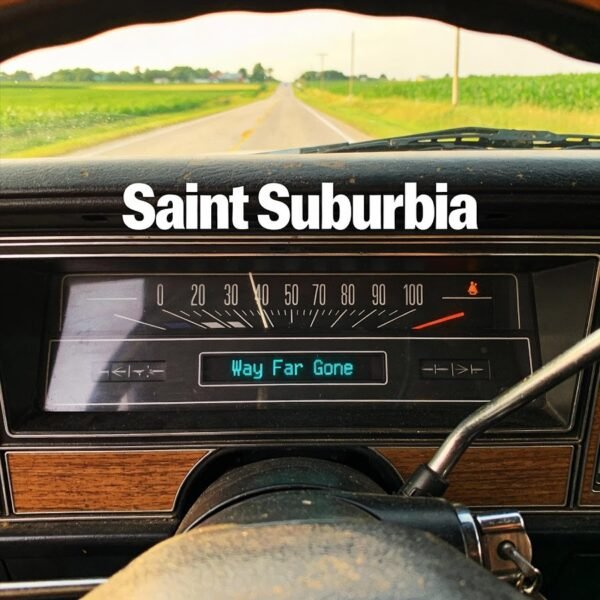
Some albums are made to chase trends; others are content to tell honest stories that linger long after the final note fades. Saint Suburbia’s latest full-length album, Way Far Gone, comfortably falls into the latter category. Over thirteen tracks, the Minneapolis/St. Paul outfit serves up a compelling mix of Americana, indie rock, and heartland songwriting that feels rooted in lived experience rather than polished mythology. Drawing inspiration from The Replacements, Uncle Tupelo, The Gear Daddies, and Gin Blossoms, the band writes songs that are melodically accessible and lyrically sincere. Way Far Gone does not operate on grand conceptual ambitions but rather through the embrace of the emotional complexities of ordinary life. It’s refreshingly unpretentious in its treatment of love, exhaustion, hope, identity, grief, and resilience, with each song adding another chapter to an album that manages to sound remarkably cohesive despite its broad emotional palette. What you get is a record you can listen to over and over again and discover new emotional textures each time.
The album opens with “It’s You,” which immediately establishes intimacy through simple but sincere lyrics. The repeated line, “It’s you, it’s me,” is an admission and a comfort, and it expresses the fragility of a person trying to hold onto something meaningful. The song thrives on emotional directness, letting the melodies carry much of the weight. This warmth flows naturally into “The Land of Milk and Honey,” where vivid geographical images transform landscapes into symbols of personal freedom and collective memory. The mention of canyon walls, flowing water, forests, and endless skies lends the story a spiritual quality that makes it more than just a travel story. The arrangements in all of these opening songs are spacious enough to let every instrument breathe, a sign that the band understands that emotional impact often comes from restraint rather than excess. It’s an inviting intro, immediately building trust between artist and listener.
One of the record’s great strengths is its willingness to be funny without sacrificing emotional depth. “Putting On Airs” might be the album’s best example of a shrewd social comment, deftly ridiculing the pretensions of culture with clever observations of popular tastes. With its references to black coffee, baseball games, Matchbox Twenty, and its unapologetic refusal to chase fashionable approval, the song is an anthem to authenticity over manufactured sophistication. It’s particularly difficult not to smile at lyrics that don’t apologize for enjoying simple pleasures. Honesty is a constant theme throughout the album, with Saint Suburbia always favoring recognizable human experiences rather than abstract symbolism. Their songwriting never seems to be trying to impress with complexity for its own sake. Instead, it embraces conversational storytelling that feels like real conversations, making the emotional stakes accessible without being simplistic. And it’s this mix of humor and fragility that makes the album so timeless.
“Brother John” is one of the darkest stories on the album, and it brings a whole new emotional atmosphere. Saint Suburbia, with its unbelievably economical storytelling, tackles the tragedy of loneliness, failed relationships, and irreversible consequences without resorting to sensationalism. You could easily see these lyrics as a piece of short fiction, slowly showing how devastating the consequences of isolation can be. But the tracks around it, rather than living only in despair, provide an emotional counterpoint. “Shattered” has a bizarre knack for capturing the stifling sameness of modern work culture, mental burnout, and personal collapse with a powerful relatability. Its descriptions of hours of staring at computer screens, routine draining the soul, and life slipping away resonate with anyone who has experienced burnout in contemporary society. “Hold On, Pt. 2,” by contrast, is an emotional counterweight that revels in the healing power of companionship. The repetition of “you can be the cure for my blues” avoids cliché because it follows songs full of hardship, so the optimism doesn’t appear to be artificially optimistic but as truly earned.
The collection’s emotional centerpiece is the title track, “Way Far Gone.” It’s about musings on time, regret, and self-doubt, and it captures the discomfiting feeling of always moving but never quite knowing where you’re going. Lines that describe steps forward, then steps back, are a compelling metaphor for adulthood itself, where progress is rarely a straight line. Musically, the song reflects that instability with measured pacing and a thoughtful arrangement that keeps the lyrics at the forefront. “Green Light Go” immediately injects some welcome energy into the sequence with a funny fantasy about ditching corporate drudgery for beaches, sunshine, and an easy life. But beneath the levity, a familiar desire emerges: to break free from habits that gradually diminish creativity and joy. The blend of existential brooding and escapist optimism shows the band’s impressive sequencing instincts, ensuring the emotional momentum never becomes predictable.
The last songs on the album continue to explore more complicated emotional territory. “Been Thinking” returns to romantic uncertainty with a youthful sincerity, offering longing stripped of melodrama as the narrator waits for the courage to cross the emotional divide. “Stolen” takes the themes to a much larger canvas, dealing with loss at an almost existential level. Its meditation on stolen dreams, unpredictable suffering, and emotional endurance speaks to experiences that go beyond individual relationships, suggesting that grief itself becomes a shared human language. Meanwhile, “Scot-Free” serves as a morality tale through deceptively simple observations, reminding listeners that there are consequences even when wrongdoing escapes public accountability. The refrain “Just because you can” recurs throughout the album, serving as a quietly devastating ethical reminder that opportunity does not automatically justify action, challenging the increasingly common assumption that it does. These songs demonstrate how Saint Suburbia can move beyond the individual to larger issues of responsibility, consequence, and the invisible weight of conscience.

The album ends with “No, I Know” and “For Any Dream,” and the result is a work that leaves listeners with cautious optimism rather than definitive answers. That could be the most significant takeaway from Way Far Gone. Rather than making neat resolutions, Saint Suburbia knows that life is rarely neat in the end. Relationships are still complicated, personal development is unfinished, and hope often exists alongside disappointment rather than replacing it. Musically, the band’s musicianship underpins this philosophy throughout the record, fusing solid Americana foundations with indie-rock immediacy and melodic instincts that never take precedence over the storytelling. Every performance feels dedicated to the songs themselves, not to technical showboating, creating an atmosphere that prizes authenticity over spectacle. In an age where throwaway singles and algorithmic production are increasingly the norm, Way Far Gone is a reminder that carefully crafted albums still have remarkable emotional power. It’s a reflective, honest, and altogether rewarding set of songs that proves Saint Suburbia knows one of music’s oldest lessons: the songs that stick most often are the ones that tell the truth.
For more information, follow Saint Suburbia
WEBSITE – SPOTIFY – FACEBOOK – TWITTER