

Classical music does not always have to begin with grand tragedy, ancient mythology, or some weighty philosophical proposition. Sometimes, apparently, it can begin with a farmer heading off to visit his neighbor wearing only one shoe. That wonderfully peculiar premise sits at the heart of Sergiy Bolotny’s “Little Dutch Rhapsody No. 1,” a solo violin work that takes the humorous Groningen folk tune “Ain boer wol noar zien noaber tou” and transforms its rustic character into its sophisticated concert-hall makeover. The result is an engaging meeting between folklore and virtuosity, a piece that never loses sight of the playful spirit contained within its source material while allowing the violin to explore a much broader expressive vocabulary. Bolotny’s perspective makes the concept particularly intriguing. As a Ukrainian concert violinist living in the Netherlands and performing with the Noord Nederlands Orkest, he occupies an interesting artistic position from which to examine Dutch musical tradition. Rather than approaching folklore as something fixed behind glass, he treats it as raw material—something that can be stretched, reshaped, accelerated, softened, and transformed while retaining a recognizable connection to where it came from. “Little Dutch Rhapsody No. 1” therefore feels less like an arrangement in the conventional sense and more like an imaginative conversation between different musical worlds. The folk melody supplies the personality, humor, and cultural grounding, while the solo violin supplies the freedom. There is something immediately appealing about that balance. The piece does not ask the listener to choose between tradition and classical sophistication. It allows both to occupy the same space, and the strange story of the farmer with one clog becomes an unexpectedly effective doorway into a lively piece of contemporary concert writing.
From a technical standpoint, “Little Dutch Rhapsody No. 1” provides Bolotny plenty of opportunity to demonstrate just how much movement, color, and rhythmic excitement can be extracted from a single instrument. The rapid string crossings are among the most energetic aspects of the work, producing a sense of perpetual motion that seems almost tailor-made for the song’s mischievous premise. There is a physicality to these passages: the bow has to move quickly, the fingers have to remain precise, and the performer must maintain control while giving the music enough spontaneity to feel alive. That combination of difficulty and playfulness is one of the work’s defining qualities. Bolotny does not allow technical virtuosity to become an empty display. Instead, the demanding passages seem to extend the personality of the folk material, as though the violin itself has caught the restless energy of the farmer setting out on his unusual journey. Just when the momentum threatens to become overwhelming, the composition changes direction and allows a more lyrical side to emerge. These slower passages are important because they create breathing room, giving the listener an opportunity to hear the violin not merely as a machine capable of astonishing speed but as an expressive voice. The contrast between nimble dance rhythms and reflective melodic writing gives the piece its shape. It also keeps the listener engaged because there is no single texture dominating from beginning to end. The music can sprint, pause, sing, and then spring back into motion. Such changes make the rhapsodic character of the composition especially convincing. Bolotny is not simply decorating a folk tune with difficult violin passages; he is using the instrument’s full range of possibilities to dramatize and reinterpret the character already present in the original.
Perhaps the most satisfying element of the recording is the way Bolotny handles the folk source without allowing it to become a rigid blueprint. “Ain boer wol noar zien noaber tou” may be rooted in a specific Dutch and Groningen tradition, but “Little Dutch Rhapsody No. 1” does not sound as though it is simply placing the original melody on a classical pedestal. Instead, Bolotny gives the material room to wander. The melody can suggest the source while the surrounding writing takes it somewhere new, creating the sensation of recognizing a familiar voice speaking in an unfamiliar setting. That approach is crucial to the piece’s success because a straightforward reproduction would diminish the very quality that makes the project interesting. The humor of the folk story survives, but it is filtered through the language of concert violin technique. The solo format makes this transformation particularly exposed. There is nowhere for the central instrument to hide, no ensemble texture to blur a detail, and no large orchestration to distract from the relationship between performer and composition. Bolotny embraces that intimacy by recording the work with natural acoustic resonance, allowing the violin to speak in an unvarnished manner. You hear the instrument as an instrument rather than as an artificially enlarged studio object. The bowing, articulation, shifts in intensity, and movement between fast and quiet sections all become part of the listening experience. That acoustic openness suits the concept beautifully. The piece is about taking something that belongs to a communal oral tradition and translating it into a deeply individual performance, and the natural recording allows that process to remain audible. The violin sounds close enough to touch, yet the imagination behind the writing gives it plenty of room to roam.
There is also a refreshing sense of humor in the way “Little Dutch Rhapsody No. 1” refuses to take its own sophistication too seriously. The composition may demand considerable skill from its performer, but the eccentricity of its source material remains firmly embedded in its personality. That is an important distinction. The technical passages could easily have transformed the folk tune into something stern and overly academic, yet the underlying dance character keeps nudging the music back toward mischief. Even when the violin is racing through difficult passages, there is a suggestion of movement for movement’s sake, as though the music is enjoying the chase. The slower sections, meanwhile, offer another interpretation of the folk material, revealing that humor does not have to mean constant speed or exaggerated gestures. There can be tenderness and lyricism inside a playful narrative. Bolotny’s achievement lies partly in recognizing those possibilities and allowing them to coexist. His Ukrainian background and life as a performing musician in the Netherlands also make the project feel like more than an exercise in stylistic adaptation. It represents an encounter between an artist and the musical culture around him, approached with enough curiosity to create something personal rather than merely imitative. The broader idea behind his series—exploring traditional Dutch folklore through classical virtuosity—has considerable potential because folk music is full of melodies and stories that can reveal new dimensions when removed from their original setting. “Little Dutch Rhapsody No. 1” demonstrates that process in miniature. The farmer, the missing shoe, the neighbor, the old melody, and the modern concert violin all become parts of the same musical world. What might sound like an unlikely combination on paper turns out to be precisely what gives the piece its character.
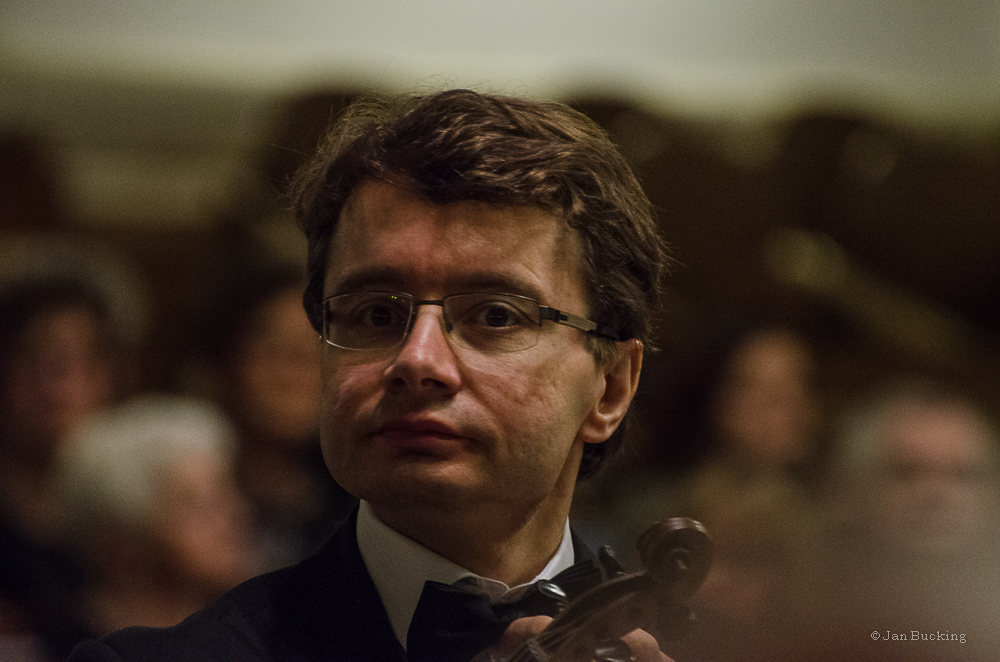
Ultimately, “Little Dutch Rhapsody No. 1” succeeds because Sergiy Bolotny understands that preserving a tradition does not necessarily mean leaving it untouched. Sometimes the most engaging way to keep an old musical idea alive is to let it travel somewhere it has never been before. Here, a humorous Groningen folk song becomes the foundation for a spirited solo violin rhapsody, retaining enough of its original identity to remain connected to its roots while gaining an entirely new physical and expressive vocabulary. The rapid string crossings inject adrenaline, the dance rhythms keep the work light on its feet, and the lyrical passages reveal a more contemplative dimension beneath the humor. Meanwhile, the natural acoustic recording ensures that the violin remains the unmistakable center of the experience, allowing every shift in texture and intensity to register with clarity. There is an appealing paradox at work throughout the piece: the story behind it is wonderfully simple and almost comical, while the musical demands of bringing it to life are anything but simple. That contrast is exactly where much of the charm lies. Bolotny has taken an unusual fragment of Dutch folklore and resisted the temptation to make it respectable by removing its eccentricity. Instead, he has carried that eccentricity into the concert setting and allowed it to dance alongside serious violin craftsmanship. The result is energetic, colorful, technically ambitious, and genuinely personable. “Little Dutch Rhapsody No. 1” reminds us that classical music can be playful without becoming lightweight, virtuosic without becoming showy, and rooted in tradition without becoming confined by it. Somewhere between a Groningen folk tale and a demanding solo performance, Bolotny has found a lively musical crossroads—and, rather fittingly, he arrives there with enough momentum to keep the journey going.
For more information, follow Sergiy Bolotny
WEBSITE – FACEBOOK – SPOTIFY – YOUTUBE – INSTAGRAM