
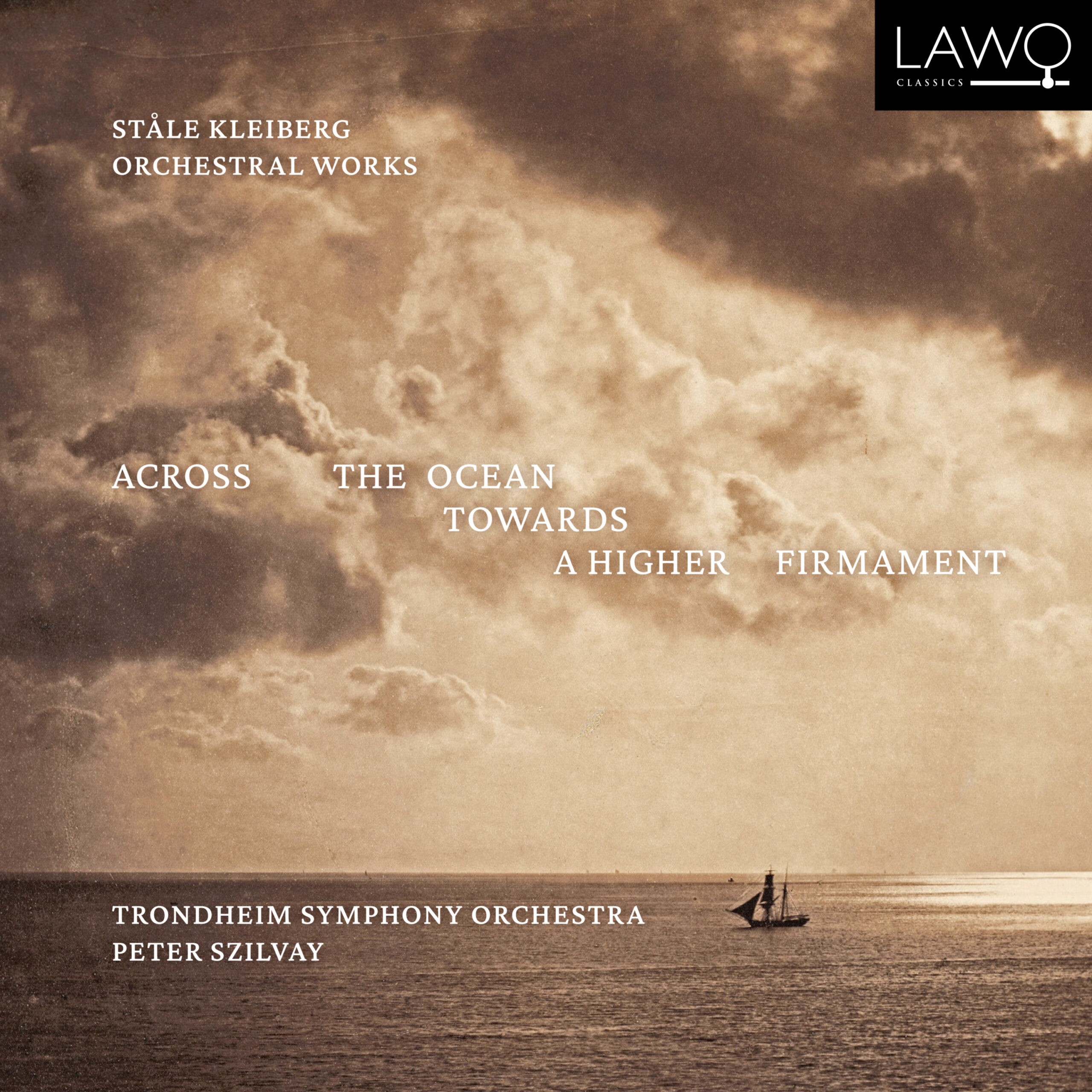
Some musical journeys begin with a departure, but the most meaningful ones are also concerned with everything that remains behind. Across the Ocean towards a Higher Firmament, Norwegian composer Ståle Kleiberg explores the complicated relationship between leaving, belonging, remembrance, and the search for a place in the world. Performed by the Trondheim Symphony Orchestra under the direction of Peter Szilvay, this substantial orchestral album brings together three works that approach human history from different perspectives. Its emotional landscape stretches from the devastating memory of a young life destroyed by Nazi persecution to the familiar rhythms of a community and, finally, the enormous historical movement of Norwegian emigration to North America. Rather than presenting these subjects as separate historical episodes, Kleiberg creates a broader reflection on how individuals are shaped by the places they inhabit, the people they lose, and the decisions that carry them into unfamiliar territory. There is a seriousness to this music, but it is never merely academic or commemorative. Kleiberg understands that history becomes meaningful when it is connected to human feeling, and his orchestral writing gives those feelings room to develop. The Trondheim Symphony Orchestra responds with considerable sensitivity, balancing intimacy and grandeur while allowing the music’s changing moods to emerge naturally. Szilvay provides a sense of direction without imposing unnecessary theatricality, making the performances feel like an unfolding narrative rather than a sequence of grand gestures. Released digitally through LAWO Classics on 28 August 2026, the album offers a compelling example of contemporary classical music engaging with the past while speaking directly to the present.
The opening work, Lamento – Cissi Klein in memoriam, establishes the album’s moral and emotional foundation with extraordinary gravity. Written in 2001, the composition commemorates Cissi Klein, a young Jewish girl from Trondheim whom the Nazis murdered during the Second World War. The subject is painfully specific, and that specificity matters. Kleiberg does not approach the tragedy as an abstract symbol of wartime suffering; he directs attention to an individual whose life was taken, reminding listeners that the enormous statistics of persecution and genocide are made up of countless personal stories. The music’s lamenting character creates an atmosphere of reflection in which restraint can be more affecting than overwhelming force. Its roughly thirteen-minute duration allows the emotional weight to settle gradually, giving the orchestra space to communicate grief, tenderness, and the quiet persistence of memory. There is something especially powerful about beginning an album concerned with migration and identity through a work about someone who was denied the chance to determine her future. The contrast makes the wider themes more urgent: the freedom to leave, to search for a new home, and to imagine another life cannot be assumed. Lamento also belongs to Kleiberg’s larger artistic engagement with Nazi persecution, alongside his Requiem—for the Victims of Nazi Persecution and cello concerto Dopo. Together, these works show a sustained commitment to remembering those whose lives one of history’s darkest chapters destroyed. Here, however, the tribute is particularly intimate. It asks for attention rather than spectacle, and its emotional force comes from the knowledge that remembrance is itself an act of responsibility.
From that deeply personal opening, The Town and its People, completed in 2022, broadens the album’s perspective on the shared experience of community. Lasting approximately ten minutes, the piece offers a different kind of historical reflection, one concerned not with a single tragedy but with the character of a place and the people who provide it life. Its position between Lamento and the title symphony is significant. After contemplating an individual whose future was violently cut short, the listener is invited to consider the everyday human connections that make a town more than a collection of streets and buildings. A community is formed through ordinary routines, encounters, relationships, disagreements, celebrations, and memories accumulated over generations. Kleiberg’s orchestral approach gives this subject a wider canvas, allowing the music to move away from the concentrated grief of the opening work and toward something more communal and expansive. The Trondheim Symphony Orchestra is particularly well suited to this transition, bringing a sense of continuity to an album so closely connected with Norwegian identity and place. The work also provides an important emotional bridge to the migration story that follows. People do not leave a homeland simply because it is a location on a map; they leave relationships, familiar landscapes, languages, customs, and entire networks of belonging. By giving Trondheim and its inhabitants a musical presence before turning towards the Atlantic crossing, Kleiberg makes the eventual journey feel rooted in real human experience. The album is therefore not simply about movement from one country to another. It is equally concerned with the emotional geography of home and with the memories that travel even when people themselves move thousands of miles away.
The central work, Symphony No. 3, Across the Ocean towards a Higher Firmament, brings these themes together on a much larger scale. Commissioned by the Trondheim Symphony Orchestra and premiered under Szilvay’s direction in April 2025, the three-movement symphony was written in connection with Norway’s National Jubilee 2030 and the 2025 focus on migration and identity. Its subject is the profound wave of Norwegian emigration to North America during the nineteenth and twentieth centuries, when enormous numbers of people crossed the Atlantic in search of new opportunities and a different future. Kleiberg approaches that history through an emotional progression rather than a straightforward historical illustration. The first movement, Espressivo e rubato. Andante establishes a mood of yearning and uncertainty, suggesting the complicated emotions surrounding departure. There is an expressive quality to the movement’s unfolding orchestral lines, with the strings and woodwinds offering a sense of reflection and anticipation. One can imagine the northern landscape gradually receding, the familiar coastline becoming smaller, and the traveller confronting the enormity of what lies ahead. Yet the music does not reduce emigration to a simple tale of courageous adventure. Leaving home can involve hope, but it also means separation, doubt, and the possibility that the life one finds elsewhere may never entirely replace the one left behind. Kleiberg allows these competing feelings to coexist, giving the movement a sense of emotional complexity that makes the historical subject feel immediate. The orchestra’s ability to move between delicate expression and broader symphonic gestures imparts the opening section its character, capturing the private thoughts of individuals within a much larger human migration.
The second movement, Tranquillo. Drammatico. Misterioso takes the journey into even more unsettled territory. Its changing character suggests the uncertainty of crossing an immense ocean, where the destination may be known in theory but the actual experience remains beyond the traveller’s control. The contrast with the first movement is important: the initial yearning now gives way to greater tension, and the orchestra can explore the drama inherent in a voyage that demanded physical endurance as well as emotional courage. The music’s darker atmosphere suggests hardship, danger, and the psychological strain of suspension between two worlds. Yet Kleiberg’s approach is not simply to turn the ocean into a dramatic backdrop. The sea becomes a metaphor for uncertainty itself, representing the distance between what people know and what they hope to discover. The third movement, Maestoso. Quasi corale then brings the symphony to a hymn-like conclusion. After the introspection and turbulence of the earlier sections, the music opens into a more expansive and affirmative statement, suggesting arrival, transformation, and the possibility of building a new life. Its majestic character offers a satisfying emotional resolution, although it need not be understood as a claim that every emigrant’s experience ended happily. Rather, the conclusion honors perseverance and the human capacity to create meaning in unfamiliar surroundings. The journey across the ocean becomes a journey towards a different understanding of home, one in which identity can be carried forward, adapted, and enriched rather than simply abandoned. Across these three movements, Kleiberg gives historical migration a deeply human dimension, transforming a vast collective event into an orchestral narrative of individual hopes and shared experience.

The performances are central to the album’s success. Kleiberg’s writing demands an orchestra capable of handling both the fine details of reflective passages and the larger architecture of symphonic drama. The Trondheim Symphony Orchestra brings the necessary breadth to the title work while retaining the sensitivity required by Lamento – Cissi Klein in Memoriam and The Town and its People. Under Peter Szilvay, the three compositions feel connected by a clear artistic purpose, even though they differ considerably in scale and emotional character. The orchestra’s contribution is not simply about producing a powerful sound; it is about understanding how that sound should change as the subject changes. The restrained atmosphere of remembrance requires a different kind of attention from the dramatic movement of the symphony, while the portrait of a community calls for its own balance of movement and warmth. This range gives the album much of its appeal. Kleiberg is a composer whose catalogue includes substantial orchestral and vocal works, among them Requiem—for the Victims of Nazi Persecution and the opera David and Bathsheba, and his experience with large musical forms is evident in the way these compositions are shaped. His long-standing artistic relationship with the Trondheim Symphony Orchestra also gives the project a particular sense of continuity. As Professor Emeritus of Music at NTNU in Trondheim, he has played an important role in Norway’s contemporary classical landscape, but the achievement here is not simply a demonstration of compositional stature. It is the ability to bring historical reflection and musical expression into a relationship that feels considered, sincere, and emotionally persuasive.
Ultimately, Across the Ocean towards a Higher Firmament is an album about the many ways people remain connected to the past while trying to move towards a future they cannot fully predict. Its three works create a thoughtful progression: the remembrance of Cissi Klein reminds us of the human cost of persecution and the importance of preserving individual stories; The Town and its People celebrates the shared experiences that give a place its identity; and Symphony No. 3 expands that perspective into a sweeping account of migration, separation, endurance, and renewal. The title itself suggests that the ocean is not merely an obstacle to be crossed but a space between one existence and another, with the possibility of a higher horizon waiting beyond it. Kleiberg does not offer simplistic answers about belonging or identity. Instead, he recognizes that both are shaped by memory, circumstance, loss, and the courage to begin again. That is what makes the album resonate beyond its specifically Norwegian historical focus. Its themes are relevant wherever people have left familiar places, carried their histories across borders, or tried to understand what home means after life has changed. With the Trondheim Symphony Orchestra and Peter Szilvay giving these compositions such committed performances, the album becomes both a significant addition to Kleiberg’s catalogue and a moving statement about collective memory. It rewards patient listening, not because it demands admiration for its scale, but because its emotional ideas gradually reveal themselves through the music. Across the ocean towards a higher firmament, it looks back without becoming trapped in nostalgia and reaches for the future without pretending the journey is easy. It is a thoughtful, deeply expressive orchestral achievement, reminding us that every crossing carries a story—and that sometimes the most important thing we take with us is the memory of where we began.
For more information, follow Ståle Kleiberg
WEBSITE – SPOTIFY – INSTAGRAM