
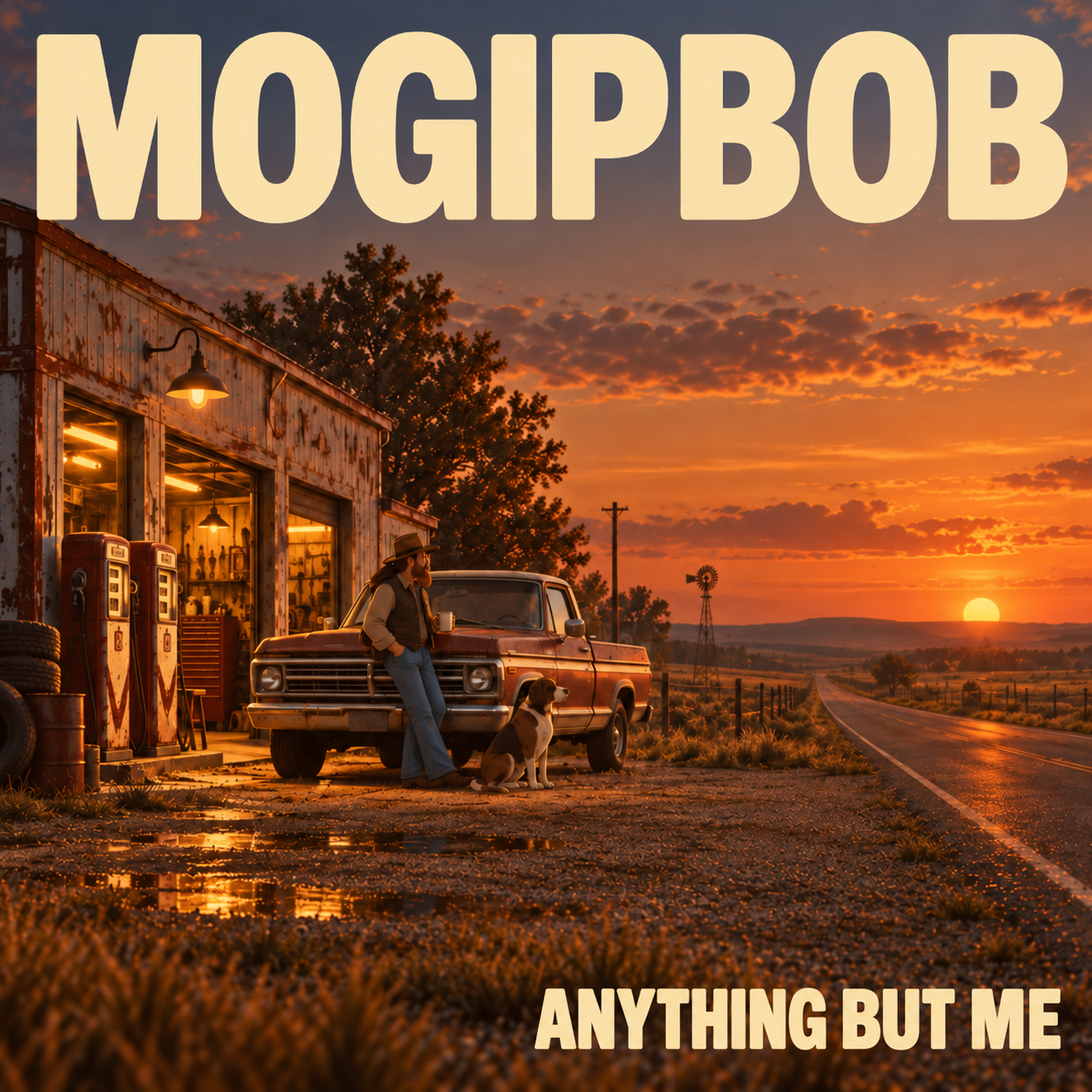
Mogipbob’s Anything but Me is the kind of album that refuses to sit still long enough to be pinned down, and that restless spirit is precisely what makes it such an intriguing listening experience. Across sixteen original songs, this small-town Canadian songwriter explores a wonderfully unpredictable musical landscape where country-soul rubs shoulders with folk-rock, blues, funk, retro-soul, and western storytelling, all connected by a sharp eye for the peculiarities of everyday life. One moment, the imagination wanders into the absurd territory of vampires, fleas, questionable deliveries, and bell-bottomed fashion; the next, it settles into more personal territory, considering the passage of time, the persistence of memory, and the small details that give life its meaning. What might initially seem like a collection of unrelated ideas gradually reveals a more coherent creative philosophy: ordinary existence is rarely as straightforward as it appears, and the right change of perspective can turn an everyday observation into comedy, a strange situation into a story, or a passing thought into something surprisingly profound. Mogipbob does not appear particularly interested in following commercial formulas or maintaining a single musical identity throughout the record. Instead, the songs determine their own direction, allowing each concept to find a suitable musical home. That freedom gives Anything but Me an adventurous, sometimes eccentric character, but there is an underlying consistency in the songwriting itself. Humor, curiosity, nostalgia, and reflection repeatedly surface, giving this wide-ranging collection a recognizable personality. It is an album that embraces its contradictions, celebrates the unusual, and understands that sincerity does not have to arrive wearing a serious expression.
The opening stretch establishes that sense of unpredictability through a sequence of titles that practically invite the listener to imagine what peculiar stories might unfold. “Set-Back Out Back” opens the sixteen-track journey, followed by “Hell’s Bell Bottoms,” a title that immediately suggests Mogipbob’s fondness for mixing playful imagery with the language of musical and cultural history. Bell-bottoms carry their own nostalgic associations, recalling an era when fashion could be as expressive and rebellious as the music surrounding it. By attaching such a familiar symbol to an exaggerated, almost mischievous phrase, Mogipbob signals that this album will not be afraid to turn ordinary cultural references into something stranger. “Walking Bass” follows, bringing musical terminology directly into the sequence, while “As Is Where Is” adds another conversational phrase whose familiarity leaves room for interpretation. The variety of these titles is part of the record’s appeal: they suggest a songwriter collecting fragments of language, overheard expressions, visual impressions, and passing thoughts, then discovering the possibilities hidden inside them. Rather than making every song serve one grand narrative, Mogipbob allows individual concepts to establish their own little worlds. This approach can be refreshing in an era when albums are frequently designed around tightly controlled genres or easily marketable identities. Here, the listener is encouraged to approach each new track with curiosity rather than a fixed expectation. The early sequence also establishes an important distinction between randomness and imaginative freedom. These songs may take unusual routes, but the ideas originate in observations and experiences that feel recognisably human. The comedy works because its raw materials are familiar, even when the resulting situations become absurd. Mogipbob’s gift lies in recognizing that everyday life already contains more than enough material for an eccentric songwriter; it simply requires the willingness to look at it from an unexpected angle.
That playful approach becomes even more apparent in the album’s more overtly imaginative selections, including “The Fleas of Hercules,” “Umpire Vampire,” “Impartial Marshal,” and “Livery Delivery.” These titles invite listeners into a world where wordplay, unlikely characters, and strange circumstances run freely. “The Fleas of Hercules” combines the grandeur of classical mythology with an irritatingly ordinary pest, creating an immediate collision between heroic scale and comic inconvenience. The contrast alone demonstrates the kind of conceptual leap that gives Mogipbob’s songwriting its distinctive flavor. “Umpire Vampire” similarly places two recognisable ideas together in a way that feels mischievous and faintly surreal, suggesting a character whose supernatural existence might be complicated by the rules and rituals of sport. Meanwhile, “Impartial Marshal” hints at the possibilities of western storytelling, where questions of authority, justice, and fairness can become the foundation for a memorable character study. “Livery Delivery” adds another twist of language, turning the ordinary business of transporting something into a phrase that sounds almost theatrical. The important thing is not whether every listener interprets these titles in exactly the same way, but how readily they establish a sense of personality before the songs even begin to unfold. Mogipbob clearly enjoys the process of taking an idea beyond its most obvious destination. There is a playful, almost old-fashioned pleasure in that kind of songwriting, recalling a tradition in which memorable characters and clever turns of phrase could be just as important as a song’s musical category. Yet the album’s humor does not exist solely to produce a quick laugh. These unusual concepts give the songwriter room to examine familiar human behaviors from a sideways perspective, using exaggeration and absurdity to make ordinary foibles easier to recognize. Occasionally a ridiculous premise can reveal a truth that a more solemn approach might struggle to communicate.
Musically, Anything but Me benefits from Mogipbob’s willingness to let the subject matter guide the arrangement rather than forcing every composition into the same stylistic framework. Country, folk-rock, blues, funk, and retro-soul provide a broad palette, while western storytelling adds a sense of character and atmosphere to the album’s more narrative-minded ideas. That variety is central to the listening experience. Country and folk can offer the conversational warmth needed for songs rooted in everyday observations, while blues brings a natural affinity for frustration, irony, and hard-earned perspective. Funk adds another layer of rhythmic personality, while retro-soul brings a more expressive, groove-oriented sensibility. Rock, meanwhile, gives the project room to stretch beyond gentler acoustic textures. The appeal of this approach is that the musical choices are intended to serve the song rather than the songwriter’s desire to maintain a consistent brand. A collection built around sixteen original concepts could easily become repetitive if every track followed the same arrangement template, but Mogipbob’s stated creative philosophy encourages the opposite. Each song is provided the opportunity to discover what it needs. This means that Anything but Me is best approached as a sequence of individual musical personalities rather than a single genre exercise. Its stylistic shifts reflect the unpredictable nature of the ideas themselves, allowing a comic premise to coexist with a reflective observation without making either feel out of place. The album’s diversity also provides it a sense of curiosity: Mogipbob seems more interested in discovering what a song might become than in proving allegiance to a particular tradition. That openness is one of the project’s defining strengths, giving the record an exploratory character that feels closely connected to the songwriter’s growing confidence in following an idea wherever it leads.
Beneath the wordplay and eccentric premises, however, Anything but Me has a more reflective center, and several tracks suggest a songwriter increasingly interested in the complicated relationship between who we were and who we become. “Some Things Never Change” introduces the enduring tension between continuity and transformation, a subject that becomes particularly meaningful when considered alongside “The Old Me Was the Young Me.” Aging has a way of making the past feel both distant and strangely present. We change in countless ways, gathering experience and revising our understanding of the world, yet old habits, familiar emotions, and fragments of our earlier selves can remain remarkably persistent. The title “The Old Me Was the Young Me” captures that contradiction in a concise, almost conversational phrase. It suggests a recognition that the person we remember from childhood or youth is not entirely separate from the individual we see in the mirror today. We may have developed new priorities, learned difficult lessons, or abandoned beliefs we once considered permanent, but the past remains woven into our identities. “Some Things Never Change” approaches a related idea from another direction, raising the possibility that some features of life and human behavior endure despite the passage of time. These themes give the album emotional depth without requiring it to abandon its humor. Indeed, the contrast makes the reflective material more compelling. A songwriter who can laugh at the absurdities of existence is also well placed to recognize its contradictions, including the strange mixture of progress and repetition that defines so many lives. Rather than treating nostalgia as an uncomplicated longing for better days, Mogipbob’s approach invites a more nuanced response. Looking backwards can bring comfort, amusement, regret, and perspective, sometimes all at once. The past is neither something we can completely recover nor something we can entirely leave behind. It becomes part of the material from which we continue to shape ourselves.
“Modern Person Ancient Solutions” adds another intriguing dimension to the album’s interest in perspective, placing the language of contemporary identity alongside the enduring appeal of older ideas. The title suggests a tension between the complexities of modern living and the possibility that some useful answers have existed for generations. In a world increasingly dominated by technological change, constant information, and the pressure to keep moving forward, there can be value in revisiting older forms of knowledge, practical wisdom, and human experience. The interesting question is not whether the past was necessarily better, but whether modern people sometimes overlook straightforward insights because they are too busy searching for something new. That idea sits comfortably within an album that repeatedly finds creative possibilities in familiar experiences. Elsewhere, “Solid as Metal” suggests a different kind of solidity, while “First Degree Second Decree” offers another example of Mogipbob’s attraction to language that carries multiple possible associations. These titles contribute to the record’s playful intellectual texture, giving the listener small puzzles to consider alongside the music. The album does not need every song to deliver a solemn philosophical conclusion; its interest in ideas is expressed through curiosity, wordplay, and a willingness to entertain contradictions. Even its stranger concepts seem to emerge from the same underlying impulse: look at something familiar, question the obvious interpretation, and see what happens when the pieces are rearranged. That process can be comic, reflective, or both. The song titles themselves become part of the experience, setting up expectations that the music can fulfill, complicate, or deliberately overturn. For a record built around sixteen original songs, this variety helps maintain momentum. There is always another concept waiting around the corner, another phrase to reconsider, or another shift in tone to keep the album from settling into predictability. Mogipbob’s imagination is not confined to any one emotional register, and the album is richer for it.
Among the collection’s most revealing titles are “Sunday Drive” and “It’s the Little Things That Matter Most,” both of which point to the quieter observations that balance the album’s more elaborate flights of imagination. A Sunday drive evokes an unhurried kind of experience, one in which the journey can matter more than reaching a destination. It suggests open roads, changing scenery, familiar surroundings viewed from a slightly different angle, and the opportunity to let thoughts wander without demanding immediate answers. Such an image fits an album concerned with the relationship between perspective and meaning. Everyday activities can seem insignificant when measured against grand ambitions, yet they often provide the moments we remember most fondly. “It’s the Little Things That Matter Most” brings that principle into sharper focus, suggesting that fulfillment is frequently found in details that are easy to overlook while chasing larger goals. The warmth of a conversation, a familiar routine, a small act of kindness, or the simple pleasure of spending time with someone can carry a significance that becomes apparent only when we stop rushing past it. These ideas give the album a grounding influence, counterbalancing the flamboyant wordplay and fantastical characters with a reminder of what ordinary life can offer. There is a quiet wisdom in that contrast. Mogipbob does not seem to believe that meaning must always arrive through dramatic revelations or extraordinary experiences. Sometimes it emerges from paying attention, allowing an unremarkable afternoon to become memorable, or recognizing the value of something that has been present all along. The country and folk traditions associated with storytelling are particularly well suited to this kind of reflection, because they often find emotional resonance in everyday scenes and familiar human relationships. Within Anything but Me, such moments provide breathing room, allowing the listener to move away from the comic spectacle and consider the quieter truths that sit beneath it.

An especially interesting aspect of the project is the way Mogipbob combines human-written concepts and lyrics with AI-assisted musical production. According to the album’s description, the creative process begins with original ideas and lyrics written by the songwriter, while AI is used as a tool to help realize arrangements and performances. Musical direction, instrument choices, repeated revisions, and careful selection from generated results all contribute to shaping the final tracks. This distinction matters when considering the identity of the album. Its character-driven songwriting, unusual premises, and recurring interest in memory, humor, and perspective begin with the human act of noticing something worth exploring. The production process then provides a means of translating those ideas into a range of musical settings. Used this way, AI becomes part of a broader creative workflow rather than a replacement for the initial songwriting impulse. It also makes the album’s stylistic range particularly relevant: a collection that moves between country-soul, blues, folk-rock, funk, retro-soul, and western storytelling requires decisions about how each song should sound and what arrangement best serves its particular character. The challenge is to ensure that variety feels purposeful rather than arbitrary, and Mogipbob’s stated method places emphasis on revision and selection instead of accepting the first available result. That process reflects the album’s broader philosophy of experimentation. Not every idea must follow an established path, and not every song must resemble its predecessor. The creative technology is one part of the picture, but the record’s personality ultimately rests on the concepts that distinguish its songs and on the willingness to let those concepts lead. For listeners interested in how independent songwriters are exploring emerging production methods, Anything but Me offers a project in which technology and imagination meet within a deliberately eclectic framework. Its most compelling feature remains the variety of human observations and absurd possibilities that set the songs in motion.
The title track, “Anything but Me,” brings the album to its final destination and provides a fitting point from which to consider the collection as a whole. Across sixteen songs, Mogipbob has moved through comic inventions, unusual characters, familiar frustrations, reflections on aging, and reminders to appreciate the small things that make life meaningful. The title itself suggests questions of identity and self-perception, connecting with the record’s wider interest in how we understand ourselves and the world around us. Who we are is never entirely fixed, and the way we see ourselves can shift according to circumstance, memory, humor, and the expectations of others. The album’s refusal to settle into one musical category mirrors that fluidity. Country, blues, funk, folk-rock, retro-soul, and western storytelling become different ways of approaching the same fundamental task: making sense of experience through song. Some tracks lean into the absurd, others invite reflection, and the most revealing moments emerge from the way these contrasting approaches coexist. Anything but Me may not offer the streamlined uniformity of a record designed around a single genre or concept, but its eclecticism is part of its identity. Mogipbob’s growing willingness to follow ideas wherever they lead gives the album a sense of creative freedom, while the recurring themes of perspective, memory, change, and everyday meaning provide a thread connecting its many turns. The result is curious, offbeat, and often thoughtful, with enough stylistic variation to keep the journey lively. Ultimately, the album is a record that finds possibility in the ordinary and entertainment in the unexpected, recognizing that life can be ridiculous and profound within the space of a single afternoon. Mogipbob’s greatest strength is the willingness to embrace both sides of that truth, reminding us that sometimes the best way to understand ourselves is to laugh at our peculiarities, look back without getting trapped in the past, and pay closer attention to the world unfolding right in front of us.
For more information, follow MOGIPBOB
WEBSITE – FACEBOOK – SPOTIFY – YOUTUBE – INSTAGRAM