


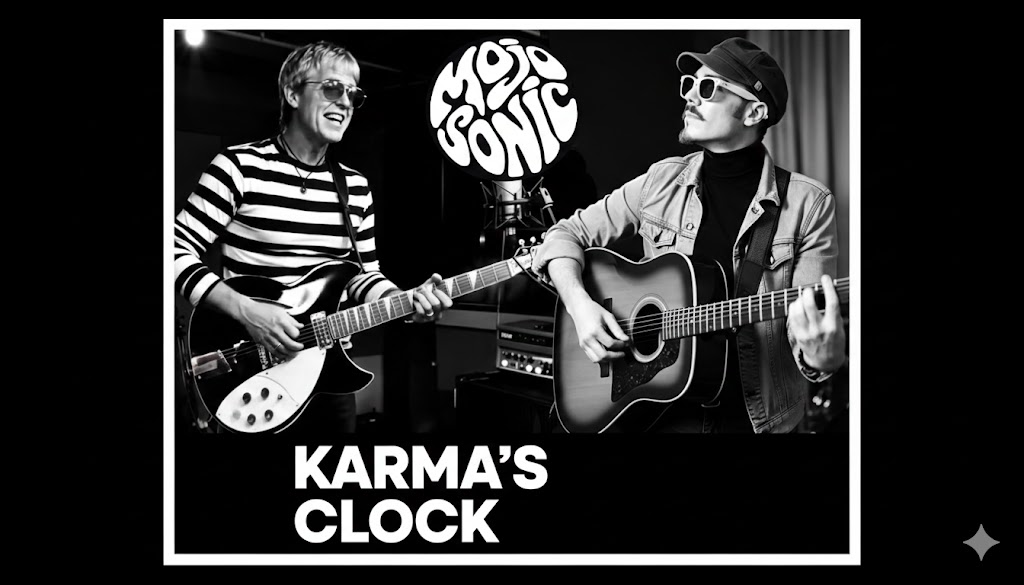
“Karma’s Clock” by MojoSonic is a conceptual universe, a philosophical statement, and a cultural mirror held up to the 21st century. Emerging from the South Coast as self-described “21st-century Modernists,” Nick and Karl have invented a language. That language is Psych Noir — a genre they pioneer, blending cinematic darkness, beat-era psychedelia, film noir atmosphere, and existential modern anxiety into a singular sonic identity. From the opening “MORNING SONG (Overture)” to the closing “TIME,” the album unfolds as a 14-track odyssey that feels less like a playlist and more like a journey through consciousness itself. MojoSonic don’t aim for entertainment, but aim for transformation. This is music that wants to be experienced as a whole, not consumed in fragments. Like Dark Side of the Moon, Tommy, or Revolver, Karma’s Clock positions itself as a cultural artefact rather than a collection of songs.
The architecture of the album is deliberate and symbolic. Divided into two conceptual halves — The Awakening (Tracks 1–7) and The Reflection (Tracks 8–14) — the record mirrors a psychological and existential journey. The opening stretch pulses with urgency, swagger, and friction: a confrontation with the “Modern World,” digital life, and contemporary identity. Tracks like “BEFORE THE SUN GOES DOWN,” “DOOM SCROLLER,” and “HEY NOW! (MODERN WORLD)” vibrate with restless energy, capturing the frantic pace of existence in the Great Simulation. This is MojoSonic’s “Mojo” side — visceral, garage-infused, urgent, and raw. There’s movement here, momentum, propulsion — the sound of a mind overstimulated, a society overstretched, a culture addicted to speed and signal.
“DOOM SCROLLER” stands as one of the album’s most cutting cultural critiques — a staccato, rhythmic indictment of digital addiction, algorithmic anxiety, and modern dissociation. It feels like a sonic embodiment of infinite scroll culture — fast, overwhelming, and numbing. In contrast, “NOTHING TO LOSE” and “NOW!” explore urgency as psychology rather than politics — the internal pressure to act, move, decide, and exist in a hyper-accelerated world. “CRAZY DAYS” acts as a bridge — chaotic, emotional, and volatile — where personal and cultural anxiety collide. The Awakening half feels like being inside the machine — aware of its noise, speed, and power, but still trapped within it.
Then the album shifts. The Reflection half opens with “KARMA’S EYES,” and the tone deepens, slows, and darkens. This is the “Sonic” side of Psych Noir — introspective, atmospheric, expansive. The sound becomes more immersive, more cinematic, more internal. Tracks like “LONG LONG WAY,” “THINK!,” and “THIS LOVE” feel like meditations rather than statements — reflections rather than reactions. The album moves from social critique to existential inquiry. Where The Awakening confronts the world, The Reflection confronts the self. This dual structure gives the album its philosophical depth, and it’s not just about society collapsing, but about consciousness evolving within collapse.
At the core of Karma’s Clock is the dual-engine leadership of Nick and Karl, whose creative roles form a perfect symmetry. Karl, as sole lyricist and lead guitarist, crafts the album’s narrative spine — his writing is dense with symbolism, existential tension, and cultural observation. His guitar work, rooted in vintage Gibson and Rickenbacker tones, provides the album’s signature chime and grit — a sonic bridge between heritage rock and futuristic sound design. Nick, as main producer and co-vocalist, sculpts the Psych Noir universe itself — building soundscapes that feel nostalgically warm and terrifyingly futuristic. His production is immersive, cinematic, and layered — not cluttered, but deep. Together, they function less like bandmates and more like architects.
Vocally, the album is defined by the interplay between Nick and Karl. Their shared lead duties and haunting harmonies create a ghostlike presence throughout the record — voices that feel human but distant, intimate yet spectral. This dual vocal identity reinforces the album’s psychological themes — the sense of internal dialogue, divided consciousness, and fragmented identity. The harmonies haunt the songs and feel like echoes in the mind rather than performances on a stage.
“SUPERHEROES” and “TOMORROW” inject something radical into the album’s darkness: hope. Not naive optimism — but defiant belief. These tracks feel like resistance songs for a disillusioned generation, anthems not of escape, but of endurance. “TOMORROW” in particular feels like a spiritual counterweight to “DOOM SCROLLER” — a reminder that the future still exists, even when it feels buried beneath noise and fear. The emotional arc of the album becomes clear: from chaos to clarity, from simulation to self-awareness, from panic to purpose.
The closing track, “TIME,” functions as a conclusion and thesis statement, which doesn’t resolve the album, but transcends it. The ticking clock metaphor becomes existential, generational, and spiritual. MojoSonic’s declaration — “We aren’t just making songs; we are capturing the sound of the clock ticking for a generation” — feels fully realised here. This isn’t metaphorical branding — it’s conceptual truth. The album doesn’t just talk about time, but feels like time. Movement, decay, urgency, memory, future, mortality — all embedded in sound.
Production-wise, Karma’s Clock is a masterwork. Recorded at WHMS and MojoSonic Studios in West Sussex and mixed/mastered at Wizard Audio in East Sussex, the sonic quality is expansive and cinematic. The album artwork by Kludoman further reinforces the high-concept identity, making the project feel like a unified artistic statement rather than a release cycle. This is a record built for immersion.
Influence-wise, the album feels like a convergence point: The Beatles’ Revolver experimentation, Floydian atmosphere, Bowie’s conceptual ambition, Byrds-style jangle, Petty’s melodic clarity, Oasis urgency, and Tame Impala’s production scale — all filtered through MojoSonic’s original Psych Noir vision. But the result is not imitation, but synthesis. The heritage informs the sound; the future defines it.
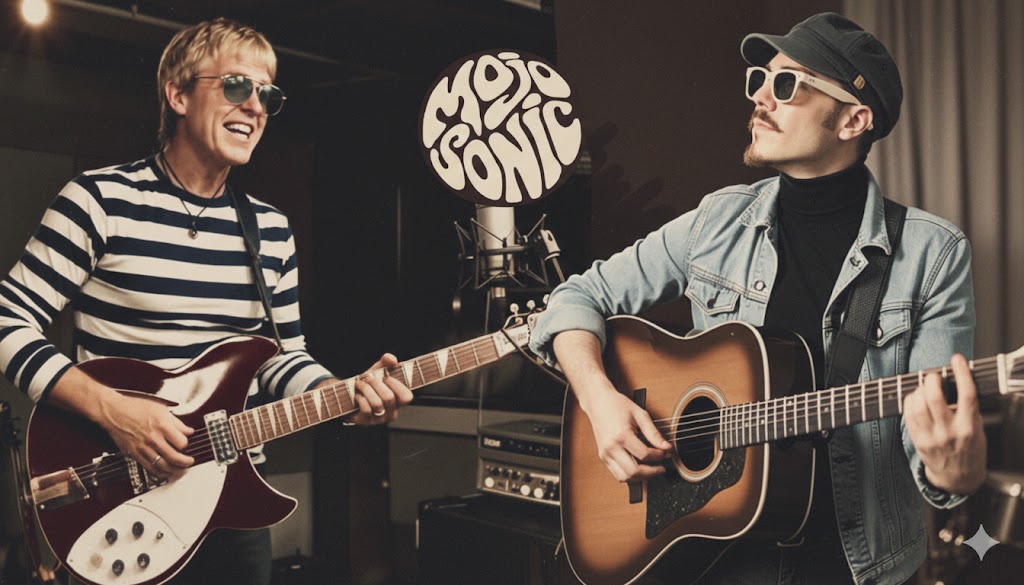
Ultimately, “Karma’s Clock” is a 21st-century modernist manifesto. It is an album that refuses to be background noise. It demands attention, reflection, and presence. By using vintage instrumentation to confront futuristic themes, MojoSonic create a paradoxical sound — retro-futurist, nostalgic and prophetic at once. This is not escapist music, but confrontational art which forces the listener to engage with time, technology, identity, anxiety, hope, and existence itself.
In an era of disposable content and algorithmic culture, Karma’s Clock stands as a rare thing: a cohesive, conceptual, philosophical album that believes in the power of the long-form experience. MojoSonic have made a statement, a world, and a genre. Psych Noir is a worldview, and Karma’s Clock is its defining document: a ticking, glowing, haunted mirror of modern life, reminding us that time is moving, consciousness is shifting, and the future is not waiting.
For more information, follow Mojosonic:
WEBSITE – SOUNDCLOUD – INSTAGRAM – YOUTUBE – FACEBOOK