
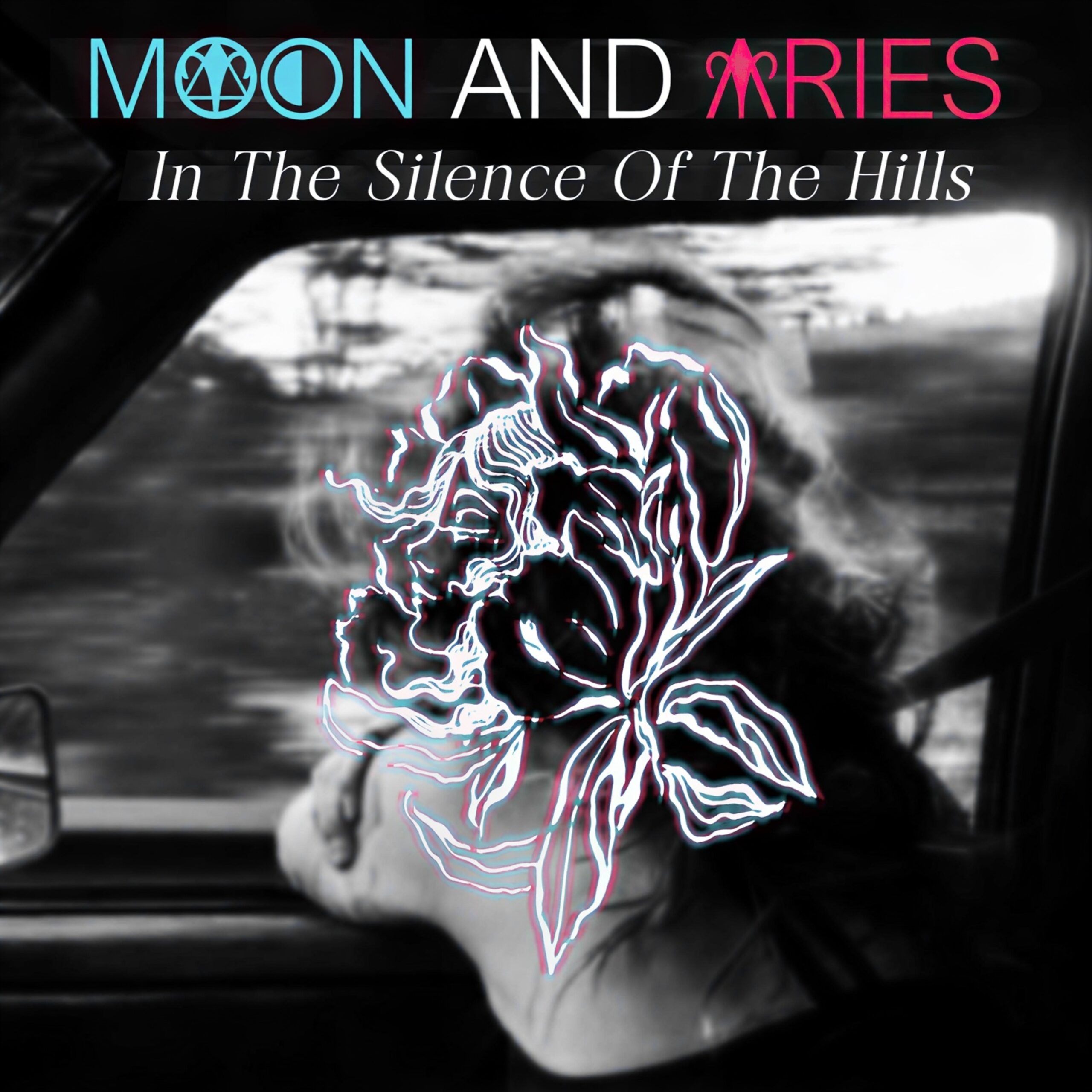
In a musical culture that often equates movement with momentum, Moon and Aries make a compelling case for standing still. “In the Silence of the Hills” is an intimate, drumless composition that finds its power not in what it adds, but in what it deliberately leaves open. There is no pounding beat demanding attention, no rhythmic machinery pushing the listener toward an obvious destination. Instead, the track creates an expansive space where piano, analog synth textures, cello, guitar, saxophone, and voice can exist with the kind of breathing room that modern production sometimes forgets to provide. It is music about stepping away from the noise of a busy life and rediscovering the things that become difficult to hear when everything around us is moving too quickly: nature, memory, connection, and our own thoughts. Moon and Aries, the transatlantic duo of Jordana Moon from Kelowna, Canada, and Tom Aries from Cologne, Germany, have developed a sound that sits between trip-hop, indie, and atmospheric electronic music, but “In the Silence of the Hills” feels less concerned with genre than with emotional geography. It is a song that seems to create its own landscape as it unfolds, one with wide horizons and very few unnecessary structures. The title is therefore more than descriptive. Silence becomes an active presence here, not an absence of sound but a condition in which meaningful sounds suddenly become easier to notice. The track invites the listener into that condition with remarkable patience, asking us to slow down enough to hear what the music has been quietly saying all along.
The song’s origins make that sense of distance and connection even more meaningful. It began with a piano composition by Tom Aries in Germany, where the initial melody gradually evolved through analog synth textures before making its way across the Atlantic to Jordana Moon in Canada. Moon then gave the composition its human voice through her warm, vulnerable vocal performance and lyrics, transforming what began as an instrumental idea into something more emotionally exposed. From there, the piece continued its journey across borders, gathering individual contributions from musicians who never needed to occupy the same room to become part of the same musical conversation. Classically trained cellist Zara Hudson-Kozdoj contributed from London, Peter J. Mitchell added atmospheric guitar from Canada, and Hanna Marchand of Joko Magic brought expressive saxophone from Switzerland. Each musician listened to the developing composition, responded to it by ear, and sent their performance back to Aries, who ultimately brought these distant voices together. That process is almost a perfect reflection of what the song itself communicates. “In the Silence of the Hills” is about rediscovering connection, and the recording is literally built through acts of listening and response across great distances. Nobody seems to be competing for space. Instead, each performer contributes something that expands the emotional landscape while respecting the openness already established by the composition. The result is a rare sense of musical conversation without physical proximity. In a track concerned with escaping the crowdedness of modern life, that approach feels especially appropriate: connection does not have to mean noise, and collaboration does not have to mean clutter.
The absence of drums is perhaps the boldest and most revealing production choice. Rhythm is so fundamental to contemporary electronic music that removing percussion can easily leave a track feeling incomplete, but Moon and Aries understand that silence can create its own pulse. The piano establishes a contemplative foundation, while the analog synths add an atmospheric glow that keeps the composition connected to the duo’s electronic identity. The cello introduces a deeper, organic resonance, its classical character giving the track a sense of physical warmth. Atmospheric guitar stretches the sonic horizon further, while the saxophone brings another human breath into the arrangement, capable of sounding almost like a voice responding from somewhere beyond the immediate scene. Over all of this, Jordana Moon’s vocal performance becomes less a conventional lead and more an emotional guide. Her warmth and vulnerability suit the song’s theme because the performance never feels like it is trying to overpower the environment. Instead, the voice seems to belong inside it. That is an important distinction. A less restrained arrangement might have turned the song’s message into an obvious meditation on nature or escape, but “In the Silence of the Hills” trusts texture and space to communicate what words cannot. The instruments feel like parts of a landscape rather than components in a conventional pop arrangement. One can almost imagine the sound moving through a wide valley, disappearing into the distance, and returning in another form. There is serenity here, but it is not empty serenity. It contains a quiet emotional tension—the feeling of someone who has been overwhelmed by the noise of life and is finally discovering what it means to listen again.
That sense of listening is what ultimately makes “In the Silence of the Hills” more than a beautiful atmospheric piece. Beneath its cinematic surface is a deeply human idea about presence. Busy life has a way of making every moment feel occupied, yet constant activity does not necessarily produce meaningful connection. Sometimes the opposite is true. We need stillness to notice another person. We need quiet to recognize our surroundings. We need enough space between thoughts to understand what we are actually feeling. Moon and Aries approach that idea without turning the song into a lecture. The music itself becomes the argument. It slows the listener down. It allows sounds to emerge without immediately demanding another sound in response. It creates the impression that nothing needs to be rushed. Even the geographical journey behind the recording reinforces this philosophy. Germany, Canada, London, and Switzerland become invisible points on a musical map, connected not by physical proximity but by attention. Every contributor listened first and responded second. That is perhaps the simplest description of what genuine musical collaboration should be, and it provides the track an emotional authenticity that matches its organic instrumentation. There is also something quietly cinematic about the piece, fitting naturally into Moon and Aries’ broader identity as creators of emotionally immersive soundscapes adaptable to visual storytelling. Yet the track never feels like it is waiting for a film to provide it meaning. It already contains its imagery. The listener can supply the hills, the trees, the open sky, the distant road, or the solitary figure walking away from the noise. The music leaves enough space for imagination to complete the picture.

As the fourth song from the forthcoming five-song Prairie Souls EP, “In the Silence of the Hills” feels like an especially revealing chapter in Moon and Aries’ evolving artistic direction. Their cinematic electronic world is moving closer to the earth here, trading some of the more obvious machinery of electronic music for organic instruments, open spaces, and the imperfect warmth of human performance. That movement does not represent a rejection of their electronic identity; rather, it shows how naturally atmosphere and human musicianship can coexist within it. The track’s final strength lies in its refusal to force a climax. It does not need one. There is no drum-driven explosion waiting around the corner because the destination is not released through impact. The destination is presence. Piano, synth, cello, guitar, saxophone, and voice become enough. Mixed and mastered by Chris Kung and Francois Rocheleau, the recording preserves that sense of spaciousness while allowing the many contributions to exist as part of one coherent emotional world. “In the Silence of the Hills” ultimately feels like an invitation rather than a command: step away, breathe, listen, and remember what remains when the noise falls away. In an age of constant stimulation, that invitation feels surprisingly radical. Moon and Aries prove that stillness can be cinematic, that silence can be full, and that a song does not need to fill every available space to leave a lasting impression. Sometimes the most powerful music is the music that gives us enough room to finally hear ourselves.
For more information, follow MOON AND ARIES
WEBSITE – FACEBOOK – YOUTUBE – SPOTIFY – INSTAGRAM