
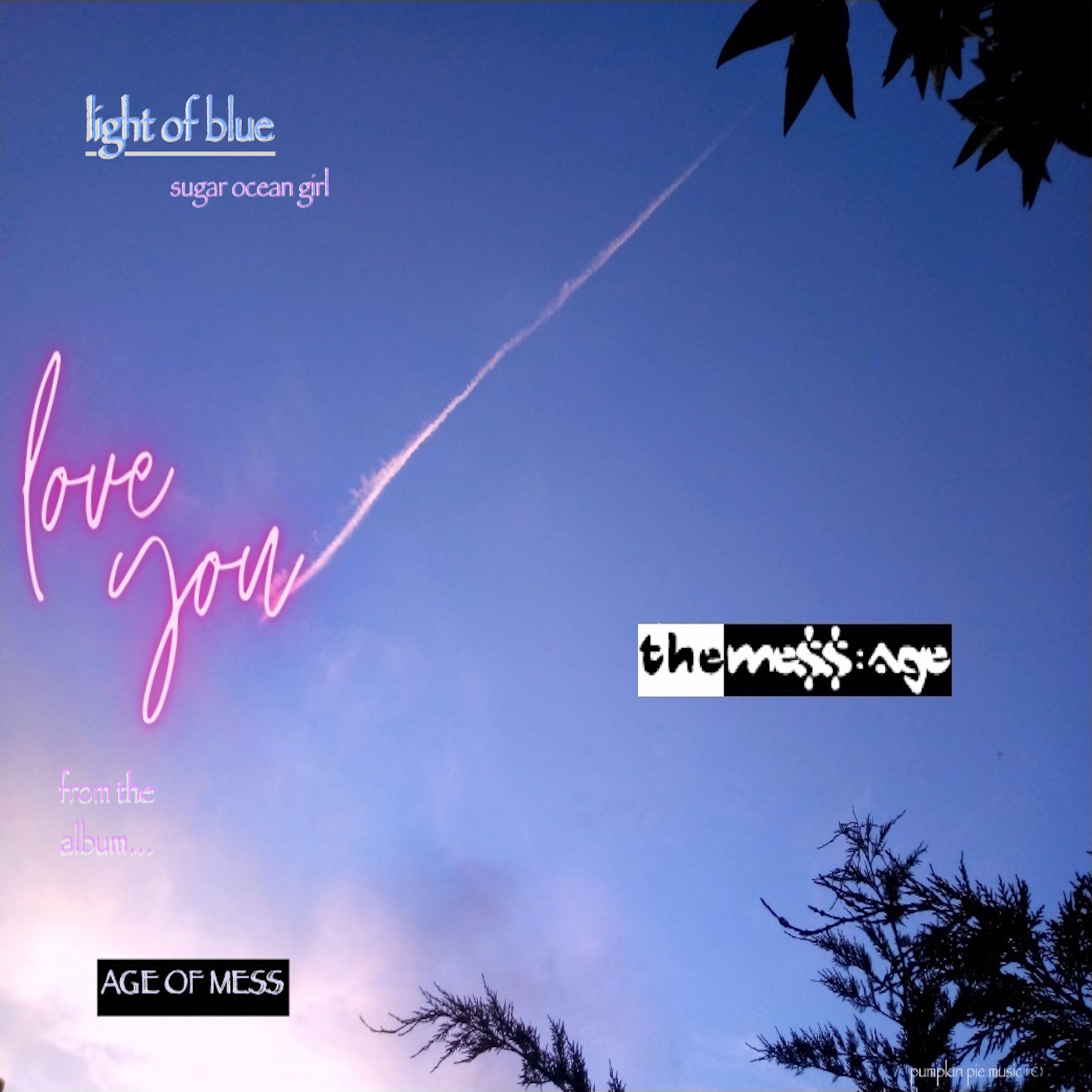
LIGHT OF BLUE “Sugar Ocean Girl” arrives like a sudden change in weather, opening with rolling waves before a glistening melody begins to shimmer across the soundscape. It is an immediately visual piece of music, the kind of introduction that can make a listener feel as though a window has been opened onto a bright coastline. Yet beneath its breezy surface, there is considerably more happening than a straightforward summer pop-rock song. The ocean ambience establishes an atmosphere of freedom and escape, while the panning details and luminous textures create a sense of movement that seems to stretch outward in every direction. Then the guitars arrive with considerably more force, injecting the arrangement with high-octane energy and giving the track an expansive rock pulse. That contrast between tranquility and propulsion becomes one of the release’s defining characteristics. The Mess:Age does not simply use the beach as scenery; the ocean becomes part of the song’s emotional vocabulary. The waves suggest new beginnings, the light suggests clarity, and the guitar energy represents the excitement that comes with finding a new sense of possibility. Over this vivid backdrop, Ziggy’s vocals bring another dimension, delivering poetic lines and situational descriptions with a conviction that prevents the music from becoming merely decorative. His vocal presence provides the track its human center. The result is a release that can comfortably function as a feel-good summer listen while carrying an underlying message about awakening, connection, resilience, and the importance of maintaining hope when the world feels increasingly complicated.
What makes LIGHT OF BLUE “Sugar Ocean Girl” especially engaging is the way it disguises its heavier ideas beneath an arrangement that feels effortlessly sunny. The melodies are uplifting, the rhythms have a buoyant quality, and the ocean sounds naturally encourage the imagination toward warm days, open spaces, road trips, beaches, and evenings when the horizon seems endless. But the song is not content to remain at the level of escapism. Its central imagery is built around light and water as symbols of renewal, giving the track an allegorical quality that becomes more apparent with repeated listening. The concept of the “Light of Blue” functions as more than an attractive phrase within the world of Ziggy and The Mess:Age has created it; it represents an internal frequency associated with positivity, spiritual awakening, resilience, and human connection. That provides the track an unusual duality. On one level, it is accessible pop-rock designed to make you feel positive. On the other hand, it asks what happens when people deliberately choose optimism rather than surrender to negativity. The environmental dimension also adds another layer to the song’s intent, particularly through its references to the ocean and the broader concerns surrounding the planet. Whether a listener agrees with every idea expressed through the song’s message or simply embraces its more universal call for positivity, there is no denying that The Mess:Age has built the music around a clear conceptual identity. The lyrics do not exist simply to fill space between choruses; they are part of the architecture. The hooks have a mantra-like quality, repeating the central emotional idea until it begins to feel less like a statement and more like an invitation to participate.
Musically, there is a strong sense of familiarity here without the track becoming trapped in nostalgia. The influence of melodic, sophisticated rock-pop associated with acts such as Mike + The Mechanics, Tears for Fears, Simple Minds, Don Henley, and Sting can be felt in the combination of polished songwriting, prominent melody, atmospheric production, and anthemic guitar work. Those reference points are useful because they help explain why LIGHT OF BLUE “Sugar Ocean Girl” can sound both expansive and immediately approachable. There is a certain adult-pop craftsmanship in the arrangement, but The Mess:Age gives it enough contemporary spaciousness to keep the song from feeling like an exercise in retro imitation. The guitars provide the muscle, the piano contributes much of the emotional glow, and the synthesizers help widen the horizon around the vocal. Then there is the ocean ambience, which acts almost like another instrument. It provides the production a physical environment and helps establish the cinematic character that distinguishes the release. Even when the arrangement becomes energetic, that coastal atmosphere remains present in the listener’s mind. This is where the song demonstrates some of its most effective production choices: it understands that cinematic does not necessarily mean orchestral or oversized. Sometimes cinematic music simply creates the sensation that there is a larger world beyond the edges of the speakers. LIGHT OF BLUE “Sugar Ocean Girl” achieves precisely that. Its opening can suggest a quiet shoreline, while the guitar-driven passages feel like the camera suddenly pulling back to reveal an enormous landscape. The piano and atmospheric layers keep the emotional temperature warm, while Ziggy’s vocalizations prevent the track from losing its distinctly human character. It is polished enough for mainstream ears but eccentric enough in its conceptual details to retain an individual personality.
There is also an appealing sense of optimism running through the release that makes its darker concerns easier to absorb. Rather than approaching environmental responsibility, spiritual renewal, and human connection with a gloomy musical vocabulary, The Mess:Age surrounds those ideas with brightness. That choice is significant because the song seems determined to argue that positivity itself can be an act of resistance. The listener is not being asked to spend the entire track dwelling on everything that is wrong; instead, the music keeps returning to the possibility of awakening, connection, and better energy. The effect is almost like receiving a serious message through a postcard from the coast. You notice the beautiful scenery first, then discover the thought written on the back. That balance gives the song considerable replay value. It can work as background music during a summer afternoon, but it also rewards listeners who pay closer attention to the allegorical language and recurring motifs. Its potential visual life is equally obvious. The rolling waves, shimmering guitars, piano glow, and persistent rhythmic lift could easily accompany a travel sequence, a coming-of-age moment, an environmental documentary, or a scene in which a character finally begins to see the world differently. The song’s cinematic qualities therefore feel organic rather than artificially imposed. It already thinks in images, too. Even the unusual story surrounding the artwork—described as a chemtrail visible from Ziggy’s garden—adds to the release’s fascination with looking upward, outward, and beyond the immediately obvious. That kind of imagery is consistent with The Mess:Age’s broader tendency to combine music with ideas, symbolism, and provocation, while this particular release presents those characteristics in a more accessible pop-rock setting.
Ultimately, LIGHT OF BLUE “Sugar Ocean Girl” succeeds because The Mess:Age understands that a song can be uncomplicated and layered. The first impression is wonderfully straightforward: waves, light, melody, guitars, an inviting vocal, and the unmistakable sensation of summer. Stay with it, however, and the deeper themes begin to emerge. The ocean becomes a metaphor for movement and renewal; light becomes a symbol of hope and inner clarity; the energetic guitars embody a kind of emotional liberation; and the lyrics encourage listeners to consider positivity, connection, and responsibility beyond the boundaries of the individual. That combination makes the release more substantial than its sunny exterior might initially suggest. Ziggy’s performance provides the writing a strong focal point, while The Mess:Age production brings together piano, synth, guitar, percussion, vocal textures, and natural ambience without allowing any single element to overwhelm the others. There is enough melody to make the song memorable, enough rhythmic energy to make it feel alive, and enough conceptual depth to keep it from disappearing after one play. For listeners who enjoy polished pop-rock with cinematic atmosphere, coastal imagery, and an unusual philosophical streak, the track is a compelling meeting point between accessibility and imagination. LIGHT OF BLUE “Sugar Ocean Girl” feels like music made for standing somewhere near the water and watching the horizon widen, but its real destination is internal: that place where optimism, curiosity, and human connection can still push back against the noise. The Mess:Age turns a summer-infused song into something more enduring—a bright, guitar-powered reminder that sometimes the simplest way forward is to keep looking toward the light.
For more information, follow THE MESS:AGE
WEBSITE – TWITTER – SPOTIFY – YOUTUBE